
How GPS Tracking Reduces Insurance Claims
March 22, 2026 · 9 min read
How GPS Tracking Reduces Insurance Claims
GPS tracking is transforming trailer rental businesses by cutting down theft, accidents, and disputes while lowering insurance costs. Here's how it works:
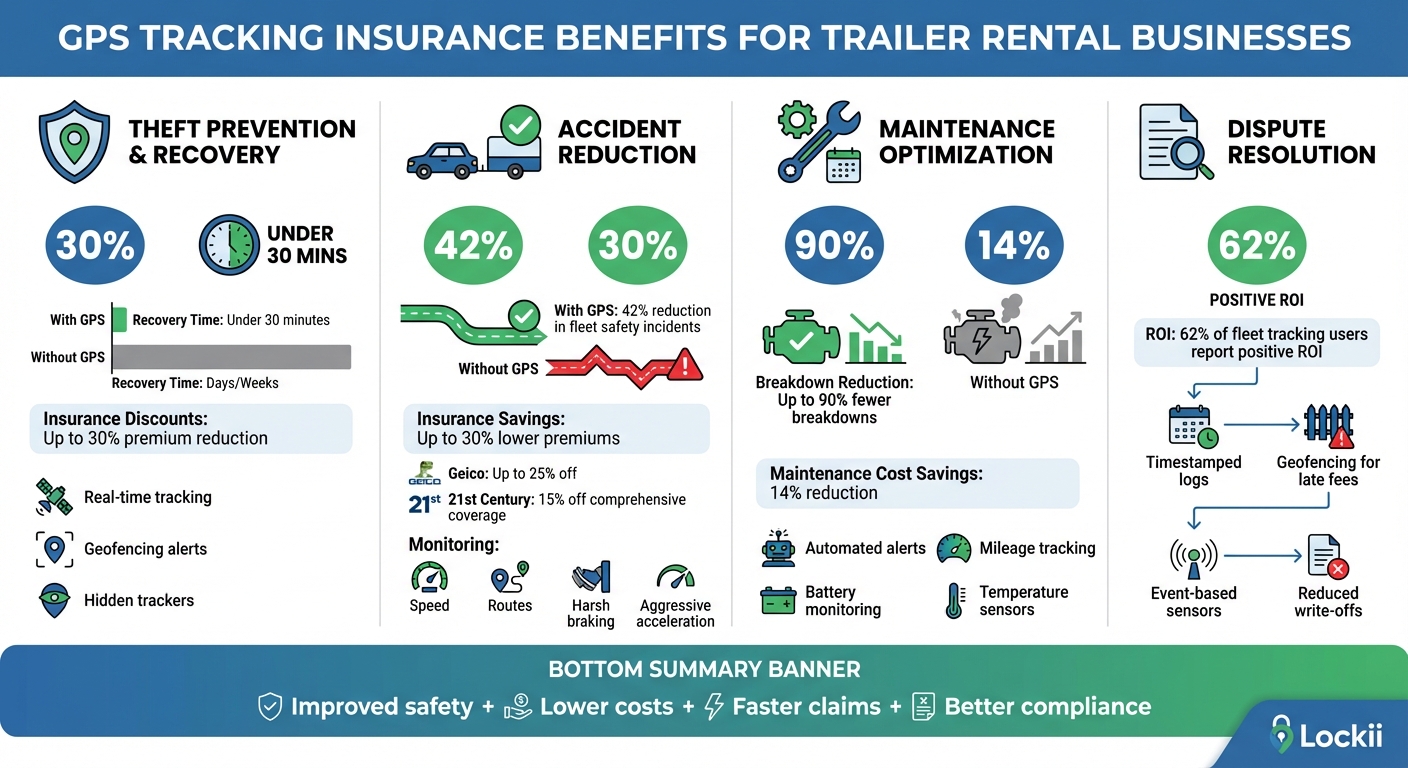
- Theft Prevention & Recovery: Real-time location tracking and geofencing and securing contactless rentals help recover stolen trailers quickly, often in under 30 minutes. Hidden trackers and alerts deter theft and reduce financial losses.
- Accident Reduction: Driver behavior monitoring (speed, routes) improves safety, cutting incidents by 42%. Insurers reward safer practices with up to 30% lower premiums.
- Maintenance Optimization: Automated alerts ensure timely servicing, reducing breakdowns and repair claims.
- Dispute Resolution: GPS logs provide clear evidence for resolving late fees, damage claims, and false reports, minimizing write-offs and administrative costs.
Lockii’s platform combines GPS tracking with digital locks, identity verification, and maintenance tools, simplifying operations and improving efficiency for trailer rentals.
Preventing Theft and Recovering Stolen Trailers
Real-Time Monitoring and Geofencing Alerts
Geofencing creates virtual boundaries around your storage yards, depots, or job sites. If a trailer crosses these boundaries without permission, you'll get an instant alert on your mobile device [4][5].
Modern GPS trackers go beyond basic tracking. Equipped with motion and tamper sensors, they notify you of unusual vibrations or interference - especially useful during off-hours - helping to prevent trailers from being moved far [5].
For maximum security, discreet placement of the GPS tracker is crucial. These devices are compact and can be hidden in hard-to-find spots on the trailer, making it difficult for thieves to locate and disable them. For trailers carrying high-value goods, some businesses even add a secondary backup tracker. This ensures tracking continues even if the main device is discovered and tampered with [4][5].
These alerts not only act as a deterrent but also make it easier to recover stolen assets quickly.
Faster Recovery of Stolen Assets
If a theft does occur, GPS tracking allows law enforcement to pinpoint the trailer's exact location, enabling swift recovery. With GPS, stolen trailers are often recovered in under 30 minutes - much faster than the days or even weeks it can take when relying solely on traditional locks [5].
"The ability to quickly recover lost or stolen trailers can save you thousands of dollars and provide peace of mind." - Towlos [2]
Quick recovery reduces the chances of severe damage or complete loss. It also helps streamline insurance claims. GPS data serves as solid evidence, strengthening your case and speeding up the claims process [5][6]. On top of that, many insurers offer discounts - up to 30% - to businesses that use GPS tracking systems, thanks to the reduced risk [6].
sbb-itb-eb44693
Reducing Accident Claims Through Driver Behavior Monitoring
Monitoring Speed, Routes, and Driving Patterns
GPS telematics devices are game-changers when it comes to tracking high-risk driving behaviors like speeding, hard braking, and aggressive acceleration [7]. By analyzing this real-time data, trailer rental businesses can spot dangerous habits before they escalate into accidents.
Plus, drivers tend to be more cautious when they know they're being monitored. As Nori Gale from WEX Inc. puts it, "Drivers who know they're being monitored by GPS tracking devices are safer drivers" [7]. These systems also send alerts for risky actions - like harsh cornering, which can lead to cargo damage or even rollovers [1]. Beyond safety, GPS tracking can detect unauthorized route changes or excessive mileage, discouraging renters from using trailers for personal errands and cutting down on unnecessary road time [7]. This kind of driver-focused monitoring has contributed to a 42% drop in safety incidents across fleets [1]. The real-time data not only reduces accident risks but also strengthens your case for better insurance rates.
Using Data to Negotiate Lower Insurance Premiums
With safer driver behavior in place, you can leverage GPS-generated reports on mileage, routes, and driving patterns to negotiate with insurance providers. These reports offer concrete proof of improved safety practices [6].
"When you use GPS tracking to get more fleet insurance savings, your insurance company has verifiable proof that your drivers are as safe as you say they are." – Linxup [6]
Insurers recognize the reduced risk and reward it with meaningful discounts. For instance, Geico offers up to 25% off for businesses using tracking and anti-theft systems, while 21st Century Insurance provides a 15% discount on comprehensive coverage [7]. In total, companies using GPS tracking can secure premium reductions of up to 30% [6]. And if your business operates in states like New York, Florida, or Texas, these discounts might even be required by law - so don’t miss out [7].
Improving Maintenance Tracking to Prevent Breakdown Claims
Automated Maintenance Alerts and Logs
Maintenance tracking is a game-changer when it comes to reducing risks and claims. GPS tracking takes the guesswork out of trailer upkeep by logging precise mileage and operational hours. This allows fleets to trigger maintenance alerts when a trailer hits its service threshold, ensuring tasks like tire inspections or brake checks happen based on actual wear instead of fixed calendar intervals.
Some advanced GPS systems go even further, monitoring breakaway battery voltage in real time to confirm emergency brake functionality. For specialized units, features like temperature monitoring and door event tracking can catch issues early, preventing costly cargo spoilage claims.
By using motion-based tracking, fleets get frequent updates while a trailer is in use and conserve battery life when idle. This approach aligns maintenance schedules with real-world operating conditions, creating a more accurate and efficient system.
Meeting Compliance and Safety Standards
Automated GPS-generated maintenance logs are essential for meeting safety regulations and insurance requirements. These electronic records include detailed data on service intervals, speed alerts, and usage patterns, making it easier to demonstrate proactive care during safety audits or insurance reviews.
These records are also invaluable in claims disputes. For instance, if a renter damages a trailer, GPS logs can provide evidence of reckless handling or excessive speeds, supporting damage recovery efforts. This level of documentation not only satisfies compliance requirements but also speeds up claims resolutions, helping to protect insurance rates and reduce overall risks.
5 Ways Smart Field Service Fleets Cut Costs & Improve Job Performance
Resolving Disputes and Reducing Administrative Claims
Accurate tracking data isn’t just about keeping equipment in good shape or preventing accidents - it’s also a powerful tool for resolving disputes and cutting down on administrative claims.
Accurate Usage Logs and Location History
GPS tracking provides a reliable, timestamped record that eliminates the guesswork in disputes between rental operators and customers. When paired with rental management software, location data ties directly to individual rental agreements, offering clear evidence of a trailer’s movements.
Take geofencing, for example - it logs exact return times, which can quickly settle late fee disputes. If a customer insists they returned a trailer at 5:00 PM but GPS data shows it arrived at 7:30 PM, the system’s record clears up the disagreement instantly. Similarly, GPS data can confirm if a trailer was taken outside its permitted area or into restricted zones, helping to enforce contract terms with solid evidence.
Historical data also comes in handy when reconstructing events like breakdowns or theft. Combined with event-based sensors that monitor door activity or harsh driving, these records help clarify claims involving cargo damage or misuse. This level of detail not only resolves disputes efficiently but also minimizes unnecessary write-offs.
Reducing Write-Offs with Detailed Tracking Records
Digital tracking records go beyond dispute resolution - they also improve financial accountability. By creating an electronic audit trail, GPS systems reduce errors and automate workflows, ensuring every asset is accounted for. Automated systems track each trailer’s make, model, condition, and location, making physical audits simpler and ensuring nothing is overlooked on the balance sheet.
When administrative claims arise, GPS data helps determine fault quickly. For instance, location records can verify exactly where a trailer was during an incident, exposing false claims and speeding up insurance processes. In fact, industry reports show that 62% of fleet tracking users experienced a positive return on investment, largely thanks to lower administrative costs and fewer disputes [1].
How Lockii's GPS Tracking Reduces Insurance Claims
Lockii takes the proven benefits of GPS tracking and combines them with a powerful all-in-one platform tailored specifically for trailer rentals. By integrating GPS tracking, digital locks, and automated workflows, Lockii tackles the key issues behind insurance claims - like theft, accidents, breakdowns, and disputes - while enabling 24/7 operations without requiring on-site staff.
This system doesn’t just track trailers; it actively reduces risks in real-time, making it an essential tool for trailer rental businesses focused on safety and efficiency.
Features Built for Trailer Rentals
Lockii's platform is designed with trailer rental operations in mind, incorporating features that minimize risks at every step. For example:
- Digital identity verification: Before issuing access codes, Lockii verifies renters’ identities, ensuring they meet age and license requirements (typically 25+). This helps prevent unqualified users from renting trailers.
- Real-time GPS alerts: The system notifies managers of overdue bookings or unauthorized key changes, keeping operations under control.
- Maintenance tracking: Lockii automatically blocks bookings for trailers that need servicing and keeps a detailed history of each asset’s maintenance schedule. Proactive measures like these can reduce breakdowns by up to 90% and lower maintenance costs by 14% [9].
- Mandatory return photos: Renters are required to upload photos upon return, allowing managers to identify wear or damage early, which helps avoid costly repairs or disputes.
Additionally, every rental generates a detailed audit log that includes GPS data, confirmations, photos, and maintenance records. This documentation simplifies claim resolution and strengthens negotiations with insurers. Matt Cole, Founder of Empire Trailer Hire, highlighted how Lockii transformed his operations:
"Since switching to Lockii, things have gotten so much easier. I was juggling three different systems before, and now it's all in one place" [8].
These features not only streamline operations but also make contactless rentals more efficient and secure.
Integration for Contactless, Scalable Operations
Lockii seamlessly integrates with IglooHome digital locks, Stripe for payments and identity verification, and Zapier for workflow automation. This interconnected system reduces human error during handovers, a common source of disputes, while ensuring safety protocols are consistently followed. Automated pre-pickup messages guide renters on essential towing practices, like proper hitch connection and weight distribution, reducing the likelihood of accidents.
Geofencing adds another layer of control, logging exact pickup and return times to instantly resolve late fee disputes. It also tracks whether trailers enter restricted zones or exceed permitted areas, ensuring contract terms are upheld. Ben Keep, Owner of Hatoza Hire, shared his experience with Lockii:
"Lockii has significantly reduced complexity and allows me to focus more on running my business" [8].
On top of operational improvements, Lockii’s GPS tracking can lead to financial perks. Many insurers offer discounts of 25% to 35% on premiums for businesses using fleet tracking systems [9]. By addressing risks head-on, Lockii not only simplifies trailer rentals but also delivers measurable savings for businesses.
Conclusion
GPS tracking tackles key risks, ensuring trailer rental businesses stay profitable and efficient. It helps prevent theft, keeps an eye on driver behavior, automates maintenance, and provides solid documentation for resolving disputes. These benefits don’t just improve safety - they also streamline operations and boost financial performance. In fact, fleets using tracking systems have seen a 42% drop in safety incidents and impressive returns on investment [1].
On top of that, proactive GPS risk management can improve your standing with insurers, even if direct discounts aren’t available [3]. Lockii takes this a step further by combining GPS tracking with a contactless rental platform. This system integrates tools like identity verification, digital locks, automated safety instructions, and maintenance logs into a single solution. It’s designed to address the unique needs of self-service trailer rentals, cutting down on claims while enabling 24/7 operations without on-site staff. This makes it easier for businesses to expand across multiple locations efficiently.
In a time when cargo theft is on the rise [1], these measures make GPS tracking an essential tool for protecting assets, ensuring profitability, and supporting long-term growth.