
GPS Tracking vs. Manual Monitoring for Trailers
Compare trailer GPS tracking and manual monitoring: costs, real-time visibility, theft prevention, labor needs, and ROI to find the best approach.
Which is better for managing trailers: GPS tracking or manual monitoring? Here's the short answer: GPS tracking is more efficient, accurate, and secure, especially for theft prevention and real-time updates. Manual monitoring, while cheaper upfront, becomes time-consuming and less reliable as fleet size grows.
Key Takeaways:
- GPS Tracking: Provides real-time location, automated alerts (like geofence breaches), and theft recovery tools. Costs include $30–$50 per device upfront and $10–$30/month per trailer.
- Manual Monitoring: Relies on staff for physical checks and spreadsheets. It's labor-intensive, prone to errors, and slower to detect issues like theft.
Quick Comparison:
| Feature | GPS Tracking | Manual Monitoring |
|---|---|---|
| Cost | $30–$50/device + $10–$30/month | $0 upfront, labor-intensive |
| Real-Time Updates | Yes | No |
| Alert System | Automated (geofence, tampering) | None |
| Labor Needs | Low | High (manual checks/logs) |
| Theft Recovery | High (precise location data) | Low (delayed detection) |
GPS tracking is ideal for scaling businesses, while manual monitoring may work for very small fleets. Keep reading for detailed insights into how each method works and their pros and cons.
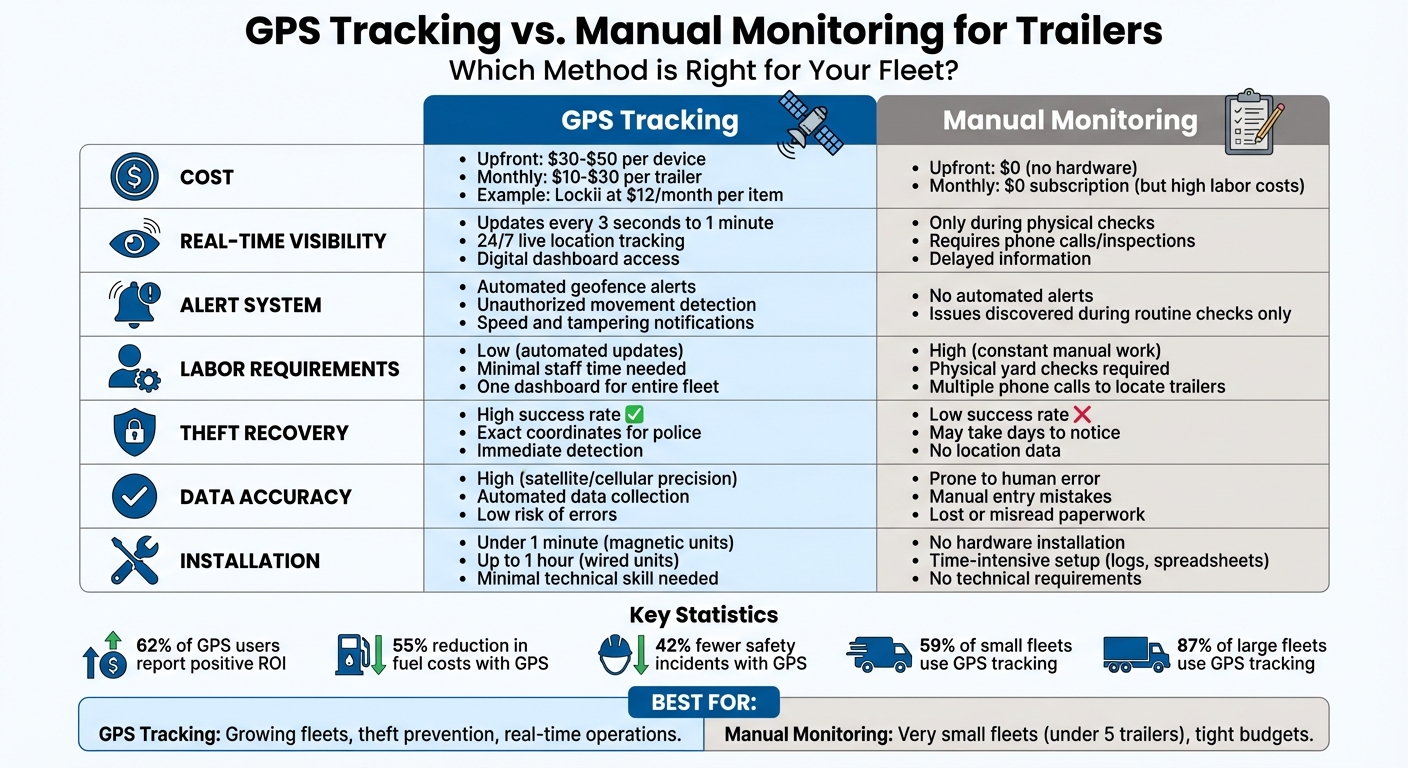
GPS Tracking vs Manual Monitoring for Trailers: Complete Comparison Chart
GPS Tracking for trailers
What is GPS Tracking for Trailers?
GPS tracking for trailers combines rugged hardware and user-friendly software to provide real-time updates on the location, movement, and security of your assets. Durable, weatherproof GPS trackers are mounted on trailers, using satellite signals to pinpoint their exact position, speed, and direction. This information is then sent through cellular or satellite networks to a central dashboard, where it's displayed on a digital map for easy monitoring.
Trackers can be tailored to your needs, with updates as frequent as every 3 seconds for high-value assets or daily "heartbeat" signals for stationary equipment. Battery life varies from 1 to 7 years, depending on how often updates are sent. Many rental businesses prefer motion-based tracking, which provides frequent updates while moving and conserves battery by entering sleep mode when the trailer is stationary.
Geofencing adds an extra layer of control by creating virtual boundaries - like a rental yard or state lines. If a trailer crosses these boundaries, the system sends instant alerts, helping prevent theft and ensuring trailers stay within their designated zones.
Automated alerts can notify you about unauthorized movement, tampering, low battery levels, or even speeding. These systems can also track mileage and usage hours, seamlessly integrating with maintenance schedules. For businesses offering contactless rentals, GPS tracking can connect with rental management platforms like Lockii to automate processes. For example, it can verify when a customer picks up or returns a trailer, reducing manual work and cutting labor costs. This combination of efficiency and security makes GPS tracking a game-changer compared to manual methods.
What is Manual Monitoring for Trailers?
Manual monitoring involves having on-site staff physically track and manage trailers. This traditional approach often requires employees to walk through rental yards with clipboards, manually counting trailers and verifying that those marked as "returned" in the system are actually on-site. Staff also conduct visual inspections, checking identification, serial numbers, and data plates attached to trailer frames. While straightforward, this process becomes increasingly inefficient for larger fleets.
In manual systems, trailer details - such as numbers, locations, maintenance records, and cargo information - are logged by hand, either on paper or in spreadsheets. As Sensolus explains:
With a manual logging system, it is hard to make a waterproof system that tells you exactly how your trailer fleet is used. Errors easily slip in and you struggle to have a full overview of your trailers.
Tracking trailers out on rental adds another layer of difficulty. Fleet managers often spend significant time making multiple phone calls to drivers or site managers to pinpoint a trailer's location. Cartrack SA highlights this challenge:
When trailers were on the road, manual counting was more challenging and often required a phone call, or two, for the fleet manager to get an exact location.
Additionally, staff may waste hours searching large yards to locate a specific trailer needed for a customer pickup.
Gate processing is another bottleneck. It requires face-to-face vehicle inspections and manual logging, delaying check-ins by 5–10 minutes per vehicle - or over 30 minutes during busy periods. The reliance on paperwork introduces further risks, such as lost, misread, or incorrectly recorded information. These errors can lead to trailers being misplaced or sent to the wrong location.
As fleet sizes grow, these manual processes become harder to manage. The system is also inherently reactive. If a trailer is stolen or goes missing, it might take days to notice through manual checks, making recovery far more difficult.
Feature Comparison: GPS Tracking vs. Manual Monitoring
When comparing GPS tracking to manual monitoring, key differences emerge in areas like installation, visibility, and alert capabilities. GPS tracking systems rely on hardware mounted directly onto trailers - often magnetic units that can be installed in under a minute - paired with cellular connectivity and user-friendly software dashboards. Manual monitoring, in contrast, skips hardware installation but depends heavily on human input, including data entry, phone calls, and on-site inspections. These distinctions highlight the unique strengths and limitations of each approach.
One standout benefit of GPS tracking is real-time visibility. GPS devices can deliver location updates as often as every three seconds, providing constant oversight. Manual methods, however, only offer sporadic updates when trailers are physically checked or reported by customers. A Fleet 1st GPS tracking specialist shared:
Installation took under a minute. I mounted it, scanned the QR code, and tracking went live instantly.
Alert functionality is another critical difference. GPS systems automatically send notifications for events like geofence breaches, unauthorized movement, excessive speeds, or tampering, enabling swift action. Manual monitoring lacks these proactive alerts, meaning issues are often discovered only during routine checks. This delay can hinder theft recovery, whereas GPS tracking allows operators to provide law enforcement with exact coordinates immediately. This capability underscores the strategic advantage GPS systems offer over manual methods.
Maintenance is another area where these systems diverge. GPS trackers require occasional battery changes and firmware updates but involve minimal administrative effort. By contrast, manual monitoring avoids hardware upkeep but demands significant staff time for tasks like data entry, spreadsheet management, follow-up calls, and physical audits. For example, switching from manual processes to a GPS-based system reportedly halved labor costs while doubling fleet size in just a few weeks. This reduction in manual effort highlights the operational efficiencies GPS tracking can deliver.
Comparison Table
| Feature | GPS Tracking | Manual Monitoring |
|---|---|---|
| Installation Time | <1 minute (magnetic) to 1 hour (wired) | None (no hardware required) |
| Real-Time Visibility | High (updates every 3 seconds to 1 minute) | Low (only during manual checks) |
| Alert Types | Automated alerts (geofence, speed, tamper) | None |
| Maintenance Needs | Battery management and firmware updates | High labor for data entry and audits |
| Technical Requirements | Hardware, cellular plan, and software | Spreadsheets or basic rental software |
| Risk of Error | Low (automated data collection) | High (manual entry and cross-referencing) |
| Theft Recovery | High (exact coordinates for police) | Low (delayed information) |
GPS Tracking: Benefits and Drawbacks
GPS tracking offers real-time visibility into trailer locations, with updates available as frequently as every 1–60 seconds. This constant stream of information allows operators to make schedule adjustments on the fly. Automated alerts for geofence breaches, unauthorized movement, or excessive speeds ensure that potential issues are flagged immediately, rather than hours or days later.
One of the standout benefits is theft recovery. GPS systems provide precise location data to law enforcement, significantly increasing the chances of recovering stolen or abandoned trailers. As LandAirSea explains:
The presence of a GPS tracker is often enough to prevent theft.
This deterrent is especially important given the rise in cargo theft in the U.S., which increased from 797 incidents in 2019 to 1,059 in 2020. Additionally, fleet tracking users have reported impressive results: a 55% drop in fuel costs, 42% fewer safety incidents, and 62% achieving a positive return on their investment.
But these benefits come with some trade-offs. The drawbacks revolve around costs and technical challenges. Hardware typically costs $30–$50 per unit upfront, with monthly subscription fees ranging from $10–$30 per asset to cover cellular data. Battery life varies based on update frequency - real-time tracking can drain batteries in as little as 5 days to 2 weeks, while daily updates can extend battery life to 3–7 years. Hardwired trackers eliminate battery concerns but require installation near the trailer’s electrical system. On the other hand, wireless units offer more placement flexibility but demand regular battery replacements.
Another challenge is integration. Many GPS systems don’t sync with rental management platforms, creating data silos that require manual cross-referencing between location data and rental contracts. Users report that integrating GPS tracking with rental management systems greatly simplifies fleet management. Without this integration, scaling to hundreds of trailers becomes overwhelming, as manually monitoring GPS data for 500+ units is nearly impossible without automated alerts for late returns or unauthorized movement.
Durability is another concern. Trailers endure harsh conditions like extreme weather, constant vibrations, and mud, so businesses need rugged, IP-rated hardware to avoid frequent failures. Consumer-grade trackers like AirTags or Tiles aren’t suitable for professional use - they lack true GPS and cellular connectivity, rely on nearby iPhones for updates, and even alert renters if they’re being tracked. For trailer rental operations, while the upfront and recurring costs can be high, the operational benefits can outweigh these expenses. However, proper planning is essential to manage the technical setup and ongoing maintenance effectively.
sbb-itb-eb44693
Manual Monitoring: Benefits and Drawbacks
Manual monitoring offers a straightforward and budget-friendly approach, especially for small operations. With no upfront hardware costs, businesses skip the $30–$50 expense per GPS unit, as well as the $10–$30 monthly subscription fees tied to cellular connectivity. For startups or side hustles managing just a few trailers, saving on these costs can make a big difference.
This method relies on traditional tools like maintenance logs, rental checklists, and contract templates instead of advanced software or cellular networks. There’s no need for technical training, app configuration, or troubleshooting connectivity issues. For businesses that keep trailers in secure lots with constant staff oversight, basic visual checks can suffice. While this approach works well for very small-scale operations, its limitations become glaring as businesses grow.
The downsides of manual monitoring are most evident with larger fleets. Tracking trailers manually is labor-intensive - employees must physically locate and count units, often relying on phone calls or radios to check their status on the road. This process is slow and prone to errors, especially when reconciling handwritten logs with digital records. Worse, if a trailer is stolen or abandoned, it might take days to notice. As Motive highlights:
Prior to the advent of today's tools, cargo theft was rampant... there was no way to trace them except manually.
In the past, such methods led to significant losses, and even today, North America reports six cargo thefts daily, with the average stolen shipment valued at more than $200,000. Manual systems also lack automated features like geofence alerts or notifications for unauthorized movements, leaving businesses reliant on constant human oversight. It’s no surprise that 59% of small fleets and 87% of large fleets have transitioned to GPS tracking.
Pros and Cons Table
| Feature | Manual Monitoring | GPS Tracking |
|---|---|---|
| Upfront Cost | $0 (No hardware needed) | $30–$50 per unit |
| Monthly Cost | $0 (Excluding labor) | $10–$30 per unit |
| Technical Skill | None required | Basic setup and software training |
| Visibility | Periodic (via phone calls/inspections) | 24/7 real-time location |
| Labor Requirement | High (Manual logs & yard audits) | Low (Automated updates and alerts) |
| Data Accuracy | Prone to human error | High (Satellite/Cellular precision) |
| Theft Recovery | Low (Theft may go unnoticed for days) | High (Immediate alerts and location) |
| Maintenance | Reactive maintenance | Proactive (Based on mileage and sensor data) |
Cost Analysis: GPS Tracking vs. Manual Monitoring
When comparing GPS tracking to manual monitoring, the upfront costs immediately stand out. Manual monitoring requires no hardware investment, while GPS tracking comes with an initial price tag of $15 to $249 per device, depending on the type of tracker. For instance, battery-powered magnetic units like the Spark Nano can be installed in under 15 minutes without professional assistance, keeping setup costs minimal. On the other hand, wired trackers need professional installation, which adds labor costs but eliminates the need for ongoing battery maintenance. Manual systems avoid hardware costs altogether but demand time-intensive setup, such as creating paper logs, spreadsheets, and audit protocols, which eat into staff hours.
Ongoing costs further highlight the differences between these systems. GPS tracking typically involves subscription fees ranging from $10 to $30 per unit, with options like Lockii priced at $12 per month per item. In contrast, manual monitoring doesn't come with subscription fees, but the labor costs quickly add up. Staff must perform routine physical audits, make phone calls to locate trailers, and manually update records - tasks that can take hours each week. As fleet sizes increase, these labor expenses often surpass the cost of GPS subscriptions, all while providing less accuracy and visibility.
Over time, GPS tracking proves to be more cost-effective. A study shows that 62% of fleet tracking users reported a positive ROI, with fleets achieving a 55% cut in fuel costs and a 42% drop in safety incidents. GPS systems also support proactive maintenance by using real-time usage data, helping businesses avoid costly emergency repairs that are more common with manual monitoring. Additionally, with equipment thefts rising by over 30% since 2022, GPS trackers offer real-time recovery tools that can save businesses from bearing full replacement costs. Todd Morris, CEO of BrickHouse Security, emphasizes:
A GPS tracker for trailers isn't just a high-tech gadget; it's a practical, cost-effective way to monitor trailers, protect valuable assets, and stay in control.
Another advantage of GPS tracking is the elimination of human error in record-keeping. Automated systems save time and ensure accuracy, unlike manual bookkeeping, which is prone to mistakes. GPS data also identifies underutilized trailers, enabling businesses to either reassign them to busier locations or sell them, turning idle assets into revenue. These operational efficiencies are particularly vital for managing trailer rentals.
Furthermore, many insurance companies offer premium discounts to fleets equipped with GPS tracking and anti-theft systems, further lowering overall costs.
Cost Comparison Table
| Cost Factor | GPS Tracking (e.g., Lockii) | Manual Monitoring |
|---|---|---|
| Initial Setup | $15–$249 per device | $0 (Labor-intensive setup) |
| Installation Time | <15 minutes (Battery/magnetic units) | Ongoing (Frequent manual updates) |
| Monthly Expense | $12/item (Lockii subscription) | $0 subscription (High labor costs) |
| Maintenance Labor | Low (Automated alerts/diagnostics) | High (Physical inspections/manual logs) |
| Theft Recovery | High (Real-time coordinates) | Low (Replacement cost + downtime) |
| ROI | 62% report positive ROI | Variable (Depends on labor efficiency) |
| Fuel Savings | 55% reduction | Minimal (No route optimization) |
How Trailer Rental Businesses Use Each Method
Manual monitoring relies heavily on physical inspections and phone calls to manage trailer inventory. Staff members walk through the yard, counting trailers and comparing their findings with paper logs or spreadsheets. If a trailer's location is unclear, employees have to physically search the lot or radio drivers to confirm availability. Missing trailers often go unnoticed until routine audits, which can take days to uncover the issue. These time-consuming processes reveal the inefficiency of manual tracking.
On the other hand, GPS tracking simplifies and automates these tasks. Lockii's system provides real-time trailer locations on a digital map, removing the need for yard searches. When a customer asks about availability, staff can pinpoint the exact trailer instantly and offer accurate return estimates. Paul Menig, CEO of Business Accelerants, highlighted the growing adoption of GPS technology:
20 years ago about 2% of trailers had trackers. Now, about 50% of trailers have trackers.
GPS tracking also plays a critical role in theft prevention. Geofencing alerts notify managers immediately if a trailer exits a designated area. In the event of theft, owners can share live coordinates with law enforcement, speeding up recovery efforts. Lockii's trackers include tamper-resistant features like anti-theft screws and waterproof designs, as well as adjustable ping rates for second-by-second updates during theft scenarios.
Another major benefit is improved customer satisfaction. GPS tracking allows rental businesses to manage delays more effectively. For instance, if a trailer is running late, businesses can see its exact location and notify the next renter to adjust their plans. This level of transparency shows professionalism and helps maintain positive relationships with customers. Additionally, GPS data can track unsafe towing behaviors, such as excessive speed or harsh handling, enabling businesses to address these issues before they cause damage.
Lockii's GPS tracking seamlessly integrates with its 24/7 self-service rental platform. The system automatically records trailer locations, eliminating the need for manual yard checks, and flags underused assets for redeployment or sale. By combining automation with real-time tracking, rental businesses can expand to multiple locations without increasing labor costs.
Conclusion: GPS Tracking Outperforms Manual Monitoring
GPS tracking offers clear, measurable benefits over manual monitoring for trailer rental businesses. For instance, it can cut fuel consumption by up to 20%, a critical advantage given that fuel expenses often account for 30% of operating costs. It also automates billing by tracking actual usage and simplifies real-time dispatching, allowing businesses to assign the nearest trailer without the need for multiple phone calls.
Security is another major win. GPS tracking uses geofencing to set up virtual perimeters, sending instant alerts if a trailer moves without authorization. This feature significantly improves theft recovery rates. One logistics company in the UK even reported recouping its investment in just four months, thanks to GPS tracking paired with EBS data reporting. This helped them avoid costly manual inspections and downtime.
Beyond improving day-to-day operations, GPS tracking offers scalability that manual processes simply can't match. As Ben Wiesen, President of Carrier Logistics Inc., explains:
Without software, LTL companies tend to have trailers that they just forget about or that aren't doing anything productive.
While manual monitoring becomes more cumbersome as fleet size grows, GPS systems streamline operations through a single, centralized dashboard.
Lockii takes GPS tracking a step further by integrating it with automation tools tailored for trailer rental businesses. The platform provides real-time location updates, automated maintenance alerts based on usage, and geofencing - all combined with 24/7 self-service rental options. This eliminates the need for manual yard checks, reduces labor demands, and allows businesses to expand to multiple locations without adding more staff.
FAQs
How many trailers justify GPS tracking?
A fleet of about 10 trailers is often enough to warrant the use of GPS tracking. This technology improves security, simplifies monitoring, and optimizes operations. For rental businesses, it’s a practical way to manage trailers more efficiently while minimizing risks and maintaining better control.
What GPS update rate should I choose?
For tracking trailers, an update rate of 30 seconds to 1 minute works well. This interval strikes a good balance between providing accurate location updates and keeping data usage in check. Many trailer rental companies find this timeframe effective for real-time tracking while also conserving battery life and minimizing expenses.
Where should a trailer GPS tracker be installed?
To get the best performance from a GPS tracker, it should be securely installed under the trailer chassis or in a well-protected spot. Avoid placing it inside metal enclosures, as this can weaken the signal. Also, make sure the device is fully charged or activated before installation to ensure it works effectively.