GPS Tracking in Rental Apps: Benefits for Businesses
January 31, 2026 · 14 min read
GPS Tracking in Rental Apps: Benefits for Businesses
GPS tracking is transforming rental businesses by solving common challenges like asset theft, delayed maintenance, and billing disputes. It provides real-time location data, automated alerts, and usage logs, helping businesses save time, reduce costs, and improve efficiency. Here's why it's becoming indispensable:
- Theft Prevention: GPS reduces theft by up to 90% and improves recovery rates with real-time location sharing. This works alongside automated access solutions to secure assets without needing on-site staff.
- Accurate Billing: Usage-based tracking eliminates billing disputes and ensures fair charges.
- Maintenance Automation: Tracks engine hours and mileage for precise scheduling, preventing breakdowns and extending asset life.
- Efficiency Boost: Cuts labor costs by using a rental business automation checklist to streamline manual processes like check-ins and asset tracking.
For example, businesses using GPS tracking have reported doubling their fleet size and halving labor costs in weeks. Tools like Lockii integrate GPS with rental platforms, offering features like geofencing, automated billing, and maintenance scheduling - all from a single dashboard.
Ready to simplify your rental operations? GPS tracking is the answer.
Justin Walters: Benefits of GPS asset tracking for equipment rental providers
Common Problems Rental Businesses Face
Running a rental business without real-time visibility can lead to costly delays. Many companies still rely on manual methods to track their assets, which slows down decision-making and rental processes [6]. For businesses managing assets across multiple locations, the lack of centralized oversight makes operations even more challenging [5][1]. These issues highlight why adopting real-time GPS tracking has become a game-changer.
Finding Rental Assets Is Difficult
Misplaced equipment is more than just an inconvenience - it directly impacts revenue. Every time a rental opportunity is lost because equipment can't be located, businesses lose money. Worse, they may end up purchasing replacements unnecessarily, further straining budgets. Without integrated systems, staff spend hours reconciling bookings with asset locations, wasting valuable time [1].
Billing disputes are another headache. When businesses can't verify how long equipment was actually on-site, disagreements with customers become common. A survey of 540 construction professionals revealed that 80% of them spend a large part of their week chasing payments, often due to missing or inaccurate usage data [6]. These disputes frequently lead to underbilling, as businesses prefer to avoid conflict. With GPS tracking, companies can document usage accurately, resolving such issues before they escalate.
Theft and Unauthorized Use
Theft is a persistent and costly problem for rental businesses. In the United States alone, construction equipment theft results in annual losses estimated between $300 million and $1 billion, with only 23% of stolen items ever being recovered [6]. Smaller businesses, in particular, find it difficult to absorb these losses, and each theft incident often leads to higher insurance premiums [7].
"The delays and financial losses associated with recovering just a single vehicle can be a major blow to a small business." - Bouncie [4]
Unauthorized use compounds these challenges. When renters violate terms - whether by crossing state or international borders, using trailers for unapproved purposes —a common risk when you start an automated trailer rental business, or engaging in reckless driving - businesses face significant risks. Such violations can void insurance coverage, leaving the company to shoulder recovery costs [4]. Without tracking systems, these breaches may go unnoticed for days, reducing the chances of recovery [4]. Beyond the cost of the asset, recovery efforts drain staff time, and mistakes like repossessing the wrong vehicle can lead to legal troubles [7]. Real-time GPS tracking allows businesses to detect and address these issues immediately.
Manual Maintenance Scheduling Problems
Maintenance becomes a guessing game without automated data on mileage or engine hours. Managers are left reacting to breakdowns rather than preventing them, which leads to two costly outcomes: scheduling maintenance too early, wasting resources, or delaying it too long, causing expensive damage and reducing asset lifespans.
When GPS data and rental records are stored in separate systems, staff must manually cross-reference information, increasing the likelihood of errors. Maintenance triggers often go unnoticed because they aren't tied to actual usage patterns. Additionally, without hardware to monitor vehicle health, issues like check engine lights or low battery voltage remain undetected until the equipment fails - sometimes during a customer's rental period. By integrating GPS tracking with maintenance systems, businesses can automate service schedules based on real-time usage, ensuring equipment stays in top condition.
How GPS Tracking Solves These Problems
GPS tracking reshapes rental operations by replacing guesswork with real-time, centralized fleet management. This technology tackles challenges like misplaced assets and delayed maintenance, paving the way for a closer look at its key features.
Real-Time Location Monitoring
With professional GPS trackers, businesses gain 24/7 visibility of their assets via web-based dashboards or mobile apps. These systems provide frequent updates when assets are in motion and conserve battery life when stationary [1].
Advanced GPS systems combine cellular and satellite connectivity, ensuring assets can be tracked even in remote locations [7]. In cases of theft, precise location data can be shared with law enforcement, significantly improving recovery chances [2].
Geofencing and Alerts
Geofencing technology creates virtual boundaries around specific areas like job sites, storage yards, or approved rental zones. If an asset crosses these boundaries, the system sends instant alerts through SMS, email, or push notifications. This immediate notification helps catch unauthorized movement - whether it’s equipment being taken across state lines or a trailer being stolen at night.
Geofencing systems are highly accurate, typically detecting boundary breaches within 33 feet [10]. Businesses can also set curfew alerts to flag any movement or ignition outside of approved operating hours. For rent-to-own operations, geofencing simplifies repossession by narrowing search areas to less than a tenth of a mile [7]. When integrated with rental software, geofencing can also automate alerts for late returns, notifying managers the moment an asset remains outside its designated zone after the contract ends [1].
In addition to securing assets, GPS tracking enhances maintenance efficiency and asset utilization.
Data-Driven Maintenance and Utilization
GPS devices monitor actual engine hours and travel distances, replacing outdated calendar-based maintenance schedules with usage-based planning [11]. Plug-in trackers for OBD-II ports provide real-time updates on vehicle health, including engine warnings, low battery alerts, or oil change reminders - helping prevent breakdowns during rentals [4].
Analytics dashboards highlight idle assets, enabling managers to relocate them to busier locations or adjust inventory levels [1][11]. When paired with rental software, GPS tracking automatically updates asset status to "available" as soon as they return to the yard, speeding up turnover and boosting revenue [1].
For example, in August 2025, Matt, owner of Empire Trailer Hire, adopted Lockii’s integrated GPS and rental software. By replacing three separate systems with one streamlined solution, he doubled his fleet size and cut labor costs in half within weeks [8]. This success highlights the power of scaling rental businesses with contactless models to drive rapid growth.
Main Benefits of GPS Tracking for Rental Businesses
GPS tracking offers rental businesses a clear path to improving their operations and financial outcomes. It helps curb theft, trim down maintenance expenses, and boost revenue - all while enhancing overall efficiency.
Better Theft Prevention and Asset Recovery
Theft is a major issue in the equipment rental industry, with losses exceeding $1 billion annually. Every month, about 1,000 pieces of commercial equipment are reported stolen, and without tracking systems, less than 25% of these items are recovered [9].
GPS tracking has been shown to reduce theft and unauthorized use by an impressive 90% [12]. In cases where theft does occur, real-time location tracking ensures swift recovery. For instance, in June 2025, a Texas rental company recovered a stolen light tower within an hour, thanks to geofencing alerts that flagged the asset crossing its designated boundary [9]. Similarly, a Georgia rental yard relied on live GPS data to guide police directly to a stolen mini-excavator [9].
Advanced GPS systems make it easy to share live tracking links with law enforcement during theft incidents, providing precise location updates in real-time. Some businesses even use discreet, battery-powered secondary trackers on high-value equipment for added protection [9].
On top of recovery benefits, GPS tracking can lead to lower insurance premiums due to increased security and higher recovery rates [12][13]. Many businesses report recovering their investment in GPS systems within 6 to 12 months, thanks to reduced losses and better operational efficiency [12].
Lower Maintenance Costs
Maintenance is a significant expense for rental fleets, often making up as much as 50% of the total cost of ownership [16]. GPS tracking systems help manage this by monitoring runtime and mileage, enabling automated maintenance schedules. This proactive approach prevents breakdowns and extends the lifespan of equipment [13][14][15].
By scheduling maintenance during slower periods, businesses can ensure equipment is ready when demand spikes [13]. Alerts for issues like oil changes, engine warnings, or low battery levels help managers address problems before they escalate into expensive repairs. Additionally, GPS data can uncover unauthorized usage, such as customers using the equipment for "side jobs" outside their rental agreement. This helps enforce proper use policies and minimizes unnecessary wear [9].
Higher Revenue Through Better Asset Use
Accurate GPS data takes the guesswork out of billing. With precise runtime and engine hour metrics, businesses can invoice customers based on actual usage, eliminating disputes [13][14][17].
"One of the primary benefits of GPS asset tracking is the ability to verify billing. With accurate tracking information, you can ensure that you are billing customers correctly based on the actual usage of the equipment." – Geoforce [17]
Real-time tracking also helps spot idle or underused equipment, allowing managers to move assets to busier locations or adjust pricing to maximize returns [14][15]. Historical data provides insights on when to invest in new equipment or retire older assets. GPS tracking even streamlines asset allocation, helping businesses identify the nearest available equipment for a customer, cutting down on transportation costs and delivery times [14].
The hardware for GPS devices typically costs between $50 and $300 per unit, with monthly service fees ranging from $15 to $40 [12]. Given the gains in revenue from better utilization and theft prevention, most businesses see a positive return on investment within the first year.
These advantages make GPS tracking for rental businesses an essential tool, and Lockii’s solutions are ready to help rental businesses harness its full potential.
sbb-itb-eb44693
Using GPS Tracking with Lockii
Lockii brings GPS tracking into its self-service rental platform, offering a streamlined solution for 24/7 contactless operations. Instead of juggling multiple systems, rental businesses can manage real-time location data, rental orders, customer contracts, and automated workflows all in one place.
The platform works with over 36 GPS tracker providers, including Samsara and Digital Matter, consolidating location data into a single dashboard. This means you can instantly see which asset is rented, who has it, and where it is. When the asset is returned, GPS automatically confirms its arrival and updates its availability - no manual check-ins needed. This integration simplifies operations and sets the stage for advanced tracking features.
Real-Time Tracking and Alerts
Lockii's GPS features don’t just track locations - they actively address challenges like asset visibility and unauthorized use. Automated alerts notify you if an asset isn’t returned on time or leaves a designated geofenced area. These alerts help prevent theft and unauthorized activity without requiring constant oversight.
Many businesses have seen major improvements after switching to Lockii. Matt Cole, owner of Empire Trailer Hire, shared:
"Since switching to Lockii, things have gotten so much easier. I was juggling three different systems before, and now it's all in one place." [18]
Lockii combines GPS tracking with digital locks and automated identity verification, creating a fully contactless rental system. For example, when a customer extends their booking online, the platform checks GPS data to confirm the asset’s availability before approving the extension.
Easy Integration and Scalability
Lockii is designed to grow with your business. It supports unlimited locations and scalable growth and integrates seamlessly with tools like IglooHome for smart locks, Stripe for payments, and Zapier for custom automations. This eliminates the need for on-site staff, cutting overhead costs.
The GPS integration also ensures that assets are where they’re supposed to be before the next reservation starts, preventing double bookings and reducing manual coordination. For businesses managing multiple sites, Lockii’s unified dashboard provides a clear view across all locations. You can track assets moving between locations, set geofences for specific sites, and maintain a single audit log that combines GPS data, identity verification records, and end-of-rental photos.
Benefits for Trailer and Equipment Rentals
GPS tracking is especially useful for trailer and equipment rentals, where assets often travel long distances and face higher risks of theft. Lockii’s system combines location tracking with automated security measures and maintenance management, making it ideal for these high-risk rentals.
Mario Clewlow, operator of Hitch Haul, noted:
"Lockii has been a game changer for our trailer rental business. We now offer fully automated, contactless rentals. It's streamlined, secure, and exactly what our business needed." [18]
The platform even uses GPS data for maintenance scheduling, basing service needs on actual usage instead of fixed calendar dates. This approach helps prevent breakdowns, extends the life of equipment, and reduces unnecessary service appointments. Combined with end-of-rental photos and quizzes, Lockii creates a complete record of each rental cycle - no staff intervention required.
For smaller businesses, GPS providers like Linxup offer trackers for about $15 per month per asset, with no long-term contracts. Pair this with Lockii’s $12 per month per locked item pricing, and even small operations can afford a fully automated rental system at a predictable monthly cost.
Operations With and Without GPS Tracking
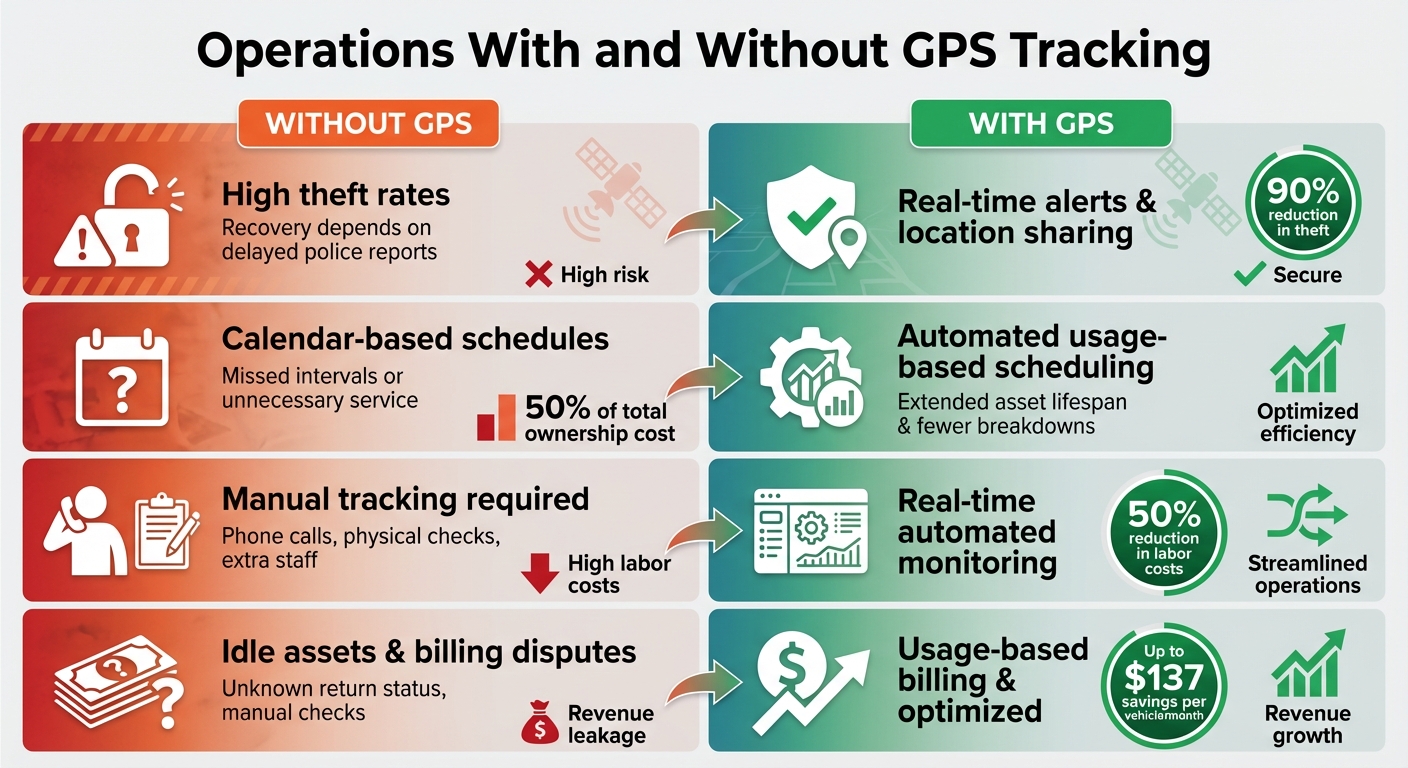
GPS tracking has reshaped how rental businesses handle their daily operations. Without it, companies often find themselves reacting to problems like delayed theft detection or poorly timed maintenance. With GPS, however, businesses can take control, managing everything proactively through a centralized dashboard.
Take theft, for example. Annie Morris from Island Golf Cart Rentals in Folly Beach, South Carolina, experienced the difference firsthand. Before GPS, her team wouldn't even realize a cart was stolen until it failed to return. Now, with GPS trackers, she can set up geofences around her service area and receive instant alerts if a cart leaves the designated boundaries. This proactive approach has significantly improved theft detection and response times [3].
Another major advantage is the automation GPS tracking provides. Tasks like manually logging odometer readings or tracking down assets are eliminated, slashing labor costs and improving operational efficiency. Companies using platforms like Lockii have reported cutting their labor expenses in half within just a few weeks [1]. This automation not only saves time but also reduces the need for additional staffing.
To better understand the operational differences, here’s a side-by-side comparison:
Comparison Table
| Challenge | Without GPS Impact | With GPS Solution | Quantified Benefit |
|---|---|---|---|
| Theft Risk | High theft rates; recovery depends on delayed police reports | Real-time alerts and live location sharing with law enforcement | Reduced asset loss and lower insurance premiums [3][19] |
| Maintenance Costs | Calendar-based schedules lead to missed intervals or unnecessary appointments | Automated scheduling based on actual engine hours and usage data | Extended asset lifespan; fewer breakdowns [13][2] |
| Efficiency | Manual tracking requires phone calls, physical checks, and extra staff for handovers | Real-time location monitoring with automated availability updates | 50% reduction in labor costs [1] |
| Revenue Potential | Idle assets due to unknown return status; billing disputes from manual odometer checks | Usage-based billing with precise GPS logs; optimized utilization | Up to $137 savings per vehicle per month [19] |
The impact of GPS tracking is evident in stories like that of Road Star Car Rental in Toronto. When customers violated rental agreements by crossing provincial boundaries, General Manager Haiven Duong used satellite photos to prove the violations and collect per-mile charges. In another instance, the same GPS system helped locate a vehicle in a police impound yard on the same day it was towed, avoiding five days of lost rental revenue [19].
These examples highlight how GPS tracking not only solves operational challenges but also opens up opportunities for better efficiency and profitability.
Conclusion
GPS tracking has become a game-changer for rental businesses, addressing challenges like theft, maintenance costs, and time-consuming manual tasks. With 59% of small fleets and 87% of large fleets already using GPS tracking - and adoption rates climbing steadily - this tool is no longer optional; it’s a necessity [1]. It provides solutions that directly affect your bottom line, streamlining operations and saving money.
Integrated platforms take it a step further by offering the ability to cut labor costs in half and double fleet sizes in just weeks. This isn’t just about efficiency; it’s about scaling operations without the need for proportional increases in overhead or staffing [1]. For businesses managing multiple locations, GPS tracking delivers centralized visibility, making it easier to oversee assets remotely from one dashboard.
Lockii takes this a step further by combining GPS tracking with features like automated billing, digital locks, identity verification, and maintenance scheduling. This integration supports 24/7 contactless pickups, enables seamless multi-location growth, and allows fully remote operations. Whether you’re managing 10 trailers or 1,000 pieces of equipment across state lines, Lockii provides the tools to stay in control.
The rental industry’s shift toward self-service and automation makes adopting GPS tracking even more crucial. Relying on outdated methods like phone calls and manual check-ins not only makes operations more labor-intensive but also limits your ability to grow. With tools like Lockii, you can automate rental business operations, simplify your processes, and position your business for long-term success.
Learn more about how Lockii can transform your operations at Lockii.