Smart Locks for Multi-Location Rental Businesses
April 1, 2026 · 14 min read
Smart Locks for Multi-Location Rental Businesses
Managing rentals across multiple locations can be a logistical nightmare - physical keys get lost, late-night check-ins require staff, and rekeying costs add up. Smart locks solve these problems by offering remote, digital access management. Here's what makes them a game-changer:
- Remote Access: Send time-limited PIN codes to guests or staff, eliminating the need for in-person key handoffs.
- Centralized Control: Manage locks across all properties from one dashboard - lock/unlock doors, revoke access, and track activity in real-time.
- Cost Savings: Reduce staffing needs, avoid rekeying costs, and handle lockouts remotely without emergency locksmiths.
- Enhanced Security: Unique credentials (PINs, biometrics) prevent copying, and detailed logs provide accountability.
- Scalability: Easily add new properties without increasing operational complexity.
Benefits of Smart Locks for Multi-Location Rentals
Lower Costs and Smoother Operations
Smart locks simplify rental management by using digital codes that automatically expire at the end of each guest's stay, cutting down on costs and eliminating the need for in-person key handoffs [3][4].
For example, if a guest accidentally locks themselves out, you can resolve the issue remotely in seconds - no need for costly emergency locksmiths or wasted time. Maintenance crews can also gain temporary access without having to pick up keys in person. Plus, with a centralized dashboard, you can oversee access across dozens - or even thousands - of units without requiring on-site staff [3][4].
Automation takes this to the next level. When paired with your rental management software, smart locks can automatically issue and revoke digital keys during check-ins and check-outs. This removes the hassle of manual updates and ensures no one keeps access longer than they should [3][4].
On top of saving time and money, smart locks add an extra layer of security by controlling and monitoring who enters your properties.
Enhanced Security and Fraud Prevention
Unlike traditional keys, which can be copied or shared, smart locks use unique credentials like PIN codes, biometric fingerprints, or digital badges. These credentials are tied to specific individuals and cannot be duplicated, closing common security loopholes [2].
Smart locks also provide real-time audit trails. Every entry is logged with a timestamp, giving you a clear picture of who accessed a property and when. This transparency speeds up investigations and ensures accountability. If a device is lost or a rental period ends, access can be revoked instantly - no need to track down physical keys [2][4].
Some advanced models go even further with features like anti-tamper alarms that activate during unauthorized entry attempts and dynamic keypads that prevent "shoulder surfing." These features are particularly valuable for multi-family apartments, which are 85% more likely to experience burglaries than single-family homes [6].
This strong security setup also helps businesses scale more effectively.
Simplified Expansion for Growing Businesses
For multi-location rentals, smart locks eliminate many of the challenges that come with scaling. Adding a new property doesn’t require hiring on-site staff for key exchanges or setting up physical key management systems. Many retrofit smart locks can be installed in under 10 minutes, and everything can be managed remotely through your existing dashboard [5][7].
Centralized access management means a single operator can oversee multiple properties from one system [1][2].
"The right smart lock doesn't just open doors, it is the foundation for streamlining every aspect of building operations" [4].
As your business grows, the time spent managing access stays consistent. Whether you’re handling 5 properties or 50, the workload remains manageable. Some systems even allow you to store and manage up to 250 unique guest codes at once, giving you room to expand without needing to switch platforms [7]. This flexibility makes it easier to explore new markets without heavy upfront investments in staff or infrastructure.
sbb-itb-eb44693
Key Features for Managing Multiple Locations
Remote Access and Code Management
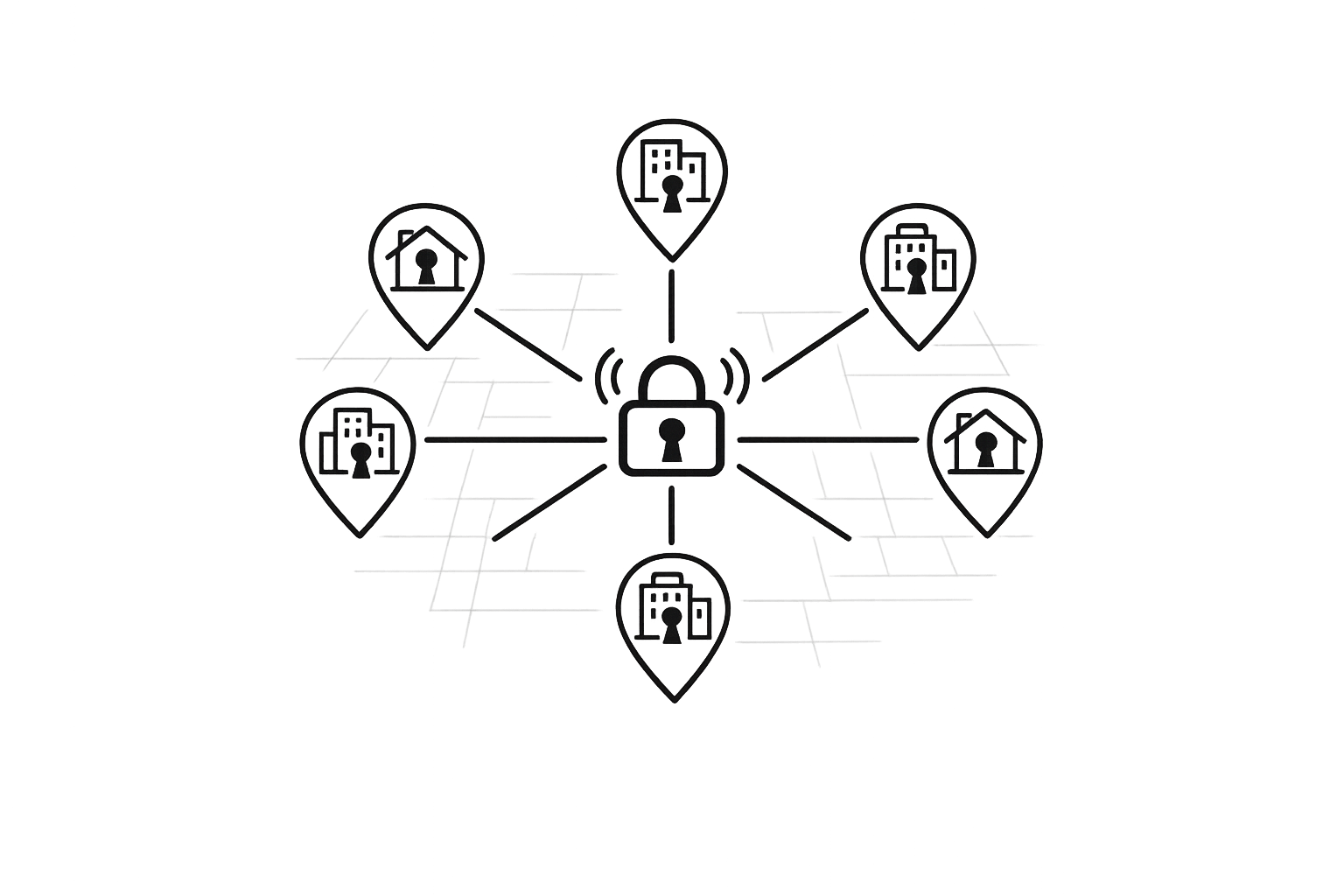
Managing multiple rental units becomes much simpler with a centralized, cloud-based smart lock system. From a single dashboard, you can issue, revoke, or update digital keys and PIN codes for thousands of units without ever needing to visit a property in person.
These systems allow you to generate time-limited or one-time-use codes for guests, maintenance staff, or vendors, all from any connected device. When a guest checks out or an employee leaves, their access can be revoked instantly.
For businesses with frequent customer turnover, like equipment or trailer rentals, automated code management is a game-changer. Temporary codes reset between users, and role-based permissions ensure managers have ongoing access while limiting contractors to specific time frames. This makes access control more efficient and reduces the manual workload.
By combining these features with real-time monitoring, you can maintain complete oversight of all your locations.
Real-Time Monitoring and Alerts
Real-time monitoring takes remote management to the next level by giving you a clear view of activity across your properties. Every access attempt - successful or denied - is logged with a timestamp, providing a detailed digital audit trail. This makes it easier to resolve disputes, monitor service providers, and ensure accountability across multiple sites.
Centralized monitoring also helps you catch issues early. For example, low-battery alerts let you schedule maintenance before problems arise, avoiding lockouts during busy times. If a door is left unlocked or someone makes an unauthorized access attempt, instant notifications allow you to act immediately, even if you're managing properties in different states.
Modern systems also monitor the health of devices across your portfolio. This eliminates the need for in-person checks just to confirm that locks are functioning correctly, saving time and resources.
Integration with Rental Management Software
Smart locks that integrate with rental management platforms can automate much of the guest experience. For instance, when a customer books through Lockii, the system automatically generates and sends access codes via SMS or email. These codes are then deactivated once the rental period ends.
Lockii's platform goes beyond access control by integrating features like identity verification, GPS tracking, damage reporting, and customer support. It also works seamlessly with IglooHome smart locks and connects to tools like Stripe for payments and Zapier for workflow automation.
This unified system simplifies operations, especially for businesses managing multiple locations. Instead of juggling separate tools for bookings, access, and communication, everything runs through one platform. Whether you're managing a handful of properties or scaling up to dozens, this approach keeps operations efficient and ready for growth.
How to Implement Smart Locks with Lockii
Connecting IglooHome Smart Locks with Lockii
Getting IglooHome smart locks set up with Lockii is simple and doesn’t require technical know-how. The Igloohome Smart Mortise 2+ connects via Bluetooth and offers multiple entry options, like mobile apps, PIN codes, RFID tags, and even physical keys [3]. This variety gives your customers flexibility, including the option to rely on traditional keys as a backup.
Once the locks are installed, you can connect them to Lockii’s cloud platform using the IglooHome integration. Lockii then generates time-sensitive access codes for each booking and sends them to customers via SMS or email. These codes automatically deactivate when the rental period ends, so there’s no need for manual updates.
The integration supports unlimited lock codes across all your locations. Whether you’re managing a handful of trailers or hundreds of rental items, the system scales effortlessly. Plus, battery-powered locks like Igloohome models can run for over 12 months on a single set of batteries, making them a low-maintenance option.
This setup not only simplifies operations but also opens the door to more advanced automation for your rental business.
Automating Your Rental Operations
Lockii takes the hassle out of managing rentals by automating time-consuming tasks. For instance, its booking widget verifies customer identities before issuing access codes [9]. This added layer of security ensures peace of mind while delivering a smooth experience for your customers.
The platform also integrates with Stripe for payment processing and connects to hundreds of other tools via Zapier. Features like GPS tracking, end-of-hire quizzes, return photos, and damage tracking make it a comprehensive solution for rental management. If your business offers 24/7 contactless rentals, customers can complete everything - booking, pickup, and return - without needing to interact with staff.
These automated workflows are designed to fit seamlessly into multi-location operations, ensuring consistency and efficiency as your business expands.
Supporting Multiple Locations with Lockii
Lockii is built to handle businesses with multiple locations, allowing you to scale without adding labor costs. Each site operates independently within the system, but you can oversee everything through a centralized dashboard. This setup lets you adjust pricing, availability, and operational settings for each location based on local demand.
The platform’s multi-location support is straightforward, with no hidden fees or complicated configurations. Whether you’re opening your second location or your twentieth, the process remains the same. Customers can browse inventory across all locations and choose the most convenient pickup point.
For businesses in industries like trailer rentals, equipment leasing, or bike sharing, this structure makes it easy to expand into new markets. You can test locations with minimal upfront costs - no need for staffed offices or expensive retail spaces. At just $12 per month per locked item, with discounts available for larger operations, Lockii’s pricing model is designed to work for businesses of all sizes.
This unified system allows you to grow your business quickly and efficiently while keeping operational costs in check.
Fully Control Smart Locks in Your Vacation Rental Business
Smart Lock Connectivity Options Compared
Getting the right connectivity for your smart locks can make or break the efficiency of managing rental properties across multiple locations. It directly impacts how much time and money you’ll spend on maintenance.
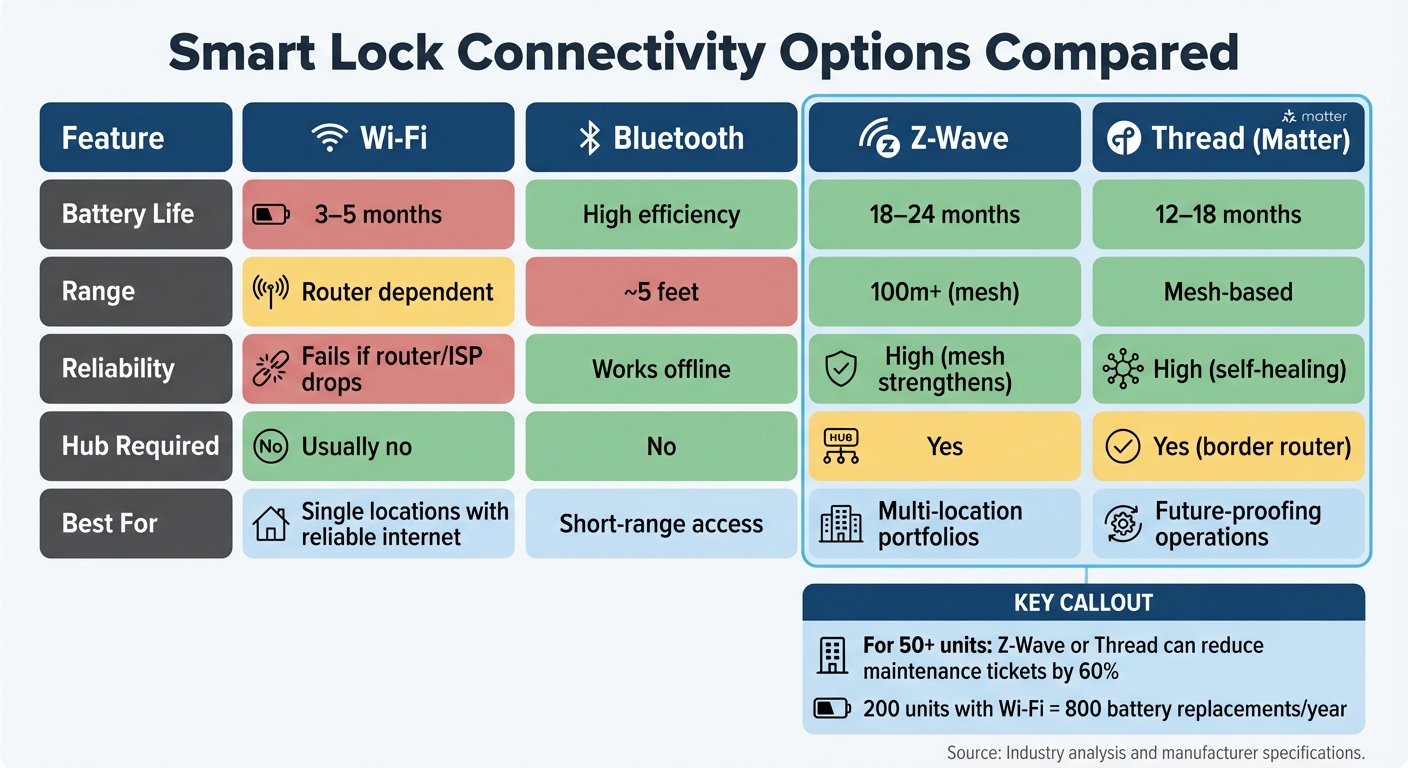
Take Wi‑Fi locks, for example. They’re convenient because they don’t need a hub, but that comes at the cost of battery life. These locks typically last only 3–5 months before the batteries need replacing [10]. For a rental business with 200 units, this adds up to 800 battery replacements a year - a significant operational headache [10].
Bluetooth locks are another option. They’re battery-friendly and work offline, but there’s a catch: you need to be within about five feet to unlock them [8][11]. This limitation makes them less suitable for remote management when you’re not on-site. On the other hand, Z‑Wave locks offer a much better balance. Their batteries can last 18–24 months, and they use a mesh network that gets stronger as you add more devices [10]. Because they operate on a sub‑1GHz frequency (908.42 MHz in the U.S.), they’re great at cutting through walls and avoiding interference from crowded 2.4 GHz Wi‑Fi networks [10].
For properties in areas with unreliable internet, cellular connectivity is a solid option, as it doesn’t depend on local Wi‑Fi [11]. And by 2026, Matter) over Thread has emerged as a reliable alternative, combining self-healing mesh networking with 12–18 months of battery life [10]. The chart below breaks down these connectivity options for easy comparison:
"Relying on WiFi locks for remote access control creates unmanageable OpEx costs due to battery drain and connectivity failures." - SuiteOp [10]
Connectivity Comparison Table
| Feature | Wi‑Fi | Bluetooth | Z‑Wave | Thread (Matter) |
|---|---|---|---|---|
| Battery Life | 3–5 months [10] | High efficiency [5] | 18–24 months [10] | 12–18 months [10] |
| Range | Router dependent [10] | ~5 feet [8] | 100m+ (mesh) [10] | Mesh‑based [10] |
| Reliability | Fails if router/ISP drops [10] | Works offline [11] | High (mesh strengthens) [10] | High (self‑healing) [10] |
| Hub Required | Usually no [10] | No [8] | Yes [10] | Yes (border router) [10] |
| Best For | Single locations with reliable internet | Short‑range access | Multi‑location portfolios | Future‑proofing operations |
For rental businesses managing 50 or more units across different locations, Z‑Wave or Thread networks, paired with an enterprise gateway, offer the best mix of reliability and low maintenance costs [10]. Transitioning from Wi‑Fi to Z‑Wave or Thread can cut lock-related maintenance tickets by as much as 60% [10].
Security and Compliance Best Practices
After choosing the right connectivity for your smart locks, the next step is to ensure they are secure and meet legal requirements. For rental businesses managing multiple locations, this means safeguarding both your assets and your customers' privacy.
Managing Access Codes and Running Regular Audits
A centralized, cloud-based platform is key for managing digital keys. It allows you to issue, revoke, and monitor time-bound access for guests, staff, and vendors. This approach minimizes the risk of unauthorized access and eliminates the problem of outdated codes lingering in the system.
Real-time audit trails add another layer of security by keeping a detailed record of access events. These trails are invaluable for resolving disputes or addressing issues like fraudulent chargebacks. For instance, in March 2026, Homely Stay - responsible for 27 vacation rentals spread across a 186-mile area - was able to automate 68% of guest communication while maintaining high-security standards without the need for on-site staff [13].
To further enhance security, implement multi-factor authentication (MFA) through email or phone verification for staff. If a device is lost, virtual keys should be disabled immediately. Set up alerts for suspicious activities, such as repeated failed access attempts, doors left open, or access during unscheduled times. Regularly review access logs and permissions to ensure former staff or vendors no longer have access.
At scale, security starts with systems that are consistent, transparent, and easy to manage across every unit.
Once you’ve established secure key management, the next priority is ensuring your systems comply with local regulations.
Meeting Local Regulations
Security is only part of the equation - compliance with local regulations is equally important, especially for businesses managing multiple properties. Consistent practices in both areas make operations more efficient and scalable.
To stay compliant, consult with professional locksmiths or property management experts to verify that your installations meet local building codes and fire safety standards. All locks should be made from durable materials, like reinforced strike plates, and must adhere to fire code requirements.
Opt for locks with advanced encryption and features like "Privacy Mode" to protect guest data and meet property access regulations. Digital logs not only enhance security but also help you demonstrate compliance with local laws. Regularly updating software and firmware will safeguard your system from new threats. Additionally, fail-safes like physical key overrides or Bluetooth backups ensure access even during power or connectivity outages.
With 67% of renters actively seeking properties equipped with smart security systems [12], strong security and compliance measures do more than just protect your business - they also give you a competitive edge.
Case Studies: Multi-Location Rentals Using Smart Locks
Examples from the field show how smart locks are changing the game for rental businesses. They tackle issues like managing physical keys, high staffing expenses, and barriers to growth. These case studies highlight how automated, centralized access management can solve these challenges. Lockii's approach to simplifying and scaling rental operations comes to life through these examples.
Expanding Trailer Rentals with Lockii
Trailer rental businesses are seeing real benefits from using Lockii's centralized smart lock system. Before, each rental location relied heavily on on-site staff to manage physical key exchanges. This setup not only limited operating hours but also drove up labor costs. With Lockii's smart locks, these businesses have significantly reduced the need for in-person key handovers.
One standout feature is remote access control. Managers can issue, modify, or revoke access permissions in real time, no matter where they are. The system uses digital codes that automatically expire, which simplifies operations during high turnover periods. This approach also eliminates the need for rekeying locks and has even led to lower insurance premiums in some cases, thanks to improved security measures[2]. These upgrades not only trim costs but also enhance the overall customer experience. Business owners can even use a contactless rental ROI calculator to estimate their specific savings.
Better Customer Experience Through Contactless Rentals
Operational improvements are just one side of the story - smart locks also elevate the customer experience. One case study shows how the shift to contactless rentals has become a major competitive edge. With 70% of property managers showing interest in smart lock technology[14], Lockii's users are appealing to tech-savvy renters who value 24/7 access. Customers can now access trailers, equipment, or vehicles anytime using their smartphone, a PIN code, or a key fob. This removes the hassle of waiting or dealing with scheduling conflicts.
Another bonus is the transparency provided by real-time audit trails. These logs track who accessed a rental unit and when, helping to resolve disputes and reduce fraud risks[1][2]. For operators overseeing multiple locations, the centralized system makes it easy to monitor activity across all sites without needing to visit each one. This combination of convenience and oversight creates a seamless experience for both operators and customers.
Conclusion
This guide has highlighted how centralized control, automation, and real-time monitoring address major challenges like physical key management, staffed vs contactless rental costs, and limited operating hours. For rental businesses managing multiple locations, smart locks offer a practical solution. Consider this: installing a smart lock takes less than 10 minutes[5], batteries last 6 to 12 months[7], and properties equipped with smart features often achieve higher rental values and may even qualify for insurance premium discounts[2]. These benefits translate directly into financial gains.
With Lockii's platform, rental businesses in industries such as trailer hire, equipment rentals, and vehicle rentals can streamline operations and unlock these advantages. By combining IglooHome smart locks with automated booking management, identity verification, and 24/7 customer access, expanding to new locations becomes feasible without significant overhead. Lockii integrates these tools into one scalable system, handling everything from code generation to audit logging, all accessible through a single, intuitive dashboard.
Adopting contactless, automated rentals isn’t just about staying current with technology - it’s about eliminating the hurdles that limit your business growth. Features like remote management, instant access, and detailed digital tracking break down geographic and time barriers. This approach sets your business up for growth, enables quick responses to market demand, and ensures a smooth, hassle-free experience for your customers.