Reinforcement Learning vs Rules for Rental Fraud
August 7, 2026 · 12 min read
Reinforcement Learning vs Rules for Rental Fraud
If I had to boil it down to one line, it’s this: _rules are best for hard stops, while reinforcement learning is better for gray-area fraud calls_.
In self-service rental, fraud can hit at booking, payment, pickup, extension, and return. And the article’s main point is simple: fixed rules help you launch fast and enforce non-negotiable checks, but they often create more false positives as edge cases pile up. Reinforcement learning can look at more signals at once and choose a lower-friction action, but it needs clean data, clear outcomes, and close review.
Here’s the short version:
- Rules work well for things that should always stop a rental:
- failed ID checks
- failed payment
- lock-code release before payment clears
- restricted GPS events
- Reinforcement learning works better when risk is less clear:
- approve now
- ask for one more check
- delay access
- require a higher deposit
- Why this matters: rental fraud is not rare in contactless hire
- 39% of companies named document forgery as their top identity threat
- 26% reported account takeover
- that rose to 33% after attackers got past electronic ID checks
- 45% said attacks peak during booking, payment, and asset handoff
- Where rules struggle:
- rule sprawl
- blunt thresholds
- more manual review
- more good customers getting flagged
- Where reinforcement learning helps:
- looks at mixed signals together
- reacts better when fraud patterns shift
- can cut friction by choosing a middle step instead of a flat denial
- But reinforcement learning is not plug-and-play:
- it needs booking history
- chargeback and theft outcomes
- GPS events
- audit logs
- ID records
- timestamped decision trails
My takeaway: most rental operators should not pick one side only. They should use a hybrid setup - _rules for clear policy gates, reinforcement learning for risk scoring around the lock-code decision_.
How can Machine Learning detect fraud?
Quick Comparison
| Criteria | Rule-Based Checks | Reinforcement Learning |
|---|---|---|
| Core logic | Fixed if/then rules | Learns from past outcomes |
| Best at | Hard stops and compliance checks | Gray-area risk decisions |
| Setup | Fast | Slower, with more data work |
| Updates | Manual | Retrained on a set cycle |
| False positives | Often higher with blunt thresholds | Can be lower if data is clean |
| Explainability | Easy to explain | Harder without added tools |
| Best fit | Small teams, new sites, low volume | Larger fleets, high-value assets, changing fraud patterns |
If you secure contactless rentals, the article’s answer is clear: when using a contactless rental process planner, start with rules where the answer should always be “no,” then use reinforcement learning where the answer depends on context.
How Rule-Based Fraud Checks Work in Rental Software
Rule engines turn rental policies into automatic holds, approvals, or review flags. If your terms say international licenses need a manual review before release, you can turn that into a rule. If your insurer says a high-value trailer can't go out until ID is verified, that becomes a rule too. Most teams set these up with simple dropdowns and if-then logic, so they can go live fast.
That speed matters most when you're opening a new site and don't have enough past data to train a model. A new location can launch with rules on day one because rules rely on policy and human judgment, not booking history.
Setup Time, Launch Speed, and Common Rule Examples
These rules usually sit at key decision points in the rental flow:
| Stage | Example Rule |
|---|---|
| Booking creation | Require manual review before release for high-value bookings |
| Payment authorization | Hold if billing ZIP code and card region do not match |
| ID verification | Deny if ID verification fails or if name/date of birth do not match the booking profile |
| Lock-code release | Block code delivery if payment capture is pending or failed |
| Return workflow | Flag the booking if end-of-hire photos are missing or GPS tracking shows the wrong drop-off location |
This setup works well for simple checks tied to policy. But once booking patterns get messier, rules start to lose their grip. Say a customer books a trailer. The system checks payment and ID before it sends the lock code. Then it does one of two things: release the booking or hold it for review. In day-to-day use, that can keep pickup and return fully automated, as part of a broader strategy to automate rental business operations, but only up to the point where the ruleset becomes too tangled to handle cleanly.
Where Rules Break Down: Sprawl, False Positives, and Manual Tuning
The weak spots in rule-based systems usually don't show up on day one. They appear later, after the ruleset has grown to cover more exceptions and edge cases, and nobody knows which rules still matter.
Rule sprawl is the main problem. Every fraud case leads to one more rule. After a while, those rules start to overlap, clash, and get hard to track. A rule meant to stop one bad actor can end up blocking a group of legitimate customers that no one expected.
False positives are the cost you notice first. A rule that sends every booking above a fixed dollar amount to manual review may seem fine during a normal week. Then the weekend hits. Or a holiday rush starts. Booking patterns change, staff is thin, and that same rule can flood the review queue. Good renters get stuck waiting for approval, or they drop off before the booking is done.
Then comes the manual tuning loop. Staff review flagged bookings, override decisions, and keep adjusting thresholds. That work adds up fast, especially when booking volume grows across multiple locations.
How Reinforcement Learning Changes Fraud Decisions in Rentals
RL turns fraud checks into a graded decision: approve, step up verification, delay access, or block - all before the customer gets the lock code. Instead of checking a booking against a fixed list of rules, it works more like a scoring model that weighs the full rental context.
That means the system can approve the booking, ask for another verification step, increase the deposit, or hold back the lock release. But there’s a catch: every decision has to be logged and tied to what happened later. Without that link, the model can’t learn.
When looking to prevent fraud with trailer rentals in self-service hire, the key call is often simple: release access now or ask for one more check. A first-time trailer renter booking late at night on a new device does not look the same as a returning renter with clean signals. RL uses that full mix of signals to pick the least disruptive action. So instead of blocking the booking outright, it might hold the lock code until a second verification step clears.
Data, Training, and Real-Time Scoring Requirements
RL needs clean outcome data. That includes booking history, chargebacks, confirmed thefts, GPS events, and extensions tied back to the first decision. If a booking was approved and later led to a chargeback, the model needs that record. If a booking was held and the customer later proved legitimate, that matters too.
The signals available at checkout, after verification, and right before access release matter just as much. Identity verification results, payment risk indicators, device fingerprinting, pickup location consistency, and booking timing all feed the score. Some fraud systems score in under 50 milliseconds [1], so lock-release decisions need to move at that same pace.
The learning loop depends on a clean, timestamped trail. That trail can include:
- Booking audit logs
- Item audit logs
- GPS tracker alerts
- Hire end photos
- Identity verification records
Those records connect each access decision to what happened afterward. Without that, an RL model has no solid way to tell which signals pointed to trouble and which ones were just noise.
Where Reinforcement Learning Outperforms Fixed Rules
The biggest edge RL has over fixed rules is how it deals with changing fraud patterns. If a fraudster knows your rule thresholds, they can tweak their device, timing, or payment details just enough to slip under them. RL looks at many weak signals together, so no single input decides the outcome. That makes the system much harder to game.
It also deals with false positives in a less blunt way. Instead of declining a booking because one detail looks odd, the model can take a middle path. It might ask for a liveness check, require a refundable deposit, or delay lock release for a short window. That helps keep legitimate customers moving through a 24/7 self-service flow while still adding friction when the risk profile calls for it.
There’s one thing to be careful about: RL does not update itself by magic. It only works when the reward matches business goals. If the model is tuned without factoring in the cost of false declines and access friction, it can start over-blocking. Bias checks should run over time so low-risk booking types do not get hit too hard. That’s why RL works best as a scoring layer, not as the only fraud control.
Rule-Based vs Reinforcement Learning: A Direct Comparison for Rental Operators
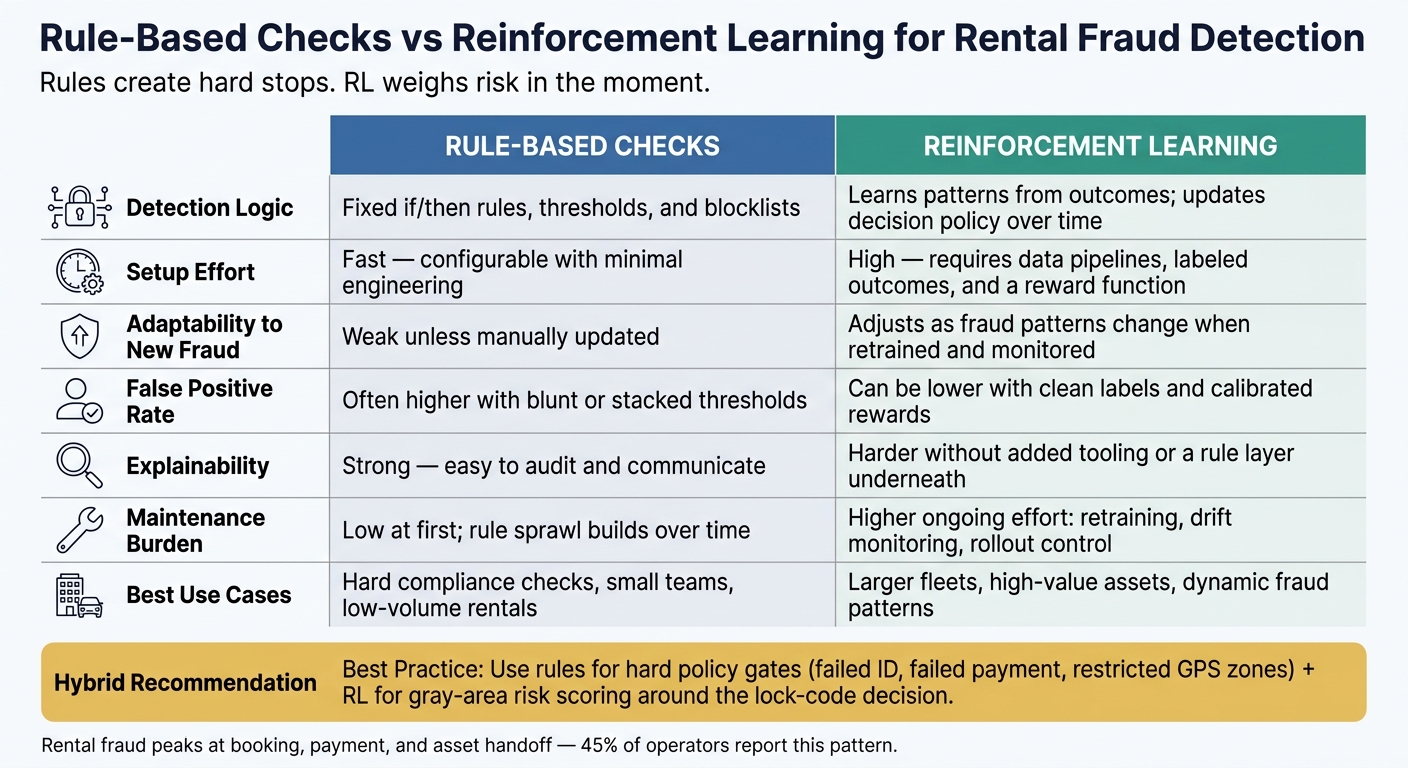
The difference is pretty simple: rules create hard stops, while reinforcement learning weighs risk in the moment using past outcomes. Rules answer, _"should this always be blocked?"_ Reinforcement learning asks, _"how risky is this right now?"_ Both matter in rental fraud. They just belong in different parts of the decision chain.
That split shows up most clearly at booking, verification, and lock-code release.
At a glance
The table below shows how each approach tends to work in day-to-day rental decisions.
| Dimension | Rule-Based Fraud Checks | Reinforcement Learning |
|---|---|---|
| Detection logic | Fixed if/then rules, thresholds, and blocklists | Learns patterns from outcomes and updates its decision policy over time |
| Setup effort | Fast - often configurable with minimal engineering | High - requires data pipelines, labeled outcomes, and a reward function tied to fraud losses and false declines |
| Adaptability to new fraud | Weak unless manually updated after fraud patterns change | Adjusts as fraud patterns change when retrained and monitored properly |
| False positive rate | Often higher when thresholds are blunt or rules pile up | Can be lower, but only with clean labels and well-calibrated rewards |
| Explainability | Strong - easy to audit and communicate to customers | Harder to explain without added tooling or a rule layer underneath |
| Maintenance burden | Low at first, but rule sprawl builds over time | Higher ongoing effort: retraining, drift monitoring, and rollout control |
| Best use cases | Hard compliance checks, small teams, low-volume rentals | Larger fleets, high-value assets, dynamic fraud patterns |
Setup, Update Cycles, and Response Speed
Rules can go live fast. RL usually takes longer because it needs historical data, labeled outcomes, and a reward function. That extra setup is the tradeoff.
Rules also need regular edits as fraud patterns shift. That makes them fast to change, but also reactive. RL updates on a more structured cycle, often weekly or monthly, and can take in new fraud signals and outcome data without someone having to write another rule by hand.
There’s also a rollout difference. RL changes usually need A/B testing and validation before they go live. A rule change, by contrast, can often be pushed in minutes. But at the actual decision point, both can work in milliseconds if the system is built well.
False Positives, Edge Cases, and Customer Friction
Blunt thresholds can turn into a direct revenue problem. In rentals, a blocked booking doesn’t just mean a lost sale today. It can also create friction that keeps a customer from coming back.
Rules tend to struggle most with edge cases. Picture a renter flying into another state and booking a trailer with an out-of-state license. Or someone booking a car 30 minutes before pickup because their flight got canceled. Or a construction company placing a high-value equipment booking from a location the system hasn’t seen before. None of those cases are strange in the real world, but they can trip several rule flags at once.
RL usually handles these situations with more nuance. Instead of treating one mismatch like a brick wall, it weighs the full picture: prior account history, device trust, payment signals, and location consistency. That can lead to a middle-ground response instead of a flat decline.
For example, the system might suggest:
- a higher deposit
- an extra ID check
- a short hold before lock release
That approach keeps good renters moving while adding friction only when it makes sense.
Which Approach Fits Each Rental Type: Trailer, Car, Bike, and Equipment
The right fit usually comes down to asset value and fraud exposure. High-value assets that are hard to recover need strict baseline rules plus adaptive scoring. Lower-value, high-volume rentals can often start with rules alone, then add RL once enough booking data starts piling up.
| Rental Category | Recommended Primary Approach | Typical Fraud Risks | Data Requirements |
|---|---|---|---|
| Trailer | Strict rules plus adaptive scoring | Theft, non-return, ghost bookings | ID verification, GPS tracking, return photos |
| Car | Hybrid: rules plus RL | Identity theft, unauthorized drivers, insurance fraud | ID, payment risk indicators, telematics |
| Bike/Scooter | Rules at launch, RL at scale | Opportunistic theft, account sharing | Usage patterns, payment history |
| Equipment | Risk-based, value-tiered rules | Asset misappropriation, high-value theft | ID, condition photos, insurance documentation |
In practice, most operators land on a hybrid model: rules for hard stops, RL for risk-based decisions.
The Case for a Hybrid Fraud Control Layer in Rental Businesses
For most rental operators, the best setup is a hybrid layer. That split matters because rental fraud is easiest to control when hard compliance gates and adaptive scoring work inside the same flow.
Controls That Should Stay as Fixed Rules
Start with decisions that should never be up for debate. If identity verification fails, lock code access stays blocked. If payment fails, the booking does not move forward. If an asset enters a restricted region, GPS-based rules trigger alerts and block new extensions. These are mandatory compliance and safety gates, not judgment calls.
Decisions That Benefit from Learning Models
Once hard stops catch the obvious risk, the model can handle the gray area. For example, it can help decide whether a new renter booking a high-value trailer should pay a higher deposit, whether a trusted repeat customer needs to verify again, or whether a low-risk extension request can be auto-approved.
A learning model can look at GPS behavior, payment history, device trust, booking timing, and past returns at the same time. Then it can route the booking to the right outcome without staff stepping in.
Key Takeaways for Operators Scaling Self-Service Rental
Self-service rental platforms already collect the signals needed for hybrid fraud control. In a contactless rental flow, the lock-code decision is where these controls matter most.
Platforms like Lockii connect identity verification, GPS tracking, hire-end photos, and audit logs directly to that decision point. That gives both fixed rules and adaptive scoring the data they need. Digital lock control then enforces the outcome: grant, hold, or block access.
Hybrid fraud control works best when rules block clear violations and learning models score everything else.