
AI-Powered Rental Support: Fraud Prevention Tips
January 21, 2026 · 10 min read
AI-Powered Rental Support: Fraud Prevention Tips
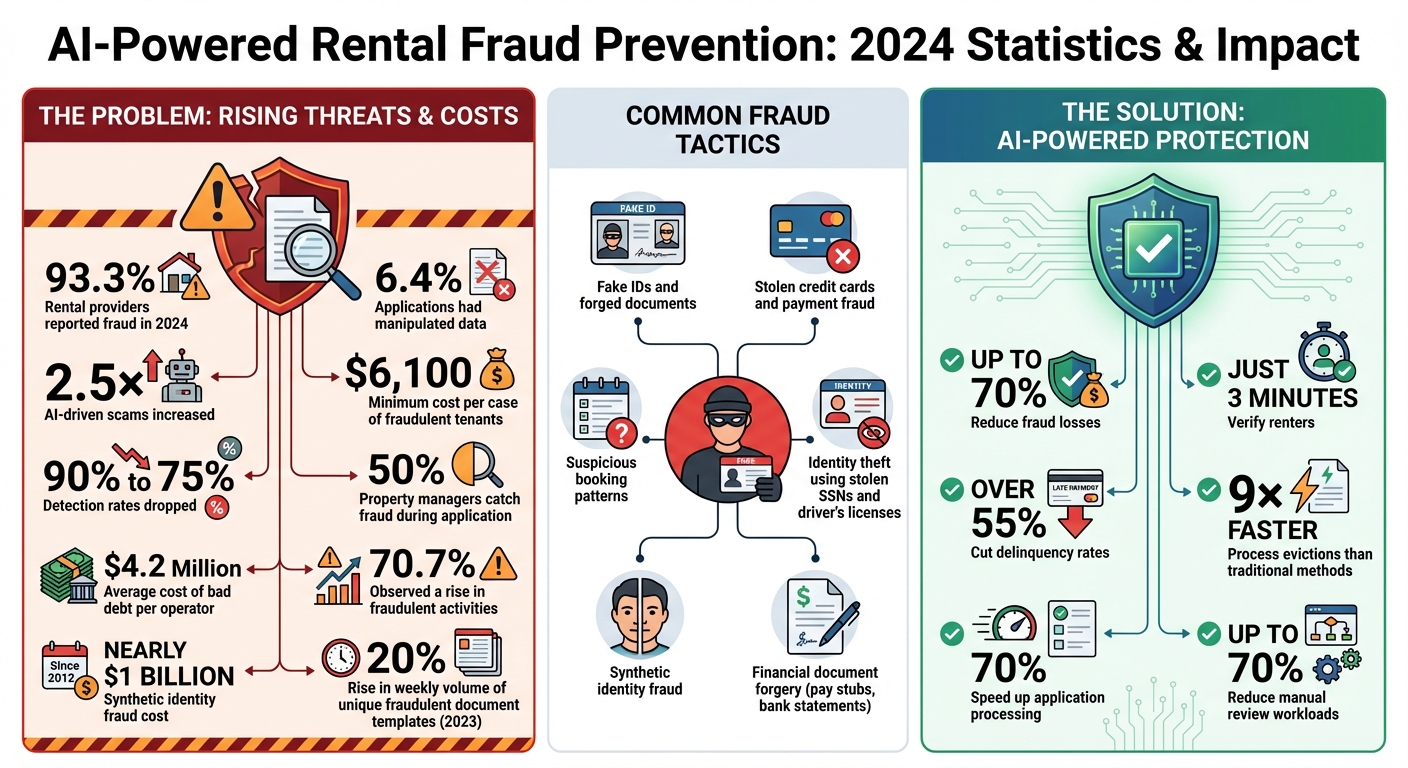
Rental fraud is a growing problem, costing businesses thousands per case. With 93.3% of providers encountering fraud in 2024 and AI-driven scams increasing by 2.5×, the rental industry faces new challenges. Fraudulent applications, fake documents, and payment scams are common tactics, leading to financial losses, property damage, and operational headaches.
Here’s the solution: AI tools can reduce fraud losses by up to 70% and verify renters in just 3 minutes. Features like biometric ID checks, real-time alerts, and tamper-proof records make detecting fraud faster and more accurate than ever. Businesses using these tools can protect themselves while speeding up the application process for legitimate renters.
Key points to know:
- 93.3% of rental providers reported fraud in 2024.
- 6.4% of applications had manipulated data.
- Fraudulent tenants cost at least $6,100 per case.
- AI tools can spot fake IDs, forged documents, and suspicious patterns with unmatched precision.
- Solutions like Lockii integrate identity verification, GPS tracking, and secure records (see our GPS tracking guide) to stop scams before they cause damage.
Fraud prevention isn’t just about stopping scams - it’s about running a safer, more efficient rental business. Read on to learn how AI can safeguard your operations and save you money.
Bad AI in Hospitality: How to Protect Your Vacation Rental Business from Fraud, Deepfakes & Scams
Common Fraud Tactics in the Rental Industry
Rental fraud has become increasingly sophisticated, with detection rates dropping from 90% to 75% [7]. Recognizing these tactics is a crucial step in safeguarding your business. Below, we explore some of the most common fraud methods and how they challenge traditional screening systems.
Fake IDs and Forged Documents
Fraudsters use several strategies to bypass verification processes. Identity theft is one of the most common, where stolen Social Security numbers and driver’s licenses - often purchased on the dark web - are used to pass background checks under someone else’s identity [7][8]. An even more advanced method is synthetic identity fraud, which combines real Social Security numbers with fake names and addresses to create entirely new identities. These synthetic identities can build credit scores over time, making them particularly difficult for traditional screening to catch [7][6][8]. Since 2012, synthetic identity fraud has cost property managers nearly $1 billion [8].
Another widespread issue is financial document forgery, where applicants submit altered pay stubs, bank statements, or employment letters to meet the common 3:1 income-to-rent ratio [1][2][5]. Modern AI tools have made these forgeries alarmingly realistic, eliminating the typos and formatting errors that once served as red flags [4]. In fact, 2023 saw a 20% rise in the weekly volume of unique fraudulent document templates detected [9]. This highlights the growing importance of advanced verification systems capable of spotting subtle manipulations.
Stolen Credit Cards and Payment Fraud
Payment fraud is another prevalent issue, often resulting in immediate financial losses. Scammers use stolen credit card details to pay deposits, only for chargebacks to occur after the tenant has moved in, leaving units occupied and revenue lost [5]. Other methods, like bounced checks and payment reversals, can disrupt cash flow and lead to bad debt [5][10].
But the damage doesn’t stop at financial losses. Fraudulent tenants can cause property damage, lead to costly repairs, and increase vacancy periods. Worse yet, they can tarnish your reputation with property owners and prospective tenants, making it harder to attract quality renters [9][5].
Suspicious Booking Patterns
Fraudsters often employ high-pressure tactics to rush the application process. They might claim other renters are interested to push you into skipping thorough screening. Many avoid official communication channels altogether and refuse to tour the property, whether in person or virtually [5][2]. Other red flags include documentation that seems too perfect [4], multiple applications with similar language from different names, or applications originating from the same IP address [2][1]. Payment requests involving untraceable methods, such as wire transfers, cash, or gift cards, are also common [5].
Shockingly, only 50% of property managers catch fraud during the application process. The rest discover it after the tenant has already moved in, making it even harder to mitigate the damage [8].
AI-Powered Fraud Prevention Methods
Modern AI systems provide rental businesses with a fast and precise multi-layered defense against fraud, far surpassing the capabilities of manual screening. Here’s a closer look at three AI-driven methods that are transforming fraud prevention in the rental industry.
AI-Based Identity Verification
AI verification tools do much more than check if an ID looks valid. They employ biometric matching, combining facial recognition with liveness detection to confirm that a live selfie matches the photo on an ID and that the applicant is physically present. Meanwhile, document forensics analyze IDs for subtle alterations, such as mismatched fonts, tampered barcodes, or incorrect holograms - details that might escape human scrutiny. These systems also conduct database cross-referencing, verifying Social Security numbers, addresses, and names against public records, credit bureaus, and utility databases to detect synthetic identities. With these measures, fake IDs and forged documents - common tools of fraud - are effectively countered. By implementing such advanced identity verification, businesses can cut delinquency rates by over 55% and process evictions nine times faster than traditional methods [11].
"Identity fraud is getting easier to commit, and harder to catch." - Findigs [11]
AI also inspects pay stubs and bank statements to uncover forgeries or AI-generated financial documents, which are increasingly used by fraudsters. These systems not only improve accuracy but also speed up application processing by as much as 70% [11].
Real-Time Alerts and GPS Monitoring
AI-driven systems provide real-time alerts, enabling rental businesses to detect and act on fraud immediately. These alerts flag suspicious activities, such as multiple applications using different identities or emerging fraud patterns, ensuring timely intervention [1]. This capability is vital, as 93.3% of rental operators have reported fraud in the past year, with 70.7% observing a rise in fraudulent activities. The financial toll is significant, with the average cost of bad debt reaching $4.2 million per operator [12].
Smart locks and lockboxes further enhance security by tracking entry times and generating unique, time-sensitive access codes. These features help prevent unauthorized subletting and maintain a clear record of property access. Additionally, advanced systems use device attestation to identify and block burner phones, VOIP numbers, and fraudulent IP addresses during the application process [11][12]. Coupled with secure data transmission and immutable records, these tools strengthen defenses against fraud.
Secure Communication and Tamper-Proof Records
Encrypted communication channels and permanent audit logs safeguard rental businesses from both fraud and legal disputes. Directing inquiries through official websites and phone lines minimizes the risk of suspicious contacts [2]. E-signature audit trails provide an unalterable record of when documents were viewed and signed, ensuring that all required fields are completed before finalizing agreements [2].
"A complete and organized record of your screening process demonstrates fairness and diligence when you maintain consistent tenant screening standards." - Buildium [2]
Digital records centralize payments within secure systems, protecting businesses against discrimination claims and supporting legal actions or insurance claims in cases of fraud [2][6]. Furthermore, data encryption ensures compliance with privacy regulations like GDPR and CCPA, fostering trust among legitimate applicants [4][13]. Multi-factor authentication - such as 2FA, Face ID, or PassKeys - adds an additional layer of security, ensuring that only verified users can access sensitive systems [11][13].
sbb-itb-eb44693
How Lockii Helps Rental Businesses Stop Fraud
Lockii takes advanced AI tools and weaves them into a seamless, contactless platform designed to protect rental businesses from fraud. By combining AI-based identity verification, GPS tracking, and audit logging, Lockii offers a strong defense against fraudulent activities while reducing the need for manual oversight. Here’s how these features work together to boost security:
Built-In Identity Verification
Lockii uses AI-powered identity verification to ensure every applicant is legitimate. How? By employing biometric matching, it compares a live selfie with the ID photo provided, while _liveness detection_ ensures the person is physically present. Advanced checks flag tampered IDs, and real-time cross-referencing with global blocklists and public databases validates identities. Even phone numbers are screened to detect burner phones and VOIP numbers often used by fraudsters.
This layered approach doesn’t just improve security - it speeds up application processing by nearly 70% and reduces delinquency rates by over 55% [11].
"Identity proofing is the 'due diligence' phase. It's the process you use to build a high-confidence digital or physical identity of an applicant, ensuring you're not falling victim to identity fraud." – LeaseRunner Team [6]
GPS Tracking and Automated Alerts
Lockii’s GPS tracking ensures that the person gaining access is physically present, preventing remote code sharing. Time-limited access codes, valid for only a short period, minimize the risk of unauthorized entry. Real-time automated alerts keep an eye on booking patterns, flagging suspicious activities like multiple applications tied to different identities. Meanwhile, electronic locks record precise entry and exit times, creating a detailed audit trail.
"The geolocation check ensures the person who did the prescreening is physically present, and not sharing the code remotely with a bad actor." – Nina Fouche, RentEngine [14]
These alerts and tracking tools work hand-in-hand with Lockii’s audit logs to create a comprehensive security solution.
Audit Logs and Contactless Operations
Lockii’s tamper-proof audit logs document every interaction, leaving no room for ambiguity. Features like hire end quizzes and end-of-rental photos add an extra layer of accountability, ensuring equipment is returned in its original condition.
What’s more, Lockii’s fully contactless operations allow businesses to scale smoothly without the need for on-site staff. Behavioral analytics automatically assess applicant risk, letting managers focus their attention where it matters most. Secure in-app delivery of access codes prevents interception, while integrations with tools like IglooHome digital locks and Stripe Identity enable around-the-clock operations across multiple locations - without ever compromising security.
Lockii isn’t just about reducing fraud; it’s about making rental businesses more efficient and secure at the same time.
Conclusion
Rental fraud is on the rise - 70% of property management companies have reported a spike in fraudulent applications over the past year [3]. Relying solely on manual reviews is no longer enough to combat this growing issue. Each case of tenancy fraud can rack up costs exceeding $6,100 [3].
To tackle these challenges, AI-powered solutions are stepping in with a multi-layered approach. By integrating identity proofing, direct-source verification, and real-time monitoring, these systems detect fraud early, saving businesses time and money. They can reduce manual review workloads by up to 70%, allowing your team to focus on genuine applicants [3].
"It isn't only about keeping bad guys out, it is about increasing access to those who deserve it." – Akaash Gupta, Head of Tenant Screening Partnerships, Nova Credit [15]
Lockii takes these advanced fraud prevention tools a step further with a contactless, 24/7 platform designed for seamless operation across multiple locations. Features like built-in identity verification, GPS tracking, tamper-proof audit logs, and automated alerts ensure rental businesses can scale without compromising security. Legitimate applicants benefit from faster approvals, while fraudsters are stopped in their tracks.
As the rental industry shifts toward contactless, digital solutions, adopting these technologies now is key to staying ahead of increasingly sophisticated fraud tactics while earning the trust of security-conscious customers.