
The pitfall of every rental company - Prepaid Cards
February 17, 2026 · 10 min read
The pitfall of every rental company - Prepaid Cards
Prepaid card fraud is a growing problem for rental companies, costing businesses billions annually. These cards, which are easy to obtain and often anonymous, are frequently exploited by fraudsters to bypass payment systems, leaving companies unable to recover costs for damages, late returns, or stolen assets.
Key takeaways:
- Why prepaid cards are risky: They lack credit checks, are untraceable, and don't offer chargeback protections like credit cards.
- Fraud tactics: Common scams include card testing, overcharges with refund redirection, and triangulation fraud.
- Financial impact: Beyond direct losses, companies face chargeback fees, operational costs, and higher processing fees.
- Prevention strategies: Use tools like Stripe Radar for transaction monitoring, require identity verification, and train staff to spot red flags.
Rental companies must combine advanced fraud detection tools with automated rental business operations, clear policies, and staff awareness to reduce risks and protect their bottom line.
How Prepaid Card Fraud Works in Rental Transactions
Common Fraud Scenarios
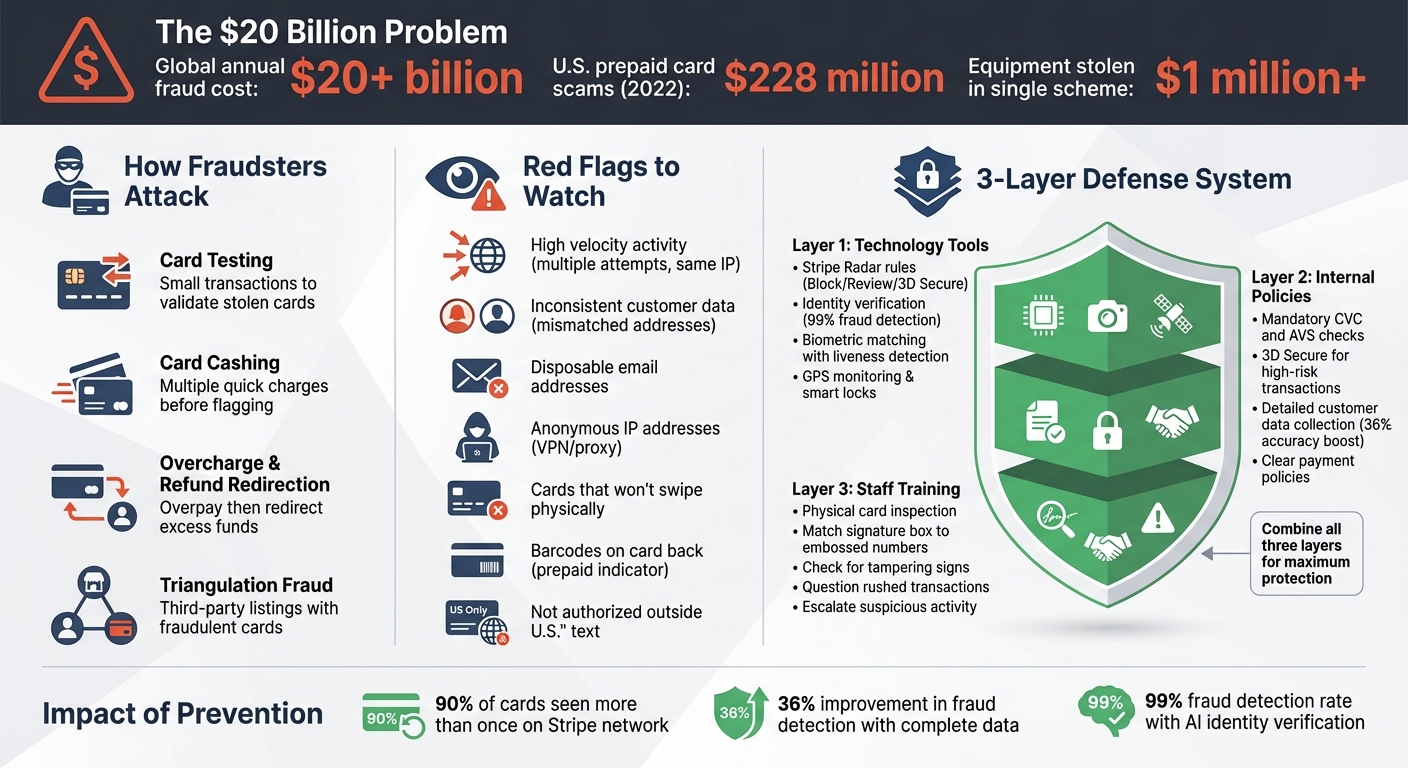
Fraudsters have devised several schemes to exploit prepaid cards in rental transactions. One common tactic is card testing, where scammers make small transactions on rental platforms to confirm the validity of stolen card numbers. Another method, known as card cashing, involves quickly authorizing multiple charges to drain the card’s value before it’s flagged as stolen [7].
Another frequent scam involves overcharges and refund redirection. Here, fraudsters overpay for a rental and then request the excess funds be sent to a third party through irreversible methods like checks or wire transfers [4]. Triangulation fraud is another headache for businesses: a scammer advertises a rental on a third-party site, uses a fraudulent prepaid card to place an order with a legitimate rental company, and leaves the business to deal with chargebacks and lost equipment [2]. As Stripe explains:
"People using stolen credit cards don't usually worry about how expensive the shipping \or service] is and want goods right away, before the card number is reported as stolen or compromised" [[4].
Recognizing these schemes early is critical to minimizing losses.
Warning Signs to Watch For
Certain patterns can signal prepaid card fraud. For example, high velocity activity - multiple payment attempts from the same IP address, email, or card number within a short period - often points to card testing or cashing [4][7]. Similarly, inconsistent customer data, like mismatched email addresses and billing information or a billing address in a different country than the card’s origin, is another red flag [4].
Other warning signs include canned responses in customer communications, unusually large orders, or attempts to split payments across multiple cards. Fraudsters often use disposable email addresses or hide behind anonymous IP addresses, such as those from VPNs or proxies, which further increases the risk when prepaid cards are involved [1][5]. Identifying these red flags is the first step in addressing potential vulnerabilities in your system.
Why Standard Security Measures Fail
Standard security measures often fall short when it comes to prepaid card fraud. These cards can be purchased anonymously with cash at retail stores, requiring no ID or credit checks [2]. As Chargeblast puts it:
"Prepaid cards are basically anonymous cash that works online, which means fraudsters can use them without leaving any trail back to their real identity" [2].
Additionally, many prepaid cards don’t support Address Verification Systems (AVS). Even when AVS is available, issuers may still approve transactions that fail CVC or postal code verification. Stripe explains:
"A card issuer might still consider a payment that fails CVC or postal code verification legitimate, and therefore approve it" [1].
This makes it easier for prepaid card transactions to slip through standard security filters, leaving merchants exposed.
Another issue is that traditional systems evaluate transactions individually, allowing fraudsters to use multiple prepaid cards from the same IP address or device to bypass transaction limits [2][1]. The lag between a fraudulent transaction and the resulting chargeback gives scammers enough time to receive the rented equipment before the fraud is detected [3]. Globally, fraud costs businesses over $20 billion annually, and in the U.S. alone, consumers lost $228 million to gift and prepaid card scams in 2022 [2][3].
These challenges emphasize the importance of tools like Lockii, which offer advanced identity verification and automated fraud detection. Addressing these gaps with integrated solutions is key to staying ahead of fraudsters.
sbb-itb-eb44693
How to Prevent Prepaid Card Fraud
Setting Up Stripe Radar Rules
Stripe Radar offers rental companies a way to identify and manage prepaid card transactions before chargebacks become an issue. It uses a straightforward rule system: {action} if {condition}. Conditions follow the format [attribute] [operator] [value] [5].
A key attribute for detecting prepaid cards is :card_funding:, which indicates whether a card is prepaid, debit, credit, or unknown [9]. You can choose from three actions: Block to reject the payment outright, Review to flag the payment for manual inspection while processing it, or Request 3D Secure to require additional authentication [5][8].
For strict control, you can implement a rule like Block if :card_funding: = 'prepaid'. If you prefer flexibility, you might use a rule such as Review if :card_funding: = 'prepaid' and :amount_in_usd: > 1000.00, which only flags high-value transactions for review [5][8]. You can also combine multiple risk indicators, such as Review if :is_disposable_email: and :card_funding: = 'prepaid', to identify customers using both disposable emails and prepaid cards [8].
Stripe’s machine learning models analyze billions of payments annually and create fraud profiles based on repeat card activity. According to Stripe, 90% of cards on the network have been seen more than once [3]. As Stripe explains:
"A good block rule results in significantly more fraudulent payments blocked than legitimate payments" [8].
Using Identity Verification Tools
Identity verification addresses the anonymity that often attracts fraudsters. By requiring customers to submit a photo ID and match it to their face, you connect an otherwise untraceable payment method to a verified individual.
Modern systems powered by AI can quickly analyze driver’s licenses and passports, spotting altered documents or inconsistencies. Biometric matching with liveness detection ensures the person is physically present, preventing the use of stolen photos or deepfakes. These tools are highly effective, detecting over 99% of known fraud cases [10].
In March 2025, federal prosecutors highlighted a rental fraud scheme where criminals used fake IDs with stolen payment credentials to steal over $1 million in equipment from Home Depot locations across multiple states. Peter Horadan, CEO of Vouched, commented:
"Vouched's AI technology can be deployed today to help businesses immediately address the rising wave of equipment rental fraud and associated financial losses. Our solution delivers fast, accurate identity verification that stops fraudulent IDs in their tracks while maintaining a smooth customer experience" [10].
To enhance security, you can set rules to trigger identity verification automatically. For example, require ID verification for rentals over $1,000 when a prepaid card is used, or verify all first-time customers using prepaid cards, regardless of the transaction amount.
Pairing these robust identity checks with integrated systems like Lockii adds even more security to the rental process.
How Lockii Prevents Prepaid Card Fraud
Lockii offers a multi-layered approach to fraud prevention, automating the process from start to finish. The platform integrates Stripe Identity verification directly into the booking flow, requiring customers to validate their documents against official databases before gaining access. This process is fully automated, eliminating the need for staff intervention.
Lockii also generates unique smart lock codes that are active only for the rental period. Alongside this, GPS monitoring tracks equipment during the rental, ensuring it doesn’t disappear from satellite locations. Even if someone uses a stolen prepaid card, they won’t be able to return for unauthorized access later.
Additionally, digital audit logs record every transaction, lock code generation, and customer interaction. This encrypted record can assist law enforcement in recovering assets. With automated communications and these security measures, Lockii ensures customers are verified and tracked throughout the rental process, discouraging fraud. Integration with Stripe allows you to implement Radar rules while maintaining a seamless, contactless experience - perfect for businesses operating across multiple locations.
How to Protect Your Business From Prepaid Card Scams
Internal Policies to Reduce Fraud Risk
Pairing advanced digital fraud prevention tools with well-thought-out internal policies can significantly reduce fraud risks.
Creating a Clear Payment Policy
A solid payment policy is the backbone of fraud prevention. Decide whether to block or flag high-risk prepaid cards and establish rules accordingly. For instance, requiring 3D Secure authentication for high-risk transactions shifts the liability for fraud-related disputes from your business to the card issuer [3].
Make CVC and AVS checks mandatory for all transactions. Collecting detailed customer data - such as email, name, billing address, and IP address - can improve fraud detection accuracy by up to 36% [6]. Also, enforce thorough verification, especially for high-value or first-time rentals, to minimize risks.
Training Staff to Spot Fraud
Your employees play a crucial role in fraud prevention, particularly during in-person transactions. Detective Kraig Palmer from the California Highway Patrol's San Diego Regional Auto Theft Task Force highlights a simple but essential rule:
"The No. 1 thing that all car rental agencies should avoid is a credit card that won't swipe. If it doesn't swipe, don't take it." [12]
Train staff to physically inspect every card. Ensure the last four digits printed in the signature box match the embossed numbers on the front. Look for signs of tampering, such as scratches or discoloration, which may indicate alterations. Standard credit cards typically lack barcodes on the back - a feature often found on prepaid or reloadable gift cards. Many prepaid cards also state "not authorized for use outside the U.S." on the back [12].
Fraudsters often rely on rushed transactions. As Palmer notes:
"Thieves like the briefness of a transaction. They want you to focus on the credit card as little as possible." [12]
Encourage employees to ask direct questions if something seems suspicious, such as how long the customer has had the card. Any doubts should be escalated to a manager without hesitation. A vigilant, well-trained team combined with regular transaction reviews can significantly strengthen your fraud defenses.
Reviewing Transactions and Logs Regularly
While automated systems are excellent at flagging potential fraud, human oversight adds a critical layer of protection. Manual reviews can help detect complex fraud patterns that automated tools might miss [8].
Set clear rules to flag high-value prepaid card transactions for manual inspection. Scrutinize transaction logs for patterns, such as "related payments" tied to the same email address, IP address, or card fingerprint across multiple suspicious bookings. A surge in declined payments within a short time frame often signals card testing, which can be mitigated by adding CAPTCHA to your checkout process [4][11].
Pay special attention to mismatches between the cardholder's country and the IP address. Over time, your team will develop a keen sense for spotting fraud, which can then be translated into more refined fraud prevention rules. As Stripe puts it:
"As reviewers sort through your transactions, they develop intuitions for fraud prevention that you can translate into better rules." [11]
For businesses using Lockii, digital audit logs automatically record every transaction, lock code generation, and customer interaction. This makes it easier to identify patterns and provides valuable documentation for law enforcement if necessary. By combining these internal policies with cutting-edge technology, you can build a strong defense against prepaid card fraud in rental transactions.
Conclusion
Key Points for Rental Businesses
Prepaid card fraud costs businesses globally over $20 billion each year, creating a massive financial strain on industries like rental services [3]. On top of this, chargeback fees and processing costs amplify the financial burden, making it clear that fraud prevention isn't just important - it's essential.
To protect your rental business, combine advanced fraud detection tools with clear internal policies. For example, you can use Stripe Radar to flag or block prepaid card transactions for high-value rentals. Adding 3D Secure authentication shifts liability for fraudulent transactions to card issuers, while collecting detailed customer data - like email addresses and IP locations - can boost fraud detection accuracy by 36% [6]. Regular monitoring is also critical for spotting patterns that automated systems might miss. A layered approach, blending technology and strong policies, is key to staying ahead of fraudsters.
How Technology Helps Prevent Fraud
Tools like Stripe Radar and Lockii work together to create a robust fraud prevention strategy. Lockii’s identity verification process feeds verified data directly into Stripe as metadata. This enables smarter rules, like allowing prepaid card transactions only when the customer’s identity is confirmed. Additionally, Lockii provides digital audit logs that track every transaction, lock code generation, and customer interaction - helping your team uncover suspicious activity and maintain thorough records.
For rental businesses that operate 24/7, automation is a game-changer. As SnowCloud, a fraud prevention team, explained: _"Using Stripe Radar for Fraud Teams... we can recognize and combat fraud in ways that were never before possible, giving us a distinct advantage over the criminals."_ [13]