Market Trends in Smart Lock Technology for Rentals
April 2, 2026 · 12 min read
Market Trends in Smart Lock Technology for Rentals
The rental industry is shifting rapidly toward smart lock adoption. Here's why it matters:
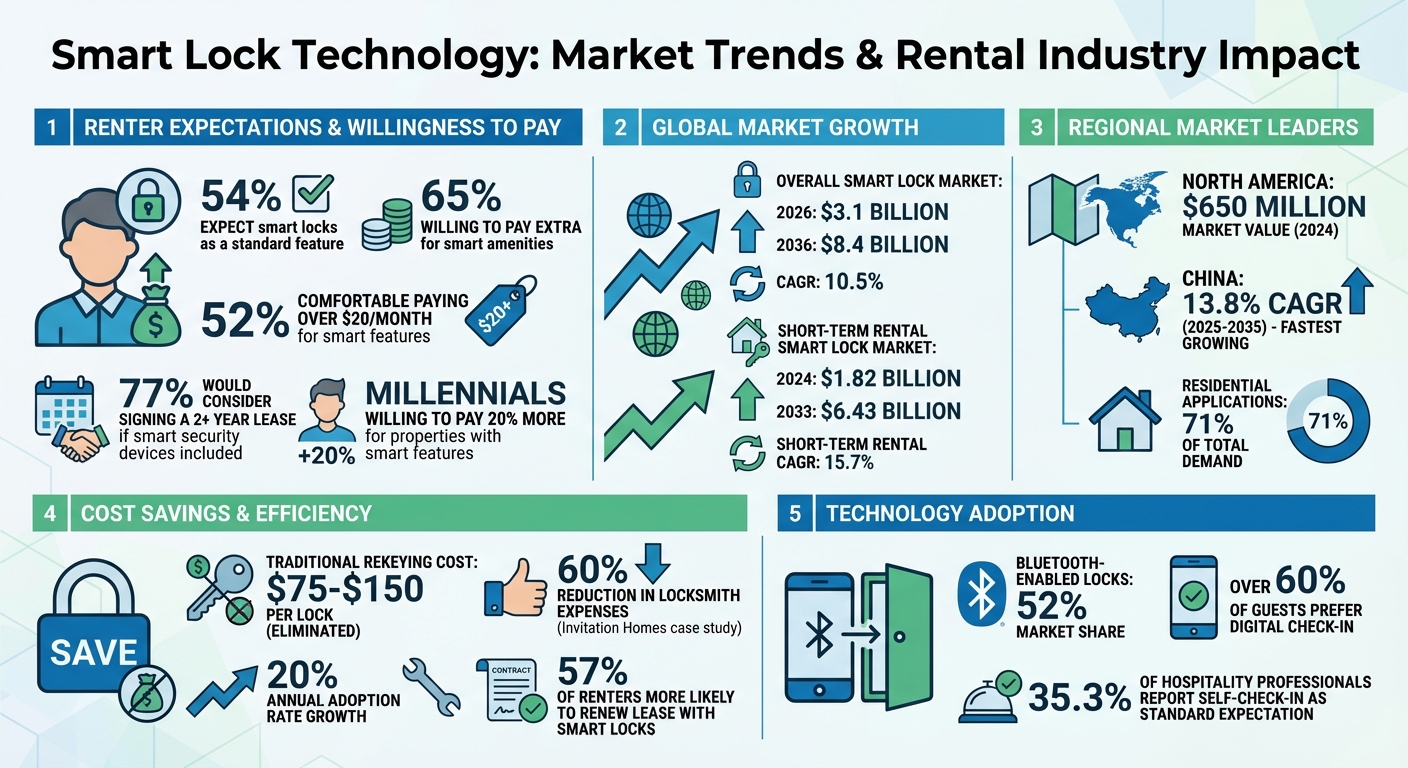
- 54% of renters expect smart locks as a standard feature in rental properties.
- 65% are willing to pay extra, with 52% comfortable paying over $20/month for smart amenities.
- Smart locks reduce costs by eliminating rekeying ($75–$150 per lock) and minimize lockout service calls.
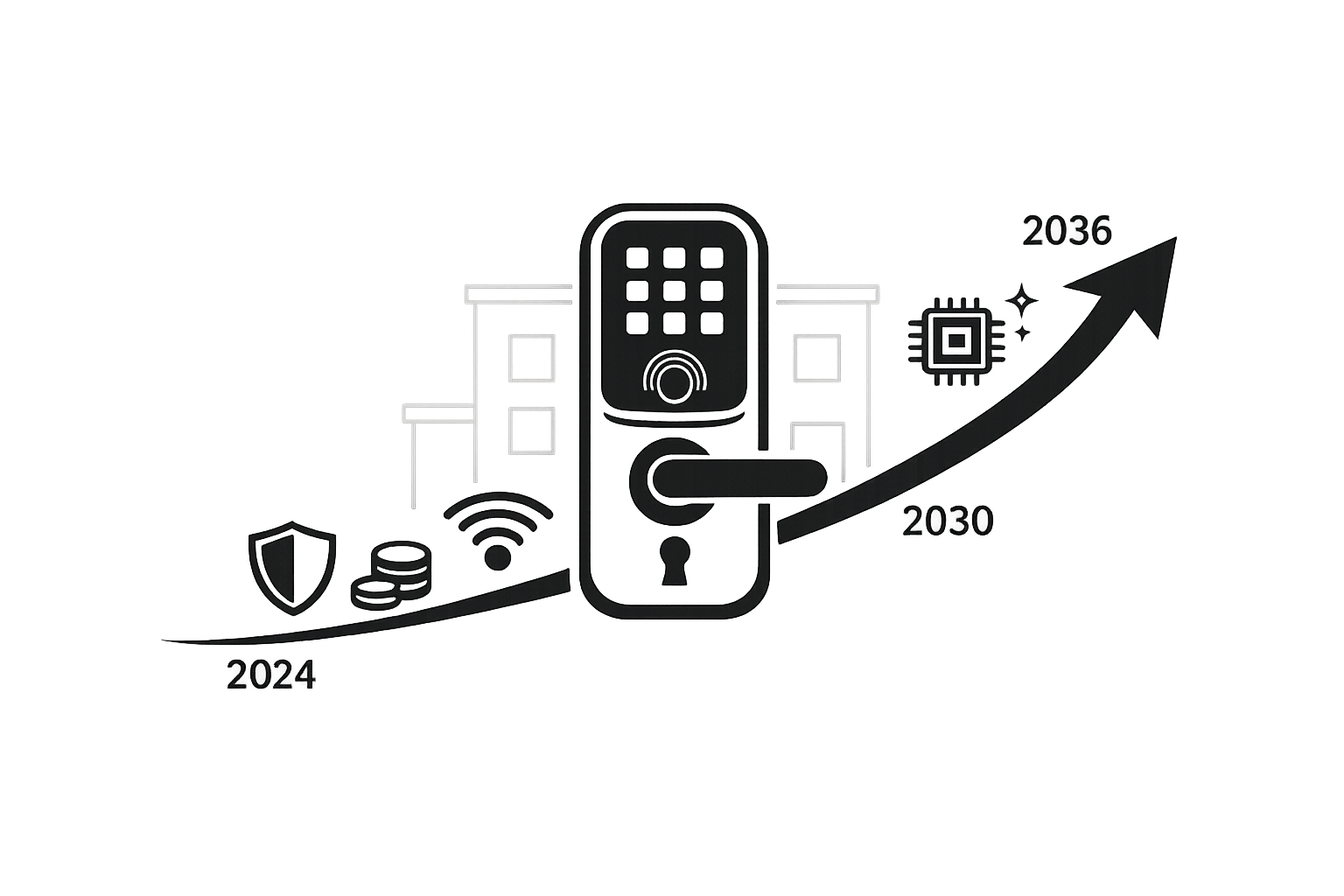
- The global smart lock market is projected to grow from $3.1 billion in 2026 to $8.4 billion by 2036.
These devices go beyond keyless entry, offering features like remote access, audit trails, and integration with property management software. They improve security, streamline operations, and enhance the renter experience. For short-term rentals, the best smart locks for self-service rentals simplify guest turnover and reduce labor needs, making them essential for modern property management.
Smart locks are also evolving with IoT and AI, introducing advanced features like biometric authentication, real-time access monitoring, and compatibility with platforms like Google Assistant and Apple HomeKit. Businesses adopting these technologies are saving money, improving efficiency, and meeting growing renter expectations.
Smart Lock Market Trends
Market Size and Growth Forecasts
The smart lock market is seeing impressive growth, particularly within the rental sector. By 2024, the global short-term rental smart lock market reached $1.82 billion, with projections showing it could climb to $6.43 billion by 2033, reflecting a 15.7% CAGR [2]. This growth rate surpasses the overall smart lock market, which is expected to expand from $3.1 billion in 2026 to $8.4 billion by 2036, growing at a 10.5% CAGR [1][7].
In 2024, North America led the short-term rental smart lock market with a valuation near $650 million [2]. Meanwhile, the Asia-Pacific region, particularly China, is emerging as the fastest-growing market, with China forecasted to grow at a 13.8% CAGR between 2025 and 2035 [4]. Residential applications, including short-term rentals, multi-family housing, and property management, account for about 71% of the total demand for smart locks [4][7].
This growth is being fueled by the professionalization of the sharing economy. What was once a luxury feature has become essential for rental businesses managing frequent guest turnovers and multiple properties [1][2]. The numbers suggest a strong foundation for advancements in IoT and AI technologies within the industry.
IoT and AI Integration in Smart Locks
The digital transformation in rental operations is driving the evolution of smart locks. They’re no longer just digital deadbolts; they’re becoming advanced IoT devices. Many now integrate with platforms like Apple HomeKit, Google Assistant, and Amazon Alexa, turning doors into real-time access monitors. With AI-powered behavioral analytics, these systems can identify unusual entry patterns and enhance security with context-aware features [1][8].
Biometric authentication, such as fingerprint and facial recognition, is the fastest-growing segment. It offers seamless entry while eliminating risks like lost keys or stolen passcodes [1].
"We are seeing a pivot where the physical lock is just the gateway to a recurring service model. The real opportunity for investors lies in the integration of smart locks with insurance providers and delivery services, creating a 'closed-loop' ecosystem of trust that simplifies modern life." - Senior Market Analyst, Fact.MR [1]
The industry is also moving toward the Matter protocol, which ensures compatibility across devices. This simplifies integration with existing property management systems, a critical need for rental businesses [7]. Additionally, many manufacturers now offer subscription-based services, providing features like cloud storage for access logs, real-time alerts, and remote monitoring of device health [8].
Smart Lock Adoption in Rental Businesses
With these market trends and tech advancements, rental operators are increasingly adopting smart locks to improve efficiency and enhance guest experiences. Currently, Bluetooth-enabled locks dominate with a 52% market share, valued for their energy efficiency and smartphone compatibility. Meanwhile, Wi-Fi-enabled locks are gaining popularity, especially among businesses managing multiple properties [4][7].
The annual adoption rate for smart locks is projected to grow by 20%, far outpacing traditional lock systems [9]. This surge is largely driven by the demand for contactless check-in, which became essential during the pandemic and remains a standard in the hospitality and rental industries [1][2].
In early 2025, Onity, Inc. (a Honeywell company) partnered with Tenant, Inc. to enhance efficiency in the self-storage sector. Their collaboration allows Onity’s Passport smart locks to integrate with Tenant’s property management software, enabling mobile credential distribution directly to tenants [10]. Shortly after, Salto Systems introduced the XS4 One S Keypad, which supports PIN codes, smart keycards, and mobile access through BLUENet Wireless technology for real-time access management [10].
For rental businesses in areas like trailer hire, equipment rentals, and vehicle sharing, smart locks provide a reliable way to track usage and access history, streamlining operations [2].
sbb-itb-eb44693
How Smart Locks Benefit Rental Operations
Better Security and Access Management
Smart locks take the guesswork out of managing keys and securing properties. By generating unique, time-limited PIN codes for each guest, property managers can ensure that access is restricted to the duration of a guest's stay. For example, a guest checking out on Friday won't be able to use the same code to return the following week [11][8].
These locks also offer remote control features like locking and unlocking from anywhere and sending real-time notifications about who enters and exits [11][2]. Many models are equipped with tamper alarms, automatic locking, and bank-level encryption to protect against hacking. A standout example is the Schlage Encode, which boasts a Grade 1 security rating - the highest for residential locks according to the American National Standards Institute [11].
Smart locks can also integrate with booking platforms like Airbnb or VRBO, automating the generation of access codes as soon as a reservation is confirmed. This eliminates manual steps, making guest transitions smoother. Maintenance and cleaning crews also benefit with their own trackable codes, allowing property managers to monitor access and streamline operations [11][2].
These features not only improve security but also simplify access management, creating a seamless experience for both guests and staff.
24/7 Access and Customer Convenience
In today’s world, guests expect convenience, and smart locks deliver. Over 60% of guests prefer digital check-in options, while 35.3% of hospitality professionals report that self-check-in is now a standard expectation [11].
"Guests that arrive at 10 pm or later intentionally get the same stress-free check-in experience as those that arrive at 1 pm." - Steve Furham, Hotelier [11]
This added convenience translates into measurable business benefits. For instance, 62% of short-term rental owners saw improved user ratings after installing smart locks [12]. Long-term rental properties also see a boost, with 57% of renters more likely to renew their lease when smart locks are available [5].
Some advanced models even offer passive entry technology using ultra-wideband chips in smartphones. This allows doors to unlock automatically as an authorized user approaches, eliminating the need to manually unlock the door [5].
Lower Costs and Streamlined Operations
Smart locks don’t just enhance security and convenience - they also save money. By eliminating the need for rekeying locks or replacing lost keys, property managers can significantly reduce expenses. Labor costs also drop since there’s no need for manual key handovers or on-site visits to resolve lockouts [6][11].
Maintenance teams benefit too. Instead of wasting time retrieving physical keys, they can use temporary digital codes to move between units more efficiently [6]. Remote troubleshooting further reduces the need for on-site interventions [6][11].
Renters are often willing to pay more for properties equipped with smart home features. 65% of renters are open to paying extra for smart technology, with 52% willing to pay over $20 more per month [5]. Millennials, in particular, are ready to spend about 20% more for properties with smart features [11]. Additionally, 77% of renters say they’d consider signing a two-year lease or longer if smart security devices were included [5]. This helps property managers reduce turnover costs and keep units occupied for longer periods.
How Can Smart Locks And Cameras Benefit Airbnb And Rental Property Owners?
Connecting Smart Locks with Rental Management Software
Smart locks shine when paired with rental management software, turning standalone devices into a fully integrated system. This combination aligns perfectly with today's market needs: touch-free operations, round-the-clock access, and the ability to scale efficiently across multiple rental sites.
How Lockii Integrates with Smart Lock Systems
When smart locks and rental management software work together, they create a smoother, more automated rental experience. Lockii, for instance, connects directly with IglooHome smart locks to simplify the entire rental process. It generates unique access codes immediately after a booking is made, verifies the renter's identity before pickup, and even tracks GPS locations during the rental period.
This system completely removes the need for physical key handovers. Lockii automatically sends time-sensitive PIN codes to customers as soon as they book through its widget. These codes, delivered via automated notifications, allow customers to collect their rental items anytime - no staff required. On top of that, Lockii integrates with Stripe for secure payment processing and uses Zapier to trigger custom workflows, creating a automated rental operation.
For example, in 2025, Invitation Homes reported a 60% drop in locksmith expenses after implementing smartphone-controlled locks across their 750,000 rental properties and integrating property management software to automate re-keying [13]. This same approach benefits equipment and vehicle rentals by speeding up turnaround times and lowering operational costs. Beyond convenience, automation also strengthens security and supports business growth.
Managing Multiple Locations with Smart Locks
The advantages of integration extend even further when managing multiple locations. Smart lock systems let rental businesses expand across various sites without increasing staff. Lockii is designed to handle an unlimited number of locations, giving businesses the flexibility to grow while maintaining centralized control.
Each location operates independently with its own inventory and unique access codes, but everything is managed from a single dashboard. This setup also provides detailed audit logs across all sites. For instance, maintenance crews or delivery drivers can receive one-time or time-limited access codes for specific units, improving security and streamlining operations [13]. Standardized protocols like Matter further simplify multi-location management by ensuring compatibility between different hardware brands [13][14]. A notable example is Allegion's 2026 expansion of its Schlage Encode Plus line, which introduced a mortise variant for multifamily properties. This new lock supports Apple Home Key and Google Wallet while meeting UL 10C fire safety standards [13][14].
Access Tracking and Data Analytics
Smart locks integrated with management software offer more than just convenience - they provide valuable insights. Every time a lock is accessed, a digital record is created, giving operators a detailed activity log. This data is especially useful for investigating damage claims or monitoring maintenance schedules, which is crucial for high-value or specialized rentals.
Lockii takes this a step further by offering extensive audit logs for bookings and individual items, along with features for tracking maintenance and reporting damage. Its AI-powered customer support tools can also resolve common issues by analyzing access data. This means rental businesses can operate more efficiently, safeguard their assets, and manage operations without needing additional staff.
"Smart home technology is no longer a nice-to-have. It's a baseline expectation. This isn't just about gadgets; it's about giving renters more control, security, and comfort in their day-to-day lives." – Merrick Lackner, CEO, Rently [5]
What's Next for Smart Locks in Rentals
The world of smart locks is evolving rapidly, driven by emerging technologies that go far beyond simple keyless entry. AI-powered behavioral analytics are set to transform security by learning typical access patterns and identifying suspicious activity before it escalates. Meanwhile, blockchain-based authentication is on the horizon, offering tamper-proof access logs that can't be altered or erased [8]. These advancements are reshaping the role of smart locks, particularly in rental operations.
New Technologies Shaping Smart Locks
Biometric authentication is gaining traction, especially in high-security rentals. With tools like facial recognition and fingerprint scanning, there's no need for codes, delivering a seamless entry experience for users. This technology is especially popular in equipment and vehicle rentals, where security is critical [1][2]. Additionally, edge computing is enhancing smart lock performance by processing data locally rather than relying on cloud servers. This not only speeds up response times but also boosts reliability [8].
Security challenges remain a pressing concern. Cyberattacks on smart home devices surged by 124% in 2024, with households facing an average of 29 cyberattack attempts daily [3]. To address this, manufacturers are developing real-time systems that detect and respond to threats proactively. A senior market analyst at Fact.MR highlighted:
"We are seeing a pivot where the physical lock is just the gateway to a recurring service model. The real opportunity for investors lies in the integration of smart locks with insurance providers and delivery services" [1].
Smart Locks in Different Rental Sectors
Smart locks aren't just making waves in vacation rentals - they're becoming essential in equipment rentals, car and bike sharing, and trailer hire. Today, 54% of renters expect smart locks to be a standard feature, not a luxury [3]. This growing demand is pushing rental businesses across various sectors to adopt automated access systems to stay competitive.
Scaling Rental Businesses with Smart Locks
Smart locks are also reshaping how rental businesses scale their operations. Remote access management allows operators to grant or revoke access codes instantly, eliminating the need for physical key exchanges. Considering that rekeying costs range from $75 to $150 per lock [15], switching to digital access systems can result in significant cost savings. For businesses managing multiple locations, this technology simplifies scaling rentals to new locations by providing centralized control and detailed audit trails. For example, Lockii's integration with IglooHome smart locks demonstrates how operators can efficiently manage multiple sites while maintaining full oversight.
Conclusion
Smart locks have transformed the way rental businesses operate. By replacing traditional keys with digital access systems, property managers can sidestep the $75 to $150 rekeying costs that used to be a recurring headache. On top of that, these systems provide real-time audit trails, offering clear records of who accessed a property and when [15]. With the global smart lock market expected to grow from $3.1 billion in 2026 to $8.4 billion by 2036, it’s clear that this technology is becoming an industry standard [1].
The numbers don’t lie: 54% of renters now expect smart locks, and 65% are willing to pay extra for smart amenities [3][5]. Features like remote access, automated credentialing, and round-the-clock availability are reshaping customer expectations in everything from property management to vehicle sharing and equipment rentals.
What’s driving this shift even further is integration. Solutions like Lockii’s combine IglooHome smart locks with tools for identity verification, GPS tracking, and communication. This allows rental businesses to manage multiple locations from a single dashboard, cutting down on labor needs while maintaining complete operational control through detailed audit logs.
Looking ahead, advancements like AI-driven behavioral analytics and biometric authentication promise to elevate these systems even more [1][8]. But for now, the real advantage lies in adopting the smart lock solutions already available. Businesses using these tools are not just keeping up - they’re redefining operations, scaling efficiently, and thriving in a world where contactless, seamless experiences are no longer optional but expected.