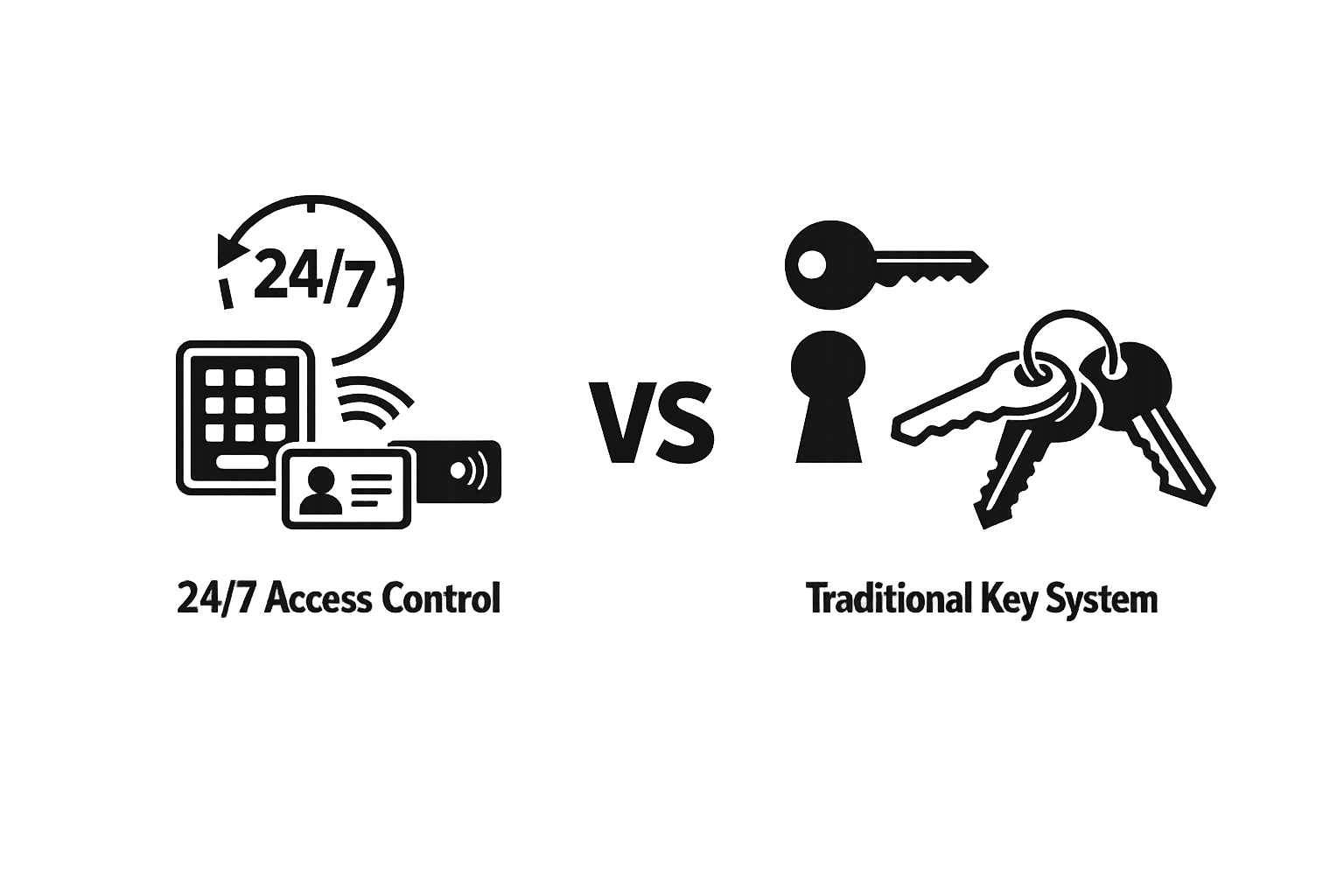
24/7 Access Control vs Traditional Key Systems
March 28, 2026 · 15 min read
24/7 Access Control vs Traditional Key Systems
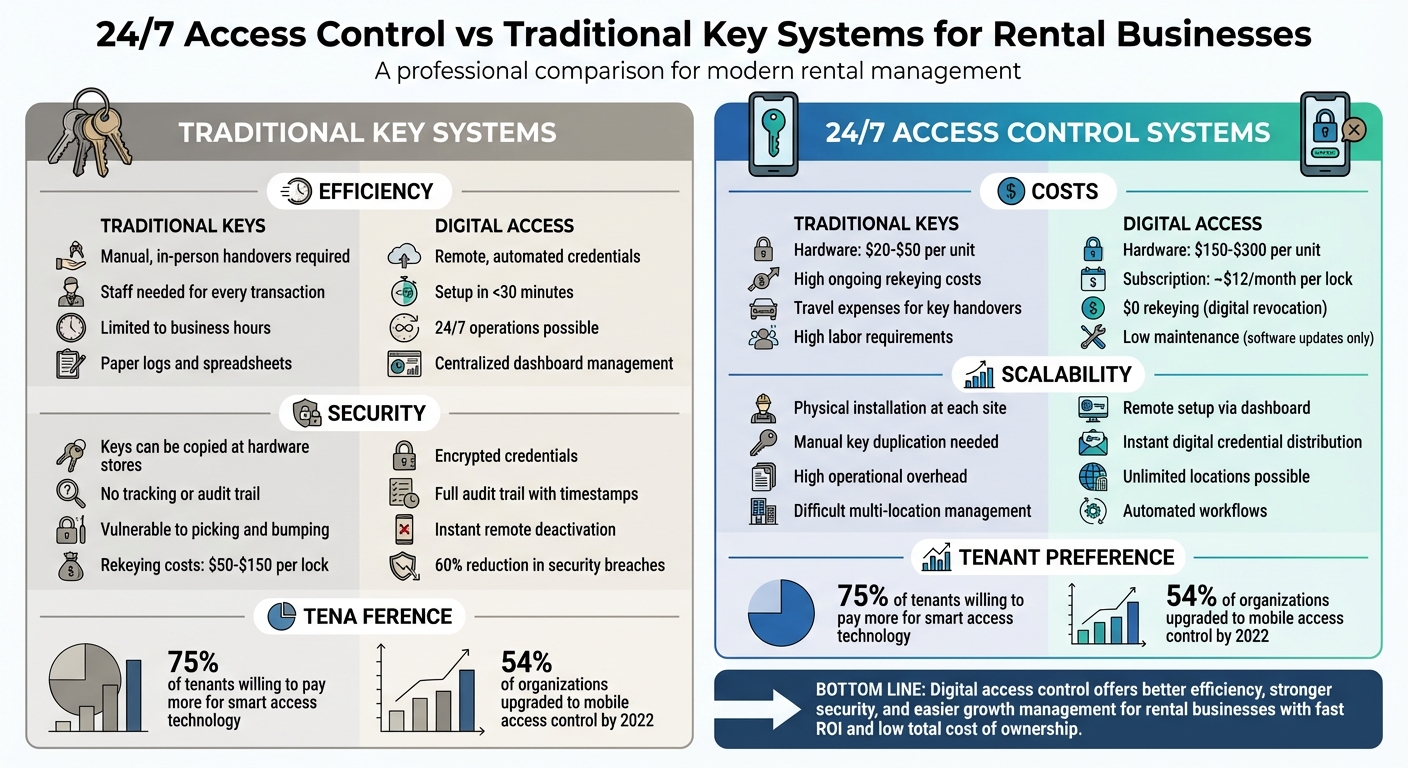
When managing rentals, choosing between 24/7 digital access control systems and mechanical key systems directly impacts efficiency, security, and growth potential. Here's the bottom line:
- Digital access systems use smart locks and software to manage entry remotely with PINs, apps, or biometrics. They save time, provide detailed access logs, and scale easily for growing businesses. Costs start at $12/month per lock.
- Mechanical key systems rely on physical keys and manual handovers. They’re simpler initially but require ongoing maintenance like rekeying ($50–$150 per lock) and lack tracking or remote management.
Key Differences:
- Efficiency: Digital systems automate tasks like access granting. Mechanical keys need in-person exchanges.
- Security: Digital systems offer instant deactivation and logs. Keys can be copied or lost.
- Scalability: Digital solutions expand easily across locations. Physical keys become harder to manage as you grow.
Quick Comparison:
| Feature | Mechanical Keys | Digital Access Control |
|---|---|---|
| Setup Time | Quick for single locks | Hardware install takes longer |
| Access Management | Manual, in-person handovers | Remote, automated credentials |
| Security | Keys can be copied; no tracking | Encrypted, logs every entry |
| Cost | Lower upfront, high ongoing | Higher upfront, lower ongoing |
| Scalability | Limited | Easy to expand remotely |
For rental businesses, digital access control systems offer better efficiency, stronger security, and easier growth management.
Smart Locks vs Traditional Locks: Which One Actually Keeps You Safer?
How 24/7 Access Control Systems Work
A 24/7 access control system replaces traditional keys with digital credentials managed through centralized software. The system relies on hardware like digital locks, keypads, and sensors, all connected using standard communication protocols [3][9]. This combination of hardware and software allows property managers to handle access remotely and efficiently.
The software acts as the command center, where managers can set access permissions, track entry and exit logs in real time, and grant or revoke access from anywhere - no need to be on-site [3]. When a booking is made, the system generates time-limited digital keys and sends them directly to users via SMS or email, eliminating the need for physical key exchanges [8].
Identity verification is built into the process, ensuring that only authorized users receive access. These digital keys are automatically deactivated when the rental period ends [3][9]. Every entry and exit is logged, creating a detailed audit trail that shows who accessed the property and when [3][5]. Managers can also monitor property usage through real-time dashboards and receive instant alerts if unauthorized access is attempted [3].
Key Features of 24/7 Access Control
One standout feature is remote permission management, which allows managers to grant temporary access to maintenance teams or customers without being physically present. This eliminates the need for on-site staff to hand over keys [3].
Another crucial aspect is real-time monitoring, which provides transparency into property usage. Instead of relying on manual check-ins or security patrols, managers can access live dashboards and receive automated alerts about activity on the property [3].
Mason Reiff, Sales Manager at iLOQ USA, highlights the benefits of smart-locking solutions, stating they deliver "a fast return on investment (ROI) and low total cost of ownership (TCO)" compared to traditional mechanical systems [9].
The contactless workflow streamlines the entire rental process. For example, a customer books online, completes automated identity verification, receives a time-limited PIN, uses the rental, and submits end-of-hire photos or forms to confirm the asset's condition [8]. Platforms like Lockii handle this process automatically, allowing customers to pick up rentals at any time without needing staff assistance [8]. At roughly $12.00 per month per locked item [8], these systems also cut costs associated with physical key management, such as travel for key exchanges and rekeying expenses [9].
Integration with payment and automation tools further simplifies tasks like booking, access management, and communication [3][8]. Before adopting such a system, it’s crucial to map out all entry and exit points - including shared areas, parking lots, and maintenance zones - to ensure full coverage [3].
How Traditional Key Systems Work
Traditional key systems function on a straightforward mechanical basis: physical keys operate mechanical lock cylinders. When a customer books a rental, the process typically involves an in-person handoff or the use of a lockbox to provide access. After the rental period ends, the key must be retrieved and stored, often in a key cabinet or safe [9][10].
This system relies heavily on manual management. Property managers usually keep track of keys using paper logs or spreadsheets, which increases the likelihood of mistakes and delays. For each new booking, staff must locate the correct key and coordinate a handoff, a process that becomes even more challenging - and costly - for businesses managing multiple properties across different locations [9].
Security measures in these systems often use lock hierarchies, like SFIC systems, which simplify rekeying slightly but still require physical effort. For example, after a tenant moves out or if a key is lost, someone must physically replace the lock cylinder. This process not only consumes time but also incurs costs for both hardware and labor [9][10].
"Mechanical key systems, once the backbone of property access control, are increasingly becoming a source of financial and operational burden for property managers", says Mason Reiff, Sales Manager Mid West at iLOQ USA [9].
These manual processes contribute to higher overall costs, making traditional systems less efficient and more cumbersome over time [9].
Limitations of Traditional Key Systems
One major drawback is the lack of digital tracking, which leaves a significant security gap. Without a way to monitor who enters a property and when, it becomes nearly impossible to assign responsibility in the event of a security breach [5][9].
Another concern is unauthorized key duplication. Physical keys can be easily copied at hardware stores without the property manager’s knowledge. This risk often goes unnoticed until a security issue arises, further highlighting the vulnerabilities of traditional systems [9][10].
"Without an excellent system, you will waste precious work hours and human labor on hunting down a key that goes missing. You could end up with wasteful spending because of rekeying costs, too", warns Gideon Leung, Product Marketing Manager at Keycafe [5].
The requirement for in-person handovers also limits scalability. Staff must be available during business hours for every check-in and check-out, making automated, staff-free rentals unfeasible without significant labor expenses. This is especially problematic for out-of-state property owners or busy managers, as it creates constant scheduling conflicts and prevents last-minute bookings outside regular hours. These operational inefficiencies not only hinder scalability but also compromise security, emphasizing the need for more modern solutions [10].
Efficiency Comparison: 24/7 Access Control vs Traditional Keys
Traditional key systems rely heavily on manual processes, like handling physical keys and maintaining paper logs. For every rental transaction, a staff member usually needs to be present, which can create scheduling challenges and restrict operations to standard business hours.
Digital access systems, on the other hand, offer a level of flexibility that traditional methods simply can't match. With these systems, administrators can remotely issue and manage time-limited credentials. A great example comes from Studio 413 in Collierville, Tennessee, where a digital solution was set up in less than 30 minutes to manage access for over 3,500 users in 2025[11].
One of the standout features of digital systems is their ability to automate tasks like activating and deactivating credentials on a schedule. This automation eliminates the need for staff to intervene directly, streamlining operations[2].
"With smart access control, no one needs to be on site to manage keys. That means you can provide after-hours tours and vendor access without adding to your headcount." – Kathryn Casna, Author at SmartRent [4].
To better understand the operational differences, here's a side-by-side comparison of how traditional key systems and 24/7 access control systems perform:
Efficiency Comparison Table
| Efficiency Metric | Traditional Key Systems | 24/7 Access Control Systems |
|---|---|---|
| Setup Time | Quick for single locks; slow for master key systems | Initial hardware install takes time; software setup is fast (<30 mins)[11] |
| Access Flexibility | Limited; requires physical key duplication | Highly flexible; remote issuance of time-bound digital credentials[11] |
| Operational Automation | None; manual locking/unlocking required | Fully automated scheduling, self-service entry, and remote control[11] |
| Staff Requirements | High; staff needed for key handovers and maintenance | Low; centralized management with self-service options[1] |
| Management Effort | High; manual key tracking and frequent rekeying | Low; centralized dashboard for streamlined user and location management[1] |
These metrics make it clear why digital access systems are transforming rental operations. By eliminating the need for manual key handling and solving labour shortages by reducing on-site staffing requirements, solutions like Lockii are redefining efficiency in the rental industry. This shift is essential for scaling rental businesses with contactless models that prioritize growth and customer convenience.
Security Comparison: 24/7 Access Control vs Traditional Keys
Securing rental assets requires more than just a lock and key. When it comes to protecting your property, traditional keys often fall short.
Traditional key systems come with inherent vulnerabilities. Physical keys can be easily duplicated, creating a constant security risk [7] [11]. If a key is lost or stolen, the only solution is to rekey or replace the entire lock - a process that’s both expensive and time-consuming [1] [11] [4]. Moreover, traditional locks are susceptible to tampering methods like lock picking and bumping [1] [11].
Another major drawback is the lack of accountability. With traditional keys, there’s no way to track who accessed your property, when they did it, or whether a duplicate key was used without authorization. As Joseph Ferdinando, Founder of Building Security Services, puts it:
Modern digital systems, on the other hand, tackle these issues head-on.
Digital access control systems significantly reduce risks with features like encrypted credentials, instant deactivation, and comprehensive audit trails [12] [14]. If a mobile credential is compromised, it can be disabled with a single click [13]. Every access attempt is logged with a timestamp and user identity, making it easy to investigate any security incidents [12] [14]. This matters because over 60% of security breaches stem from unauthorized access [14].
Advanced systems also incorporate multi-factor authentication and biometric verification [12] [14]. For rental businesses managing multiple locations, these tools provide an essential layer of security and help automate rental business operations. Solutions like Lockii offer full traceability of access events - something traditional keys simply can’t deliver.
Security Comparison Table
| Security Metric | Traditional Key Systems | 24/7 Access Control Systems |
|---|---|---|
| Unauthorized Access Risk | High (picking, bumping, duplication) [1] [11] | Low (encrypted credentials, biometrics) [12] [13] |
| Usage Tracking | None (no audit trail) [1] [11] | Full (real-time event logs) [12] [14] |
| Access Revocation | Slow (requires rekeying/lock change) [1] [4] | Instant (remote deactivation) [12] [13] |
| Fraud Prevention | Low (no identity verification) [7] | High (visual/digital authentication) [12] [14] |
| Credential Cost | High (ongoing rekeying/replacement) [11] | Low (digital keys/reusable credentials) [13] |
Scalability for Growing Rental Businesses
Expanding a rental business comes with its challenges, but managing keys shouldn't be one of them. This is where the scalability of 24/7 access control systems becomes a game-changer. Unlike traditional systems, which rely on physical keys and on-site processes, digital solutions simplify operations, making growth more efficient. As Mason Reiff, Sales Manager Mid West at iLOQ USA, points out, the travel expenses tied to key handovers can quickly eat into profits [9].
A 2019 survey revealed that 54% of organizations had already upgraded or planned to upgrade to mobile access control within three years [15]. This trend isn’t just about adopting the latest technology - it’s a strategic move to stay competitive in a fast-paced market.
Digital systems, particularly cloud-based ones, revolutionize scalability. They allow new rental locations to be added remotely through a central dashboard. Features like automated SMS delivery, GPS tracking for multi-location rentals, and maintenance logs further enhance efficiency. For instance, when a customer books during off-hours, they can instantly receive a time-limited PIN code via SMS, eliminating the need for staff to travel or manually hand over keys.
For rental businesses, this means unmatched flexibility. Platforms like Lockii are specifically designed for multi-location operations, offering perks such as unlimited locations and lock codes with straightforward per-item pricing. What does this mean in practice? You can set up a new trailer rental location in just a few hours - no need for extra staff or costly office space.
Scalability Comparison Table
| Feature | Traditional Key Systems | 24/7 Access Control Systems |
|---|---|---|
| Expansion Ease | Limited; requires physical lock installations and manual key duplication for each site. | Seamless; new locations are added remotely via a central dashboard. |
| Scaling Costs | Lower initial costs but high ongoing expenses for rekeying and physical management. | Higher upfront costs for hardware/licenses but significantly lower long-term labor costs. |
| Operational Overhead | High; involves manual tracking, key handovers, and travel. | Low; automated workflows and remote management reduce strain on operations. |
| User Management | Slow; key exchanges require in-person meetings. | Instant; digital credentials are sent directly to smartphones or via codes. |
| Maintenance Needs | Recurring costs for locksmith services, rekeying, and cylinder replacements. | Minimal; software updates and occasional battery checks - or battery-free options - suffice. |
These features highlight how scalable solutions can simplify growth, paving the way for a closer look at cost and implementation factors.
Cost and Implementation Considerations
When weighing the costs of traditional locks versus smart access control systems, the financial differences are clear. Traditional lock hardware ranges from $20 to $50 per unit, while smart locks cost significantly more, between $150 and $300 per unit [16]. However, initial affordability can be deceptive, as traditional systems often come with hidden expenses. For instance, every lost key or tenant turnover necessitates rekeying, which can cost $50 to $150 per lock [16].
Access control systems, on the other hand, mitigate these ongoing costs. While the upfront investment is higher, the long-term savings are notable. Lost credentials can be deactivated digitally at no additional cost, eliminating the need for physical rekeying. Maintenance is minimal, typically limited to software updates or occasional battery checks. Some systems even offer battery-free options, further reducing upkeep. As ButterflyMX highlights:
"Traditional keys are budget-friendly at the start, but keyless entry provides a stronger return on investment. By reducing operational costs, boosting resident satisfaction, and supporting higher rents, keyless systems often pay for themselves within a few years" [16].
Beyond cost, implementation timelines also vary significantly. Traditional systems require simple locksmith services and minimal technical expertise, making them quick to install, whereas modern managers often use a contactless rental process planner to streamline digital setups. In contrast, access control systems demand professional installation, system configuration, and brief staff training. Despite this, the process can be surprisingly efficient. For example, in February 2025, Studio 413 in Collierville, Tennessee, transitioned to Gallagher Security's app-based system in under 30 minutes. This upgrade enabled co-owners Maggie Rosamond and Kim McCarter to manage access for 14 faculty members and over 3,500 students remotely through a mobile app [6].
Cost Comparison Table
| Cost Factor | Traditional Key Systems | 24/7 Access Control Systems |
|---|---|---|
| Hardware (per unit) | $20–$50 | $150–$300 |
| Software/Licenses | None required | Subscription fees (e.g., $12/month per lock with Lockii) |
| Installation Labor | Low; basic locksmith work | Higher; professional setup needed |
| Rekeying Event | $50–$150 per lock | $0 (digital revocation) |
| Ongoing Maintenance | High (key replacement, repairs) | Low (software updates, battery checks) |
| Labor Requirements | High (manual key management) | Low (remote automated management) |
| Security Breach Cost | Full rekeying required | Instant digital credential revocation |
While traditional systems may seem cost-effective at first glance, the long-term savings and operational efficiencies of access control systems make them a compelling choice for scalable, franchisable rental businesses and property managers.
Why 24/7 Access Control Works Better for Rental Businesses
For rental businesses juggling multiple assets, implementing 24/7 access control systems offers three standout benefits over traditional keys: streamlined operations, stronger security, and effortless scalability.
The operational advantages are hard to ignore. With these systems, property managers can grant, modify, or revoke access remotely in real time. This eliminates the need for physical key handovers and simplifies after-hours requests, saving both time and hassle [17][18]. As Zach Grimes points out:
"Keyless entry systems can enhance the guest experience by offering a safe and convenient way to access the property. In fact, many guests expect contactless arrival and entry, and even look for it when booking" [18].
Security is another area where digital access control systems outshine traditional keys. Unlike mechanical keys, digital credentials can't be duplicated [17]. If a credential is lost, it can be deactivated instantly, avoiding the expense and inconvenience of rekeying [17]. Plus, real-time audit trails allow managers to track exactly who accessed a property and when, providing a clear and reliable record [17].
Finally, scalability is where these systems truly shine. Centralized dashboards make it easy to manage multiple locations remotely, without the need to hire additional staff or deal with the complexities of physical keys. Take Lockii, for example - a platform designed specifically for contactless rental operations. It supports features like digital lock integration (e.g., IglooHome), automated email and SMS updates, securing contactless rentals with identity verification, and even GPS tracking. At just $12 per month per locked item, Lockii eliminates labor costs and logistical headaches while enabling businesses to expand into new markets without missing a beat.
Conclusion
When comparing traditional keys to 24/7 access control systems, the benefits of digital solutions become pretty hard to ignore. These systems cut out the hassle of managing physical keys, offer real-time tracking of property access, and can easily expand as your rental business grows.
Here’s an eye-opener: 75% of tenants are willing to pay more for smart home technology, like smart locks[3]. This means investing in access control not only meets tenant expectations but also streamlines your operations. For rental businesses juggling multiple properties, the ability to manage everything from a single cloud-based dashboard is a game-changer. No more hiring extra staff or dealing with the headaches of distributing physical keys[11].
As Kathryn Casna from SmartRent puts it:
"Smart access control is often one of the first proptech investments owners make because it lays the groundwork for so many others, like Self-Guided Tours, Work Maintenance and centralization." [4]
It’s clear that access control systems are more than just a convenience - they’re a smart move for modern rental operations.