Biometric ID Verification for Rentals
April 17, 2026 · 9 min read
Biometric ID Verification for Rentals
Fraud in the rental industry is on the rise, with synthetic identity fraud expected to make up nearly 40% of digital booking fraud losses in hospitality by 2026. Traditional ID checks are no longer enough to combat these threats. Biometric ID verification offers a safer, faster, and more reliable solution by ensuring the person booking matches their government-issued ID through live biometric scans.
Key Takeaways:
- How It Works: Combines government-issued ID checks with live biometric scans (e.g., facial recognition, liveness detection).
- Why It’s Needed: Stops fraud, blocks fake identities, and reduces chargeback disputes (85% success rate vs. the industry average of <20%).
- Business Benefits: Enables secure, contactless rentals with 24/7 access; reduces manual labor; speeds up verification to seconds instead of days.
- Customer Experience: Streamlined process with fewer delays, better security, and no need for in-person checks.
- Compliance: Adheres to state laws on biometric data collection, including consent and retention rules.
Biometric verification not only protects rental businesses but also improves efficiency and customer satisfaction. For fraudsters, it’s a roadblock they can’t bypass. Platforms like Lockii integrate this technology with ease, making it the go-to solution for modern rental operations.
Benefits of Biometric ID Verification
Fraud Prevention and Security
Biometric systems excel at spotting fraud where manual checks often fall short. One key feature is liveness detection, which requires users to perform actions like blinking or turning their heads during a 3D facial scan. This process helps block AI-generated deepfakes and bots that might otherwise bypass traditional systems using static photo uploads. By 2026, AI-generated deepfakes are expected to bypass older static verification systems in 68% of fraudulent short-term rental booking attempts [3].
Another layer of security comes from forensic document analysis. Automated systems analyze government-issued IDs down to the pixel level, identifying subtle manipulations or synthetic identities that human reviewers might miss [1][3]. In cases of disputes, these systems generate a digital evidence package - complete with verified ID and biometric match data - that can be used in chargeback disputes or legal proceedings. While the security benefits are clear, biometric verification also significantly improves the customer experience.
Better Customer Experience
Biometric verification doesn’t just make things safer - it makes them smoother, too. Guests can complete the process online days before their rental starts, avoiding last-minute approvals or in-person checks [3]. The system works hand-in-hand with smart locks, activating physical access codes only after successful verification, which means true 24/7 contactless check-ins are possible [3]. Real-time liveness checks via smartphone cameras further eliminate delays caused by manual reviews [3]. For genuine customers, this means faster access and a hassle-free experience, while fraudsters are kept out. This streamlined process also helps businesses operate more efficiently by cutting down on processing times and reducing staff workloads.
Increased Efficiency
Automation is a game-changer for rental businesses managing identity verification. Traditional methods can take 2–3 business days [2], but biometric systems handle this in real time. For example, in June 2025, Credas managed 35,000 daily compliance checks, covering over half of the residential property transactions in the UK [5].
"Digital ID verification effectively detects fraud while enhancing the experience for legitimate customers." – Tim Barnett, CEO, Credas [5]
For businesses with multiple locations, this efficiency is even more critical. Platforms like Lockii incorporate biometric verification into self-service workflows, allowing customers to confirm their identity remotely before accessing equipment or properties at any location. Unlike physical keys or passwords, biometric traits can’t be lost or forgotten, saving businesses time and effort on reissuing access credentials [4]. This streamlined system not only reduces labor demands but also simplifies scaling operations with contactless models without needing to hire more staff.
sbb-itb-eb44693
Enhanced ID Verification Tutorial with SingleKey
How to Implement Biometric ID Verification in Rentals
Step 1: Collect Government-Issued IDs
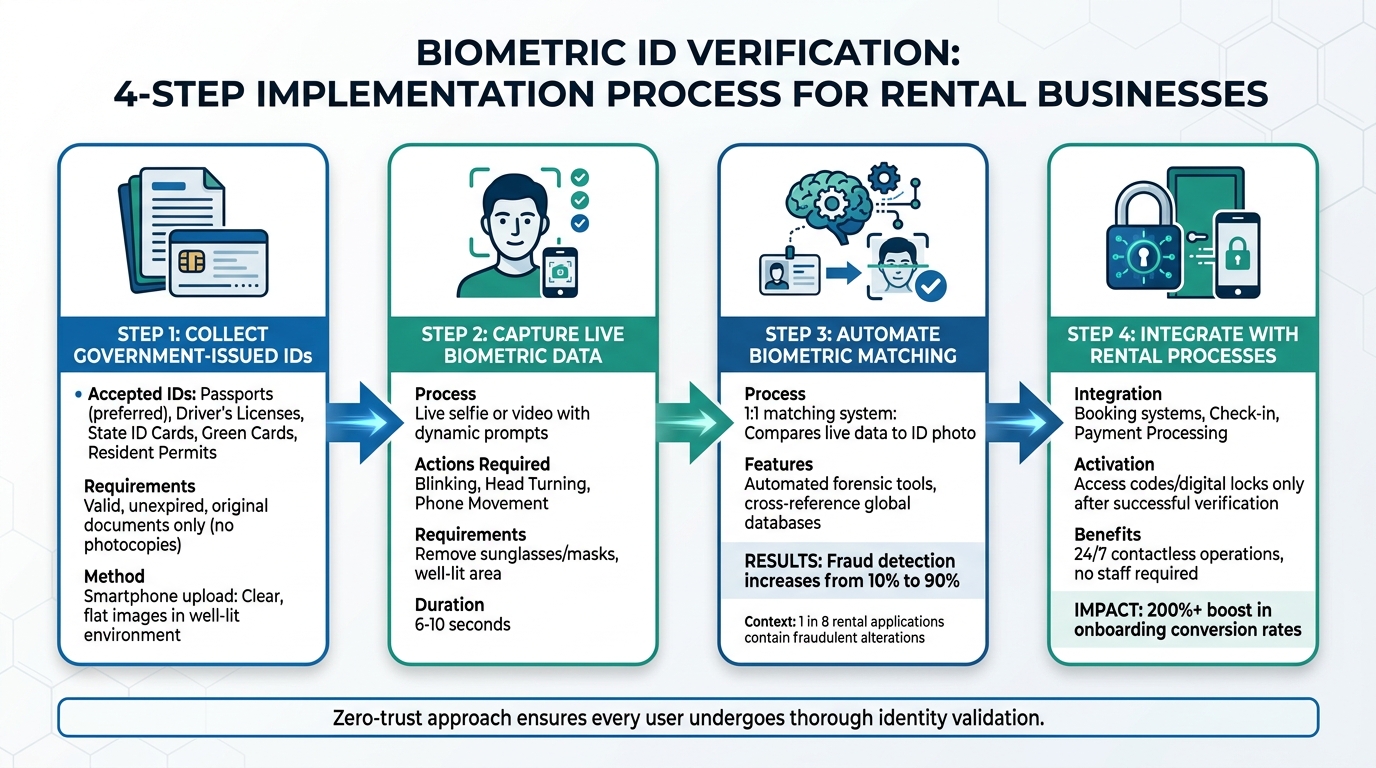
Start by gathering a valid, unexpired government-issued ID through a secure digital platform. Commonly accepted forms of identification include passports (often preferred), driver's licenses, state-issued ID cards, green cards, and resident permits. Ensure the system is set to reject photocopies or pictures of IDs - only original, unexpired documents should be accepted.
Encourage renters to use their smartphones to take clear, flat images of their IDs in a well-lit environment, avoiding glare. Once the ID is successfully uploaded, move on to verifying the renter's identity with live biometric data.
Step 2: Capture Live Biometric Data
After collecting the ID, request a live selfie or video from the renter. To confirm the person is physically present and prevent spoofing attempts, include dynamic prompts like blinking, turning their head, or moving their phone. Provide renters with clear instructions: they should remove sunglasses, masks, or bulky accessories, and choose a well-lit area to ensure accurate biometric mapping. The entire process typically takes just 6–10 seconds [6].
Step 3: Automate Biometric Matching
The next step is to verify the live biometric data against the photo on the submitted ID using a 1:1 matching system. This ensures the person submitting the ID is the same as the individual in the live capture. The system should also include automated forensic tools to detect even minor alterations to the ID. Additionally, cross-reference the name, date of birth, and ID number against global databases to confirm the document's authenticity. This method has been shown to increase fraud detection rates significantly, from 10% to 90% [6]. With one in eight rental applications found to contain fraudulent alterations [7], this step is critical for maintaining security. Once the match is verified, integrate the results into your rental workflow.
Step 4: Integrate with Rental Processes
Finally, embed biometric verification into your booking and check-in systems. Services like Lockii allow identity verification to be seamlessly incorporated into self-service operations. Renters can confirm their identity remotely, and access codes or smart locks are only activated after successful verification. This integration can also sync with payment processing, GPS tracking, and automated communications, supporting 24/7 contactless operations without requiring staff involvement. By adopting this zero-trust, fully automated approach, you ensure every user undergoes thorough identity validation. Additionally, automated identity verification has been shown to boost onboarding conversion rates by over 200% in some markets [6].
Best Practices and Compliance for Biometric Verification
Data Security and Privacy
When it comes to biometric verification, on-device processing is a smart way to enhance security. By handling identity data locally, you reduce the need for network transmission, which in turn lowers the risk of breaches. Another key step is data minimization - only collect the identity attributes you absolutely need.
Automating rental business operations, including retention and deletion policies, is equally important. Set clear rules for how long data will be stored and ensure it’s deleted promptly when no longer needed. Access to biometric records should be tightly restricted to authorized personnel, and comprehensive audit logs should be maintained to track who accesses the data. Combining these practices with multi-layered verification methods - like document checks, liveness detection, and real-time corroboration - offers a more secure approach than relying solely on document verification. Once these data controls are in place, the next step is ensuring compliance with local laws.
Compliance with Local Laws
Biometric verification isn’t just about preventing fraud - it’s also about staying on the right side of the law. Biometric regulations vary widely across the United States, and failing to comply can result in hefty fines. For instance, Illinois’s Biometric Information Privacy Act (BIPA) allows individuals to file lawsuits directly, with penalties of $1,000 per negligent violation and $5,000 for intentional violations [8][9]. Similarly, Texas’s Capture or Use of Biometric Identifier Act (CUBI) enforces civil penalties of up to $25,000 per violation, handled by the Attorney General [8][9].
Many states require written notice and informed consent before collecting biometric data. In New York City, businesses must post clear signage near customer entrances [8][9]. Virginia, on the other hand, classifies biometrics as "sensitive personal data", requiring explicit opt-in consent [9]. Retention timelines also differ: Illinois mandates deletion within three years of the last interaction, while Texas requires deletion one year after the data’s original purpose is fulfilled [8][9]. And remember, selling, leasing, or trading biometric data is strictly forbidden in Illinois, New York City, Texas, and Washington [8][9][10].
The financial stakes are high. A $1.4 billion settlement in July 2024 serves as a stark reminder of the risks tied to non-compliance [9].
Clear Customer Communication
Technical safeguards and legal compliance are essential, but so is transparent communication with renters. Let renters know upfront - ideally during booking - that biometric screening is part of the process. Explain that it’s used to combat synthetic identity fraud, which is projected to account for nearly 40% of digital booking fraud losses in the hospitality industry by 2026 [1]. Describe the process clearly, including the need for real-time actions like blinking or turning their head to confirm their identity and distinguish themselves from AI-generated deepfakes.
Position verification as a shared security measure that protects both your business and the renter. Make it clear that access codes or digital locks won’t activate until the verification is complete. Inform customers that a digital evidence package - containing the verified ID and biometric match data - will be created for dispute resolution purposes. This evidence is powerful: rental operators who use biometric evidence win over 85% of chargeback disputes, compared to an industry average of less than 20% [1].
Finally, avoid hiding biometric terms in lengthy rental agreements. Instead, use standalone consent forms to ensure renters are fully aware of and agree to the process [9].
Conclusion
Biometric ID verification is changing the game for rental businesses, offering a smarter way to safeguard operations while improving customer service. Features like liveness detection - requiring actions such as blinking or head movements - are key to stopping synthetic identities and AI-generated deepfakes, which static photo uploads can't detect. With synthetic identity fraud expected to account for nearly 40% of digital booking fraud losses in the hospitality sector by 2026 [1], relying on manual ID checks is no longer a viable option.
The operational perks are just as striking. Automated biometric systems eliminate the need for time-consuming visual inspections by using forensic document analysis. These systems can also integrate with access control, ensuring that digital codes are only issued to verified guests. This process creates a secure digital evidence package - complete with verified ID, biometric data, and signed agreements - leading to over 85% success in chargeback disputes, compared to the industry average of less than 20% [1]. Beyond improving dispute resolution, these advancements also make the rental process smoother and more efficient for customers.
For legitimate customers, the process is quick and hassle-free. Biometrics do away with the need for passwords, enabling verification in just seconds. On the flip side, fraudsters hit a nearly impenetrable wall, unable to exploit stolen credentials or fake documents.
Lockii (https://lockii.app) takes this a step further by automating the entire process as part of its automated trailer rental business platform. With built-in identity verification, automated access control using digital locks, and 24/7 contactless operations, Lockii ensures only verified customers can access rentals - no on-site staff required. By integrating with tools like IglooHome and Stripe, Lockii streamlines identity verification, creates secure audit trails, and releases access codes only after successful verification.
The message is clear: adopting biometric verification isn't just an upgrade - it's a necessity. This technology not only protects against evolving fraud tactics but also delivers measurable returns and a better experience for your customers.