
Identity Verification for Contactless Rentals: Guide
February 24, 2026 · 9 min read
Identity Verification for Contactless Rentals: Guide
Contactless rentals are booming, offering convenience and 24/7 access for customers. But how do businesses ensure security while embracing self-service models? The answer lies in robust identity verification systems.
Key Takeaways:
- Contactless rentals eliminate the need for face-to-face interactions, but they increase the risk of fraud, such as stolen IDs or fake credentials.
- Advanced verification methods include:
- Document-Based Checks: Analyze government-issued IDs for tampering.
- Biometric Verification: Use facial recognition to match users with their IDs.
- Real-Time Verification Tools: Combine multiple checks for instant results.
- Solutions like Lockii integrate these methods into automated systems, ensuring only verified users gain access.
Why It Matters: Strong identity verification not only prevents fraud but also builds customer trust and ensures compliance with privacy laws like GDPR and CCPA. By combining speed, security, and convenience, businesses can protect assets while delivering a smooth rental experience.
The 1st Contactless Fingerprint & Face Verification | AEROX eKYC
Identity Verification Methods for Rental Businesses
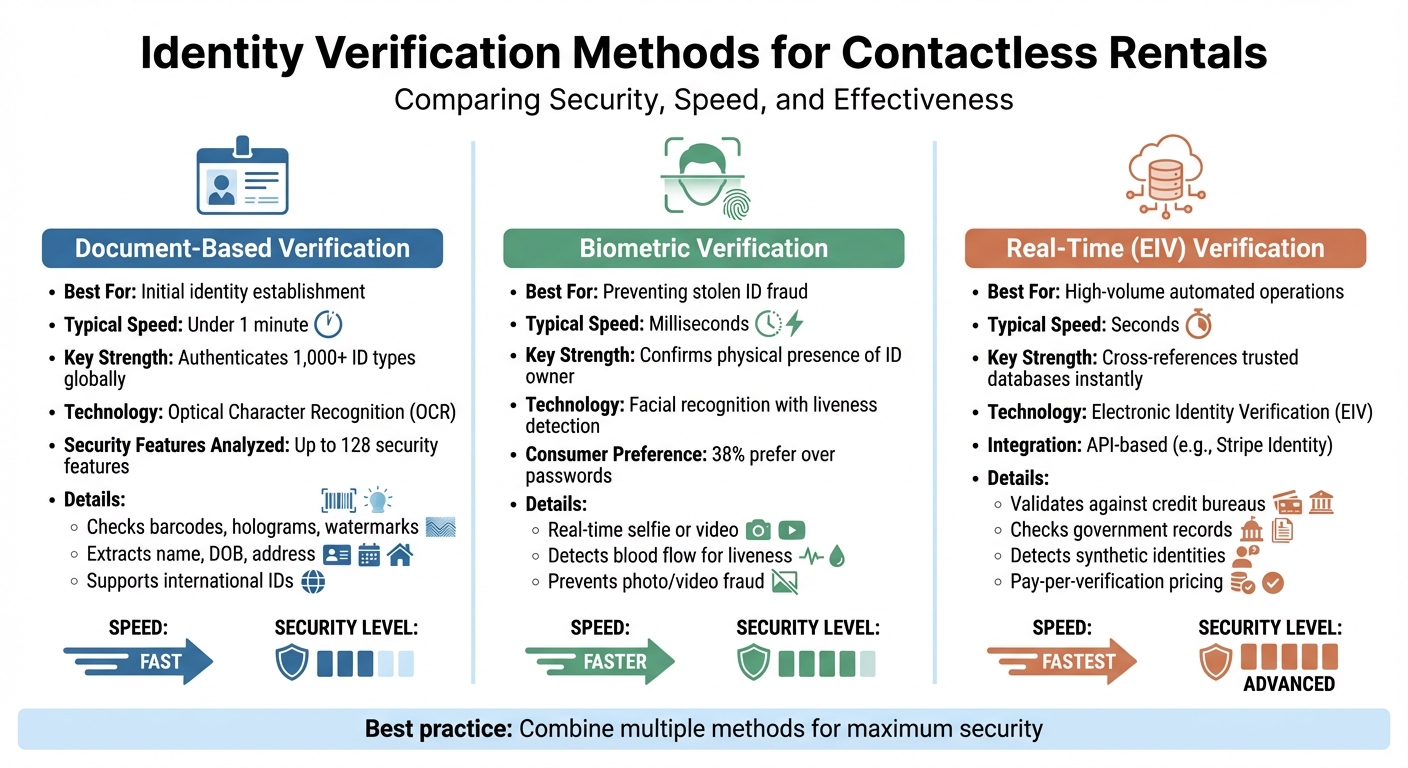
Rental businesses have several contactless methods at their disposal for verifying customer identities. Each approach varies in terms of security, speed, and convenience, making it crucial to select the right one for your needs.
Here’s a breakdown of the main methods used to ensure secure identity verification in a contactless rental setup.
Document-Based Verification
This method involves customers submitting photos of government-issued IDs, like driver’s licenses or passports. Using Optical Character Recognition (OCR), the system extracts key details such as name, date of birth, and address. It then checks for security features like barcodes, holograms, and watermarks to confirm the document’s authenticity [3][5].
Modern tools can analyze up to 128 security features on IDs, detecting forgeries with impressive precision [3]. They support over 1,000 types of government-issued IDs globally, making them a great option for businesses with international customers [3]. The process is quick, usually taking less than a minute [3].
While this method is user-friendly and easy to implement, it isn’t foolproof. Skilled fraudsters can create realistic fake IDs or tamper with genuine ones, which basic systems might overlook [2]. For this reason, many rental businesses combine document verification with other layers of security.
Biometric Verification
Biometric verification adds another layer by comparing a live user to their ID photo. The most common approach uses facial recognition technology with "liveness detection", requiring users to take a real-time selfie or short video [2][3][6].
This ensures that the person presenting the ID is its rightful owner, not someone using a stolen or borrowed document. Advanced systems even detect signs of life, like blood flow, to prevent fraudsters from using photos or pre-recorded videos [7][8]. The process is incredibly fast, often taking just milliseconds [8].
Interestingly, 38% of consumers prefer biometrics over traditional passwords for securing interactions [8]. However, some people have privacy concerns about sharing their biometric data. Clear communication about why this step is necessary and how their information will be protected can help alleviate these worries [1][3].
Biometric checks work well alongside document verification, ensuring the individual’s active participation in the process.
Real-Time Verification with Third-Party Tools
Third-party services like Stripe Identity streamline the verification process through API integration. These tools combine document analysis, biometric matching, and database cross-referencing to deliver instant "pass/fail" results [1][2][4].
These systems validate personal information - such as name, address, and Social Security Number - against trusted databases like credit bureaus and government records [2][5][6]. This Electronic Identity Verification (EIV) approach is particularly effective at catching synthetic identities or stolen credentials that might slip past simpler methods [5].
Real-time verification supports 24/7 contactless rentals without requiring manual intervention. This automation is a key strategy for solving labour shortages in the rental industry. Many providers charge per verification rather than a flat monthly fee, making this option cost-effective for businesses of all sizes [4]. Together, these methods create a scalable and secure framework for identity verification.
| Method | Best For | Typical Speed | Key Strength |
|---|---|---|---|
| Document-Based | Initial identity establishment | Under 1 minute [3] | Authenticates 1,000+ ID types globally [3] |
| Biometric | Preventing stolen ID fraud | Milliseconds [8] | Confirms physical presence of ID owner |
| Real-Time (EIV) | High-volume automated operations | Seconds [2][3] | Cross-references trusted databases instantly |
How Lockii Handles Identity Verification
Automated Identity Verification in Lockii
Lockii has streamlined identity verification by embedding it directly into its automated booking process, leveraging Stripe Identity as a post-checkout step. This approach ensures bookings are completed smoothly while confirming identities before rentals are picked up.
Here’s how it works: After completing a booking through Lockii's widget, customers are prompted to upload an ID and take a selfie. These are validated in real time using trusted, PCI-certified third-party services. The system verifies government-issued IDs - like passports and driver's licenses - alongside biometric facial recognition checks. Importantly, sensitive data isn’t stored by Lockii; instead, it’s securely managed by these certified providers.
What makes Lockii stand out is how it ties identity verification directly to access control. Smart lock codes are only generated and sent via email or SMS once a customer successfully passes the identity check. This creates a secure, fully automated system that prevents unverified users from accessing rentals, even in a 24/7 operation. Lockii reports that 95% of its bookings are fully automated [9].
Combining Verification with Contactless Features
Lockii doesn’t stop at identity checks - it integrates verification into every stage of the rental process. From booking to return, each step is designed to ensure security and convenience. When customers book through Lockii’s website widget, the system sequentially handles identity, insurance, stock, and access code verifications.
Through the customer portal, renters can manage their verification status, view booking details, and retrieve unique lock codes once approved. GPS tracking activates automatically after rental pickup, and customers may also be required to complete hire-end quizzes or submit return photos with GPS confirmation. This creates a complete audit trail, ensuring accountability from start to finish.
Lockii’s integration with IglooHome digital locks and Zapier takes things further. Businesses can set up workflows based on verification status, such as sending welcome messages to verified customers or flagging incomplete verifications for follow-up. With support for unlimited locations, Lockii enables multi-site operations to maintain consistent security standards across all rental points, making it a robust solution for contactless rentals.
Case Study: Trailer Rental Security
Lockii’s verification system has proven especially effective in high-value rental scenarios, such as trailer rentals. For instance, Mario Clewlow, Owner of Hitch Haul, shared how Lockii transformed his business:
Lockii has been a game changer for our trailer rental business. We now offer fully automated, contactless rentals. It's streamlined, secure, and exactly what our business needed to jump in front of our competitors!
Trailer rentals often involve equipment worth thousands of dollars, making theft a major concern. Lockii’s combination of identity verification, insurance checks, and GPS tracking provides multiple layers of protection. Yvann Karamoko, Operator at The Trailer Co, highlighted this impact:
It's allowed us to operate fully automated, 24/7 trailer rentals and scale that side of our operation with confidence.
One standout feature for trailer rentals is Lockii’s ability to verify insurance policies directly with providers before granting access codes. This automation removes the need for manual back-and-forth, ensuring compliance and eliminating delays in the rental process.
sbb-itb-eb44693
Best Practices for Identity Verification
As contactless systems continue to grow, sticking to legal standards and operational best practices is more important than ever.
Following Legal and Data Protection Requirements
In the U.S., rental businesses must comply with data protection laws like the California Consumer Privacy Act (CCPA) when collecting identity data [2]. This includes encrypting stored identity information and clearly explaining how the data will be used, stored, and protected [2].
When selecting a verification provider, make sure they meet recognized security standards. Additionally, businesses should conduct a risk assessment for each transaction and maintain an audit trail of identity checks for a minimum of two years [10].
Always offer a manual verification option alongside digital methods. This ensures inclusivity for customers who may lack digital-ready documentation or prefer traditional methods. It also helps avoid potential discrimination claims. Ultimately, the responsibility for fairness and non-discrimination lies with the business [12]. Companies like Lockii follow these practices to ensure secure and compliant operations.
Balancing Security with Customer Convenience
Beyond meeting legal requirements, it’s crucial to strike a balance between security and ease of use. Integrating identity verification directly into the booking process can minimize friction. Automated systems, for instance, verify identities almost instantly, whereas manual checks can take up to 31 hours per month on average [12].
Using biometric facial recognition with liveness detection provides strong security without sacrificing user convenience [13]. Allow customers to complete the process on their mobile devices and offer clear, easy-to-follow instructions. To avoid delays caused by technical issues, have a backup option like manual verification in place [14].
Another way to enhance convenience is by offering reusable digital identities. This allows customers to verify their identity once and reuse it for future bookings, eliminating repetitive steps [10].
Keeping Verification Technology Current
Fraud tactics are constantly evolving, so it’s critical to keep your verification technology up to date. Modern systems should include controls to detect deep fakes and forged media - threats that have become increasingly sophisticated [11]. For example, in July 2025, NIST released updated guidelines (SP 800-63 Revision 4) to address these challenges after reviewing nearly 6,000 public comments [11].
Replacing outdated methods like Knowledge-Based Authentication with liveness detection is another key step, as personal data is now more easily accessible than ever [2][6].
Look for providers that use multiple authoritative data sources and automated document validation tools. These systems verify authenticity by checking against document type libraries and identifying tampering in real time [15]. Regularly reviewing verification metrics is also essential to track effectiveness and adapt to new fraud patterns [11]. By partnering with advanced providers - like Lockii - you can stay ahead of emerging fraud trends.
Conclusion
Key Benefits of Identity Verification
Identity verification plays a crucial role in both preventing fraud and improving operational efficiency. Advanced systems can analyze up to 128 ID points to detect tampering or alterations, offering a robust layer of security [3]. For example, some rental companies have seen a _70% drop in attempted fraud_ within just a year of adopting multi-layered verification processes [16].
Once an identity is verified - typically in under a minute [3] - these systems can immediately send access codes, reducing costs and enabling 24/7 service. This streamlined approach aligns with modern renters' preference for secure, digital verification over manual methods. Plus, by visibly prioritizing security, businesses foster greater customer trust. As this guide has shown, effective identity verification is essential for creating safe and scalable contactless operations.
These benefits are central to Lockii's philosophy for contactless rental solutions.
How Lockii Supports Contactless Rentals
Lockii leverages these advantages to provide a seamless and secure automated rental experience. Using Post Checkout Stripe Identity Verification, the platform enhances safety without compromising initial booking conversion rates [1]. Lockii is specifically designed for self-service rental models, catering to vehicles, equipment, trailers, and storage. In these industries, where safeguarding high-value assets is a top priority, robust identity verification is absolutely critical.