
AI Identity Verification for Rentals
January 19, 2026 · 13 min read
AI Identity Verification for Rentals
Rental fraud is costing businesses thousands of dollars per case. With fake applications on the rise, traditional ID checks can't keep up. AI-driven identity verification offers a faster, more accurate solution to combat fraud, reduce losses, and improve efficiency.
Key takeaways:
- Fraud detection rates are dropping: Property managers now catch only 75% of fake applications, compared to 90% previously.
- AI systems outperform manual checks: They detect 99% of high-risk applicants and process verifications in under 5 seconds.
- Financial impact: Fraudulent tenants cost $3,500–$7,000 per eviction, including lost rent, legal fees, and maintenance.
- Automation matters: AI reduces manual review workloads by 92% and enables 24/7 self-service for renters.
AI technology like Lockii integrates ID verification, biometric checks, and fraud detection into rental operations, saving time and cutting risks. It’s a practical step forward for rental businesses navigating labor shortages and rising fraud. Implementing automated systems can help solve labor shortages while maintaining high security standards.
AI and Identity Theft: Revolutionizing PropTech with Andrew Borovsky
For property managers implementing these technologies, following a checklist for securing contactless rentals ensures that identity verification is properly integrated with access control.
Identity Fraud Risks in the Rental Industry
The rental industry is facing growing challenges as traditional methods struggle to keep up with increasingly sophisticated identity fraud. Recognizing the variety of fraud types highlights the pressing need for advanced, AI-powered solutions.
Common Types of Identity Fraud
Several forms of identity fraud are particularly relevant in the rental sector:
- Fake IDs: These include counterfeit government-issued IDs, often identified by mismatched fonts, poor-quality printing, or altered photos [8].
- Stolen Identities: Fraudsters misuse real personal information, such as Social Security numbers and names, obtained through online breaches or theft [5].
- Synthetic Identity Fraud: A more advanced tactic where fraudsters combine real and fake details to create identities that can bypass database checks [2].
- AI-Generated Documents: These highly convincing forgeries are becoming a significant challenge in rental applications.
- Technical Deception: Techniques like burner phones, VOIP numbers, or presentation attacks (e.g., using a photo of a photo) are employed to bypass two-factor authentication and biometric checks [7].
The shift to digital application processes has only heightened these risks. For instance, document fraud in financial services surged by 79% between 2021 and 2022 [4]. Additionally, 85% of property managers surveyed in 2023 reported encountering applications with falsified income or employment documentation [4].
How Identity Fraud Affects Your Business
The impact of identity fraud extends far beyond identification challenges, leading to significant financial and operational setbacks.
Each fraudulent case can result in losses ranging from $3,500 to $7,000 due to lost income, legal expenses, and maintenance costs. Poor screening practices exacerbate the problem, with nearly 20% of tenants failing to pay rent on time [4].
Operational inefficiencies also take a toll. Leasing staff often spend hours investigating suspicious applications, diverting their attention from essential tasks like customer service and property management [10]. Fraudulent applications can lead to unauthorized subletting or even criminal activity, jeopardizing community safety and tarnishing a business's reputation [8]. In contactless rental operations, even a single fraudulent approval can lead to immediate financial and operational disruption.
"A property manager can expect to lose anywhere from $3,500 to $7,000 on a single eviction case." - Truework Team [4]
Recognizing these risks is the first step toward adopting robust AI-driven identity verification systems that can safeguard your business.
How AI Identity Verification Works
AI-driven identity verification ensures quick, accurate results while actively preventing fraud. By analyzing documents, verifying biometrics, and identifying suspicious activity, these systems minimize the need for manual checks.
Real-Time Document Verification
AI systems use Optical Character Recognition (OCR) to extract and validate critical details from IDs, such as font styles, print quality, and barcode data, to detect tampering or forgery [7]. They also employ presentation attack detection to confirm customers are presenting a physical document, not a screen image or photocopy. Impressively, these systems achieve 99.8% accuracy in just 2 seconds [11].
Once the document's authenticity is validated, the process moves on to biometric checks to confirm the applicant's identity.
Biometric Authentication and Liveness Detection
Facial recognition technology matches a live image of the applicant to the photo on their ID, while liveness detection ensures the person is physically present during verification [11][13].
"Our fraud levels have dropped to below 1%, which is very impressive. This is thanks to the use of Veriff's background video recording feature, which helps us understand more about what else might be going on during a customer verification." – Juan Esteban Saldarriaga, Founder and CEO, Juancho Te Presta [13]
Most genuine users - 95% to be exact - complete verification on their first attempt in as little as 6 seconds [13]. To maximize success, customers are encouraged to use mobile devices, ensure proper lighting, and remove obstructions like sunglasses or masks during the scan [12].
Machine Learning Fraud Detection
Machine learning adds another layer of protection by continuously analyzing data to identify fraudulent activity.
These systems compare document images against updated fraud patterns, generate confidence scores for each verification, and flag synthetic identities by cross-referencing applicant data with external databases [7][14]. For example, Moody's global AI Review model, trained on over 12.1 million rows of data, has significantly improved screening accuracy [14]. Businesses using such systems report a 55% drop in delinquency rates [5].
How to Set Up AI Identity Verification with Lockii
Lockii simplifies the rental process by integrating AI-powered identity verification directly into your booking system. This setup not only streamlines onboarding but also automates fraud detection, giving you full visibility into every verification attempt.
Step 1: Add Lockii's Identity Verification to Your Booking Process
Integrate Lockii’s identity verification directly into your booking widget so customers can complete verification as part of their reservation. The system is designed to work seamlessly within your platform, eliminating the need for external redirects. This keeps users engaged, reduces drop-off rates, and speeds up the approval process.
Once payment is confirmed, the system prompts customers to upload a government-issued ID and take a selfie. For better results, encourage customers to use their mobile devices since mobile cameras generally capture higher-quality images. Provide straightforward instructions to help users understand that this step ensures security for both parties involved.
Step 2: Set Up Document Upload and Biometric Checks
After embedding the verification widget, configure Lockii to conduct detailed document and biometric checks. The system captures high-resolution images of both sides of IDs, such as driver’s licenses, passports, or state IDs. Using Optical Character Recognition (OCR), it extracts key details like name, date of birth, and ID number, while also verifying security features like holograms and watermarks. OCR technology achieves impressive accuracy - 98.5% for human-readable text and 99.98% for machine-readable text [15].
Next, customers are prompted to take a live selfie. Lockii’s facial recognition software compares the selfie with the ID photo, while liveness detection ensures the individual is physically present by requiring actions like blinking or nodding. These biometric checks boast 99.998% accuracy in identifying fraud [15]. To improve success rates, advise customers to use good lighting and avoid wearing sunglasses or masks.
Step 3: Automate Fraud Detection and Customer Approvals
Lockii’s AI examines over 500 fraud indicators in less than 20 seconds to detect forged documents [16]. It cross-references data against global fraud databases and delivers either a pass/fail result or a risk score based on its findings.
You can set up automated rules to handle these outcomes efficiently. Approved customers receive instant confirmation and digital lock access codes, while flagged applications are sent for manual review. This automation reduces manual review workloads by 92% [16] and cuts application processing times by nearly 70% [5]. For additional security, consider adding income verification for high-risk bookings to ensure reported deposits match. Use these automated tools to further automate rental business operations while maintaining high security standards.
Step 4: Track Verification Activity with Audit Logs
Lockii’s Booking Audit Logs and Item Audit Logs provide a detailed record of every verification attempt. These logs capture timestamps, outcomes, and any manual interventions, ensuring you stay compliant with legal requirements. Regularly reviewing these logs can help you spot trends - like frequent failures due to poor lighting or blurry images - and refine your customer instructions to improve the overall process. Additionally, these audit trails are invaluable for fine-tuning fraud detection rules over time.
sbb-itb-eb44693
Benefits and Best Practices for AI Identity Verification
Why AI Identity Verification Benefits Rental Businesses
AI identity verification has revolutionized the rental industry by drastically reducing manual processes. It can verify 98% of users in under five seconds [3]. This speed eliminates the delays of manual reviews, allowing legitimate customers to move through the booking process seamlessly.
Fraud prevention is another area where AI shines. Fraud tactics have become more advanced, with property managers reporting a drop in their ability to catch fraudulent applications - from 90% pre-pandemic to 75% today. However, AI tools are stepping up to the challenge, blocking 99% of high-risk applicants before they can even enter the system [2][3].
The financial benefits are just as impressive. Rental businesses leveraging AI identity verification have seen application processing times cut by nearly 70%. You can estimate your own potential savings using a rental efficiency analyzer. They’ve also experienced over a 55% drop in delinquency rates and a ninefold reduction in evictions compared to older systems [5]. These improvements enhance cash flow and significantly reduce legal expenses.
AI also boosts operational efficiency. For instance, Matt, the owner of Empire Trailer Hire, used Lockii to automate identity verification and streamline booking processes. This allowed his business to expand into new locations with minimal overhead [9]. As Bodhi Hawken, Founder of Lockii, put it:
"Labor shortages aren't just a staffing problem, they're an existential threat to rental businesses that depend on fast turnover and reliable service... Lockii automates the entire hire process so businesses can keep growing, even when they can't find workers to fill shifts" [9].
To make the most of these benefits, it’s important to follow best practices for implementation.
Best Practices for Implementation
Here are some strategies to strengthen the security and efficiency of your rental operations:
- Standardize verification processes: Apply a uniform identity verification process for every booking to comply with Fair Housing requirements [2][8].
- Stay ahead of fraud tactics: Regularly update your system’s fraud detection capabilities. With AI-generated deepfakes on the rise, Gartner predicts that by 2026, 30% of enterprises will find standalone identity verification unreliable [1]. Quarterly reviews of fraud indicators and updates to AI models are essential to detect new fake documents and synthetic identities [5][7].
- Train your team: Ensure staff are well-versed in using the system and can explain its security benefits to customers. When customers understand that verification protects both parties, they’re more likely to complete the process without frustration [1][6].
- Prioritize data privacy: Make sure your AI solution complies with privacy laws like GDPR or CCPA. Clearly communicate how customer data is stored and protected. Building trust is vital, especially since 37% of consumers have abandoned account setups due to overly complicated processes [1][6][18].
- Monitor audit logs: Use tools like Lockii’s Booking Audit Logs to identify patterns in verification failures and refine customer instructions. These logs also help with compliance audits and provide legal documentation when needed [2][3].
Manual vs. AI-Powered Identity Verification
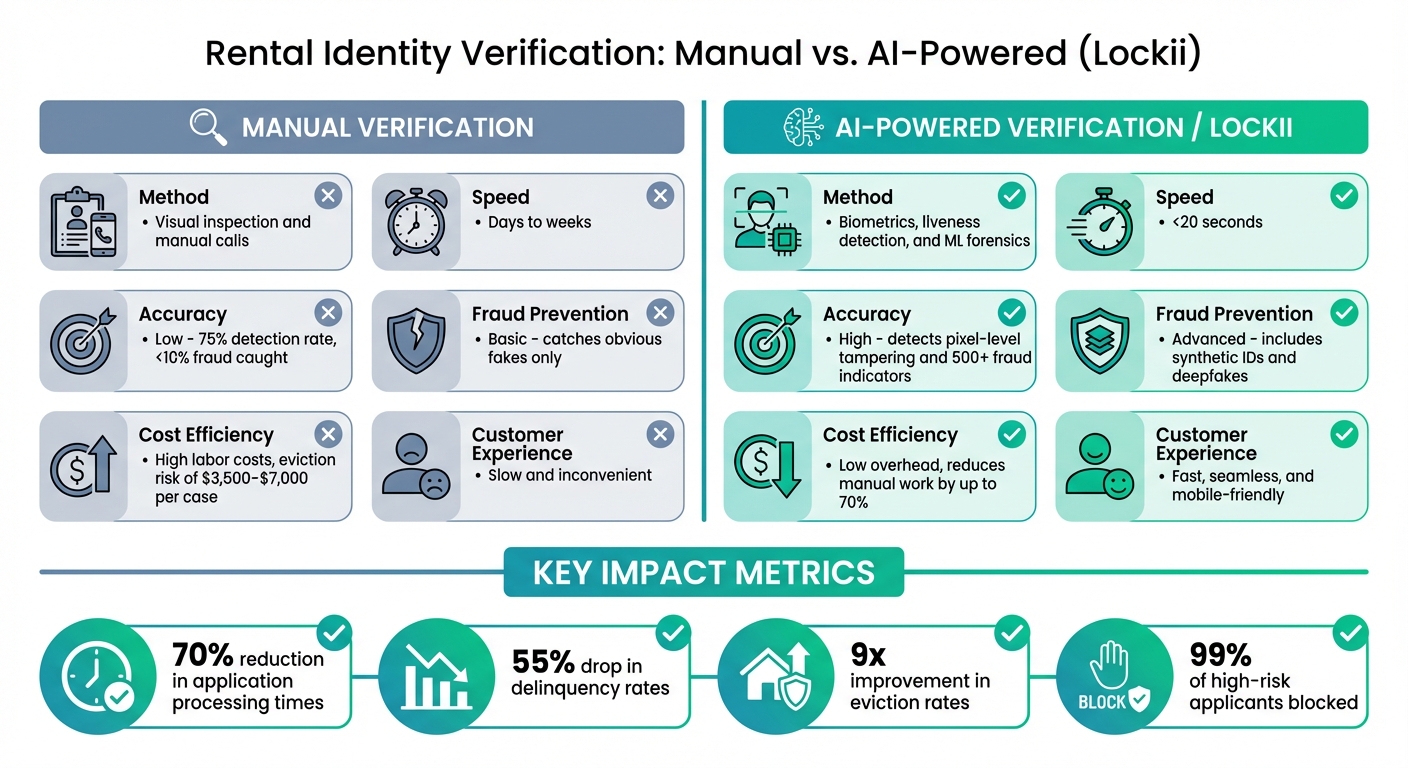
When it comes to fraud prevention in the rental industry, the choice between manual and AI-powered identity verification can make or break efficiency. The differences boil down to three key factors: speed, accuracy, and fraud detection capabilities. Let’s take a closer look at how these two approaches stack up.
Manual verification relies on human staff to visually inspect documents for signs of tampering. While this method may catch obvious issues, it struggles with sophisticated forgeries. In fact, humans detect less than 10% of document fraud manually [4]. With fraudsters now using advanced AI-generated fake documents, manual methods only catch about 75% of fraudulent cases [2]. This leaves a significant gap in fraud prevention.
On the other hand, AI-powered systems like Lockii take a completely different approach. Using computer vision, these systems can identify pixel-level changes, tampered barcodes, and even forged holograms - things that are impossible for the human eye to catch [7]. They also incorporate biometric liveness detection and facial recognition to verify the identity of the document owner, effectively stopping fraudsters who use photos or videos of stolen IDs [1]. What’s more, these AI models are continuously updated to detect new threats, including synthetic identity fraud [7]. This shift toward automation marks a significant leap in fraud prevention.
The operational differences are just as striking. Manual checks are slow and often frustrating for customers, with approval processes taking days or even weeks depending on staff availability [19]. In contrast, AI systems deliver results almost instantly - usually in under 20 seconds - providing a smooth, digital-first experience [16]. As noted by Autohost:
"AI identity verification represents the latest frontier, harnessing machine learning, biometric analysis, and advanced analytics to offer unprecedented levels of security and efficiency" [1].
Comparison Table
| Feature | Manual Verification | AI-Powered Verification (Lockii) |
|---|---|---|
| Method | Visual inspection and manual calls | Biometrics, liveness detection, and ML forensics |
| Speed | Days to weeks | Seconds (<20 seconds) |
| Accuracy | Low (75% detection rate; <10% fraud caught) | High (detects pixel-level tampering and 500+ fraud indicators) |
| Fraud Prevention | Basic (catches obvious fakes only) | Advanced (includes synthetic IDs and deepfakes) |
| Cost Efficiency | High labor costs; eviction risk of $3,500–$7,000 per case | Low overhead; reduces manual work by up to 70% |
| Customer Experience | Slow and inconvenient | Fast, seamless, and mobile-friendly |
The financial stakes are high. Each fraudulent case can cost rental businesses between $3,500 and $7,000 [4]. A 2025 analysis by rental platform Findigs highlighted the benefits of AI-powered systems: application processing times dropped by nearly 70%, delinquency rates fell by over 55%, and eviction rates improved 9x compared to traditional methods [5].
It's clear that AI-powered identity verification isn't just faster and more accurate - it’s a game-changer for reducing fraud and improving overall efficiency.
Conclusion
The rental industry is facing an alarming rise in identity fraud, with outdated manual processes struggling to keep up. Over 90% of fraud cases in the mobility and transportation sector involve impersonation [17], and identity theft complaints have surged to over 1.4 million in a single year. These numbers paint a clear picture: the current systems aren't enough.
Lockii steps in with its AI-powered identity verification, offering a game-changing solution. By combining biometric authentication, liveness detection, and real-time document analysis, Lockii can detect fraud in about 2 seconds [11]. This not only stops fraudsters in their tracks but also provides a hassle-free, 24/7 self-service option, allowing customers to pick up rentals without needing staff assistance.
The impact of these advancements goes beyond fraud prevention. AI-driven verification significantly streamlines operations, cutting down processing delays and reducing risks like delinquency. Rental operators have also seen notable improvements in eviction outcomes [5]. With labor shortages affecting the industry, automation isn't just helpful - it's becoming essential for growth.
Lockii's platform takes it further by integrating digital locks, GPS tracking, automated communications, and audit logs. This setup allows businesses to expand into satellite locations without the need for additional staff or high real estate expenses. The result? A scalable, secure, and efficient operation.
As the rental industry embraces digital-first and contactless models, innovations like these are setting a new benchmark. AI identity verification is no longer optional - it's the foundation for smoother operations, stronger fraud prevention, and an improved customer experience.