

Contactless ID Verification vs. Manual Checks
March 27, 2026 · 13 min read
Contactless ID Verification vs. Manual Checks
Contactless ID verification is transforming the rental industry by offering faster, more accurate, and cost-effective solutions compared to manual checks. While manual ID verification relies on human judgment to inspect documents, it is slow, labor-intensive, and prone to errors. Contactless methods use AI, facial recognition, and biometric tools to verify identities in seconds, reducing fraud risks and improving customer experience by automating manual tasks.
Key Differences:
- Speed: Manual checks take hours or days, while contactless verification is instant.
- Accuracy: AI detects advanced forgeries that humans often miss.
- Cost: Automated systems cut onboarding expenses by up to 70%.
- Availability: Contactless options enable 24/7 service, unlike manual processes.
Manual checks are still required in specific regulated scenarios, but for most rental businesses, contactless verification offers a scalable and secure solution to meet modern demands.
Quick Comparison:
| Factor | Manual ID Verification | Contactless ID Verification |
|---|---|---|
| Speed | Hours to days | Seconds |
| Accuracy | Prone to human error | AI-powered precision |
| Cost | High due to labor | Cuts costs by up to 70% |
| Availability | Limited to business hours | 24/7 access |
| Scalability | Requires more staff to grow | Handles large volumes instantly |
| Security | Vulnerable to advanced fakes | Detects tampering effectively |
Contactless verification is reshaping how rental businesses operate, offering a faster, more reliable, and flexible alternative to manual checks.
Facial ID tech speeds up TSA lines without touching a thing
sbb-itb-eb44693
What is Manual ID Verification?
Manual ID verification is a process where a staff member physically inspects government-issued IDs, like driver's licenses or passports, to confirm someone's identity. This method relies entirely on human judgment.
How Manual Verification Works
A staff member carefully checks the ID for features like holograms or microtext, compares the photo on the ID with the individual, and looks for any signs of tampering. While this process can be thorough, it’s time-consuming - taking hours or even days - and prone to errors caused by fatigue.
"Manual identity verification typically relies on human effort to review documents, cross-check data, and assess validity. This painstaking process often takes hours or even days for a single verification." - John Mitzel, Head of Marketing, Self-Serve, Veriff [5]
The biggest challenge with manual verification is its subjectivity. One staff member might catch subtle inconsistencies, while another might miss them entirely - especially during busy periods. Unlike machines, humans are affected by fatigue, which lowers consistency and can lead to errors, especially with advanced forgeries [6].
Common Use Cases
You’ll typically find manual verification at places like rental counters or front desks, where staff are available to inspect IDs. However, this approach is limited to business hours, making it impossible to provide service after hours.
Challenges for Rental Businesses
Manual ID checks come with significant drawbacks for rental businesses:
- High labor costs: For example, a compliance specialist earns an average of $55,333 annually, not including additional overhead [6].
- Bottlenecks during busy seasons: Increased demand can overwhelm staff, slowing down the process.
- Limited hours: Without 24/7 availability, businesses lose out on after-hours opportunities.
- Customer frustration: Long wait times and delays often cause customers to abandon the process and switch to competitors offering faster options [2][6].
For rental businesses aiming to expand into unstaffed locations or provide after-hours service, manual verification becomes a major roadblock.
Up next, we’ll explore how you can automate rental business operations and use contactless ID verification to solve these challenges.
What is Contactless ID Verification?
Contactless ID verification allows customers to confirm their identity remotely using mobile apps or web portals. This eliminates the need for direct staff interaction and provides instant access at any time. Let’s break down how this technology works and its role in modern operations.
How Contactless Verification Works
The process starts with customers uploading a photo of their government-issued ID and taking a live selfie. AI-powered systems then step in, using OCR (optical character recognition) to extract data, cross-checking it against a global database of over 12,000 document types from 230+ countries, and performing 1:1 biometric matching - all within five seconds [5][9][11].
To combat fraud, especially from static images or deepfakes - which surged by 400% in just one year [11] - the system looks for motion cues like blinking or smiling to confirm a live presence. This speedy and secure verification cuts down on wait times and reduces operational slowdowns. For example, in 2025, fintech company Novo used Middesk’s automated verification to process over 10,000 applications monthly, achieving an auto-approval rate exceeding 50% [2].
Common Use Cases
The efficiency of contactless ID verification makes it a natural fit for industries with high demand for quick and automated processes. It’s particularly useful for:
- 24/7 rental operations: Customers renting trailers, bikes, or equipment after hours benefit from the convenience of contactless verification.
- Remote pre-check-ins: Hotels and car rental companies can let customers complete verification before arrival, saving time at check-in.
One standout example is IncredibleBank, which reduced manual reviews by 90% and cut approval times by 88% through automated verification [2].
Integration with Rental Systems
Contactless verification becomes even more powerful when integrated with other systems. APIs enable it to work seamlessly with digital locks, booking platforms, and payment systems [9][2]. Once a customer is verified, the system can automatically send access codes for smart locks or gate codes via SMS, eliminating the need for human involvement [8][10].
For instance, Lockii embeds ID verification directly into the rental process. After verification, customers instantly receive access to digital locks from partners like IglooHome. This means someone can pick up a trailer, bike, or equipment at 2 a.m. on a Sunday just as easily as during normal business hours. By automating access, rental businesses can handle after-hours demand without increasing payroll costs.
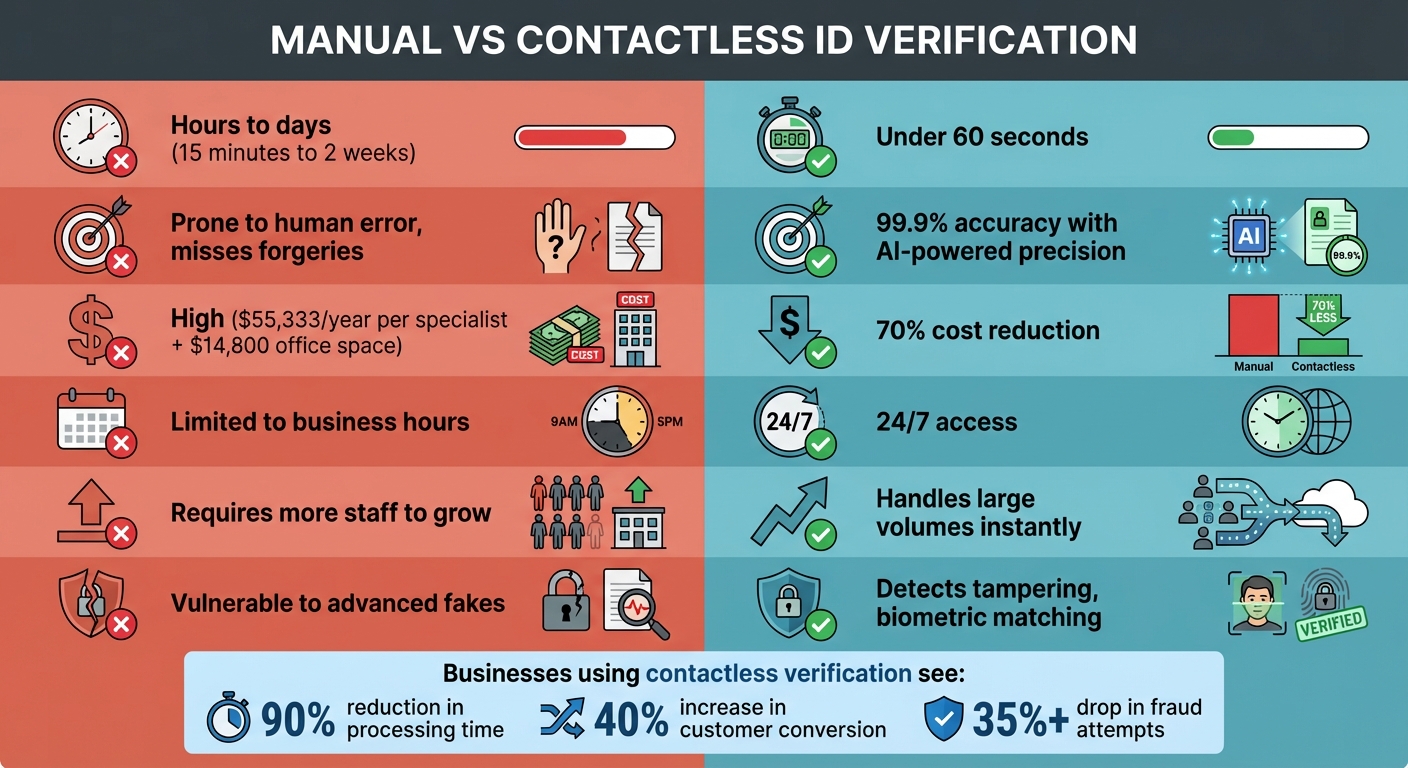
Manual vs. Contactless ID Verification
When deciding between manual and contactless ID verification for your rental business, it’s essential to weigh factors like speed, accuracy, cost, customer experience, scalability, security, and compliance. Here's a quick breakdown of how the two methods stack up:
Comparison Table
| Factor | Manual ID Verification | Contactless ID Verification |
|---|---|---|
| Speed | Takes anywhere from 15 minutes to 2 weeks [5] [6] | Completed in under 60 seconds [5] |
| Accuracy | Susceptible to human error and missed forgeries [5] [6] | AI-powered precision with biometric matching [5] |
| Cost | Expensive due to salaries, training, and office requirements [6] | Cuts onboarding costs by up to 70% [6] |
| Customer Experience | Cumbersome, often leading to drop-offs [2] | Quick and seamless [5] |
| Scalability | Requires more staff as demand grows [6] | Easily handles large volumes instantly [5] |
| Security | Vulnerable to advanced forgery techniques [5] | Detects even subtle tampering [5] |
| Compliance | Errors can result in regulatory fines [2] | Offers automated audit trails and compliance monitoring [2] |
These comparisons highlight why contactless ID verification is transforming the way rental businesses operate.
One of the standout advantages is cost efficiency. For example, Checkr managed to save over $100,000 in 2025 by transitioning from manual government portal checks to automated solutions [2].
"A human workforce (salaries, computers, office rentals, etc.) will cost a lot more than any online automated software." - Dmitri Laush, CEO, GetID [6]
Security is another critical factor. In 2022, nearly half of enterprises reported identity fraud losses exceeding $300,000 [2]. Manual processes often fail to catch sophisticated forgeries that AI systems can identify instantly. Affiniti, for instance, saved 1,250 hours of manual review annually while achieving zero onboarding of fraudulent actors [2].
The evidence makes a strong case for the efficiency, security, and overall effectiveness of contactless ID verification.
When to Use Manual ID Verification
While contactless verification is known for its efficiency and scalability, manual ID verification still plays a crucial role in specific regulated and low-tech scenarios.
Best Use Cases
Manual verification is essential in situations where federal regulations explicitly demand it. For instance, the NIST Identity Assurance Level 3 (IAL3) standard requires either in-person or supervised remote identity verification to achieve the highest level of assurance [13]. Similarly, compliance with Form I-9 under the Immigration and Nationality Act mandates that employers physically inspect an employee's identity documents within three business days of hire to confirm their authenticity [14].
Financial institutions also depend on manual checks for Enhanced Due Diligence (EDD) when automated systems flag high-risk profiles. A great example of this is Novo's approach: in September 2025, their manual review team handled the top 50% of high-risk applications out of more than 10,000 monthly submissions, ensuring compliance without sacrificing efficiency [2].
"Allocate the human oversight where KYB tools can't help - evaluating high-risk profiles and conducting EDD." - Middesk [2]
For businesses with fewer transactions and limited access to digital tools, the cost of integrating automated systems might outweigh the benefits. In such cases, sticking to manual verification can be more practical [7].
That said, while manual processes are invaluable in regulated or low-tech environments, they come with significant challenges when it comes to scaling operations.
Limitations for Growth
Though manual ID verification fulfills specific regulatory requirements, it struggles to meet the demands of scalability and round-the-clock service.
One of its biggest limitations is the inability to support 24/7 self-service operations. For example, rental businesses that want to allow customers to pick up vehicles at midnight or during weekends without staff present cannot rely on manual checks. This issue becomes even more pressing for businesses looking to expand across multiple locations or offer continuous availability.
Scaling manual processes also comes with steep costs. Each new market requires additional staff, and the numbers add up quickly. Consider this: compliance specialists earn an average salary of $55,333 per year, and office space costs around $14,800 annually per employee [6]. These expenses make manual verification a bottleneck for growth, preventing businesses from scaling efficiently.
When to Use Contactless ID Verification
Contactless ID verification simplifies rental operations by automating identity checks, supporting multi-location growth, and enabling round-the-clock service.
Best Use Cases
Car, bike, and equipment rental businesses are ideal candidates for automated systems that perform real-time biometric and fraud checks. These systems help cut down on theft risks. In fact, businesses using automated identity verification often experience a drop in fraud attempts by over 35% within the first three months [17]. Considering that one in eight rental applications is fraudulently altered [16], this level of security is invaluable.
Hospitality and short-term rentals benefit from seamless 24/7 check-ins, letting guests skip the front desk entirely while lowering labor costs. Self-service options have become a baseline expectation for Millennials and Gen Z customers, who increasingly prefer contactless interactions [8].
High-growth rental operations expanding into new territories find contactless verification indispensable. Instead of setting up local compliance teams, these businesses can rely on automated systems that use OCR and machine learning to verify over 14,000 types of documents worldwide [6][15].
Property management and proptech companies use digital verification to speed up tenant screening by confirming identity and income within seconds. This reduces the time rental units remain vacant, which averages 32 days [16]. For instance, Padsplit, a co-living marketplace, adopted automated identity and income verification in 2024. This cut down their manual processes by 70% and reduced application processing times to under 60 seconds for most cases [16].
These examples highlight how contactless verification can transform operations while delivering key advantages.
Benefits for Rental Operations
Automated systems significantly speed up processes, cutting processing times by 90% and boosting customer conversion rates by 40% [15]. By removing the need for manual compliance staff and physical office space, businesses can drastically lower onboarding costs.
This technology also supports 24/7 operations, enabling customers to pick up rentals at any time and maximizing fleet usage. It enhances accuracy and prevents fraud by validating mobile driver's licenses (mDLs) using trusted public keys from government agencies. This method is far more reliable than manual visual inspections [12]. Features like facial recognition and liveness detection ensure that the person presenting the ID is the rightful owner, making it much harder for fraudsters to exploit stolen or fake credentials [1][18].
Privacy and compliance are easier to manage too. Modern digital IDs enable "selective disclosure", which lets businesses verify specific criteria - like confirming a customer’s age - without exposing unnecessary personal details such as a home address [12]. This reduces data liability and simplifies adherence to GDPR and FCRA regulations.
"The 'quiet revolution' is really an interoperability story: when verifiers can trust what they're reading and users can trust that only necessary data is shared, adoption accelerates." - Christina Hulka, Executive Director of the Secure Technology Alliance [12]
Platforms like Lockii showcase the power of integrating contactless ID verification with digital locks and automated communications. Lockii allows customers to pick up rentals 24/7 without staff involvement by combining identity verification with tools like GPS tracking, automated SMS and email updates, and self-service order extensions. This efficient, staff-free model enables rental businesses to scale quickly across multiple locations without needing extra personnel or large real estate investments.
Future of ID Verification
The way we verify identities is evolving fast, moving away from traditional manual methods to AI-powered automation. By 2026, mobile driver's licenses (mDLs) are expected to become a standard feature, with projections estimating 143 million mDLs in the U.S. by 2030 and Brazil already reporting 83 million active digital licenses [12]. This shift aligns with a growing preference for privacy-focused verification systems. These modern systems offer features like "selective disclosure", allowing individuals to confirm details like legal age or license validity without sharing unnecessary personal information. A great example of this is in New South Wales, where nearly 80% of drivers (4.4 million out of 5.6 million adults) are already using digital licenses for face-to-face interactions [12]. This trend is paving the way for rapid adoption of automated processes.
Growth of Automated Verification
Automated verification is quickly becoming the go-to solution for businesses aiming to cut fraud and scale operations efficiently. Companies adopting these technologies have seen impressive results. For instance, in September 2025, fintech company Novo introduced automation tools that handled over 10,000 applications monthly, with more than 50% being auto-approved [2]. Similarly, IncredibleBank slashed new account approval times by 88% and automated 90% of its applications, enabling staff to focus on sales instead [2]. These AI-powered systems now handle tasks like background checks, biometric liveness detection, and global watchlist screenings, while also adapting to combat emerging threats [19][2]. However, with the rise of AI-enabled fraud - up by 2.5× recently - and 70% of property management companies reporting an increase in fraudulent applications [20], experts recommend a balanced approach. Combining the speed of automation with manual oversight for higher-risk cases ensures better accuracy and security [6][2].
Impact on Rental Businesses
For rental businesses, these advancements are a game-changer. Automated verification allows companies to expand operations across multiple locations without needing to hire more staff. By cutting onboarding costs by 70% [6] and drastically reducing processing times, these technologies address key challenges like scalability and security. Rental businesses should also ensure their scanners and kiosks are mDL-compatible and follow a checklist for securing contactless rentals to filter out fraudulent applications before investing time in due diligence [2]. Platforms like Lockii showcase how these technologies can be applied effectively. By integrating features like contactless ID verification, digital locks, GPS tracking, and automated communication, Lockii enables 24/7 self-service operations. This approach makes it possible for rental businesses to scale quickly without heavy investments in staffing or real estate.
Conclusion
When deciding between manual and contactless ID verification, the key factors are speed, cost, and scalability. Manual checks can take anywhere from two days to two weeks[21], requiring significant investments in staff, office space, and training - expenses that can climb to $45 per hour[6]. On the other hand, contactless verification completes the process in just seconds, slashing onboarding costs by as much as 70%[21]. Where manual processes require more resources to scale, automated systems adapt instantly without increasing headcount[21].
Accuracy is another major consideration. Contactless systems leverage technologies like OCR, encrypted chip reading, and liveness detection to achieve up to 99.9% accuracy, catching forgeries that manual checks might overlook[3][4]. This level of precision is crucial, especially since nearly 50% of enterprises reported identity fraud losses exceeding $300,000 in 2022[2].
"Using an automated solution can reduce the cost of onboarding by 70%." – Dmitri Laush, CEO, GetID[6]
A practical example of these advantages is seen with Lockii. By integrating automated identity verification with digital locks, GPS tracking, and 24/7 self-service options, rental companies can scaling rental businesses with contactless models to expand to new locations without needing additional staff or real estate. This approach results in faster customer onboarding, reduced operational costs, and constant availability, showcasing a broader industry trend.
The rental sector is rapidly embracing automation to stay efficient and competitive. Companies sticking to manual processes will struggle with scalability, face heightened fraud risks, and lose customers to rivals offering seamless, fast experiences. In today’s market, the speed, cost savings, and scalability of contactless methods are no longer just advantages - they’re essential for staying ahead.