
State Insurance Rules for Trailer Rentals
June 23, 2026 · 10 min read
State Insurance Rules for Trailer Rentals
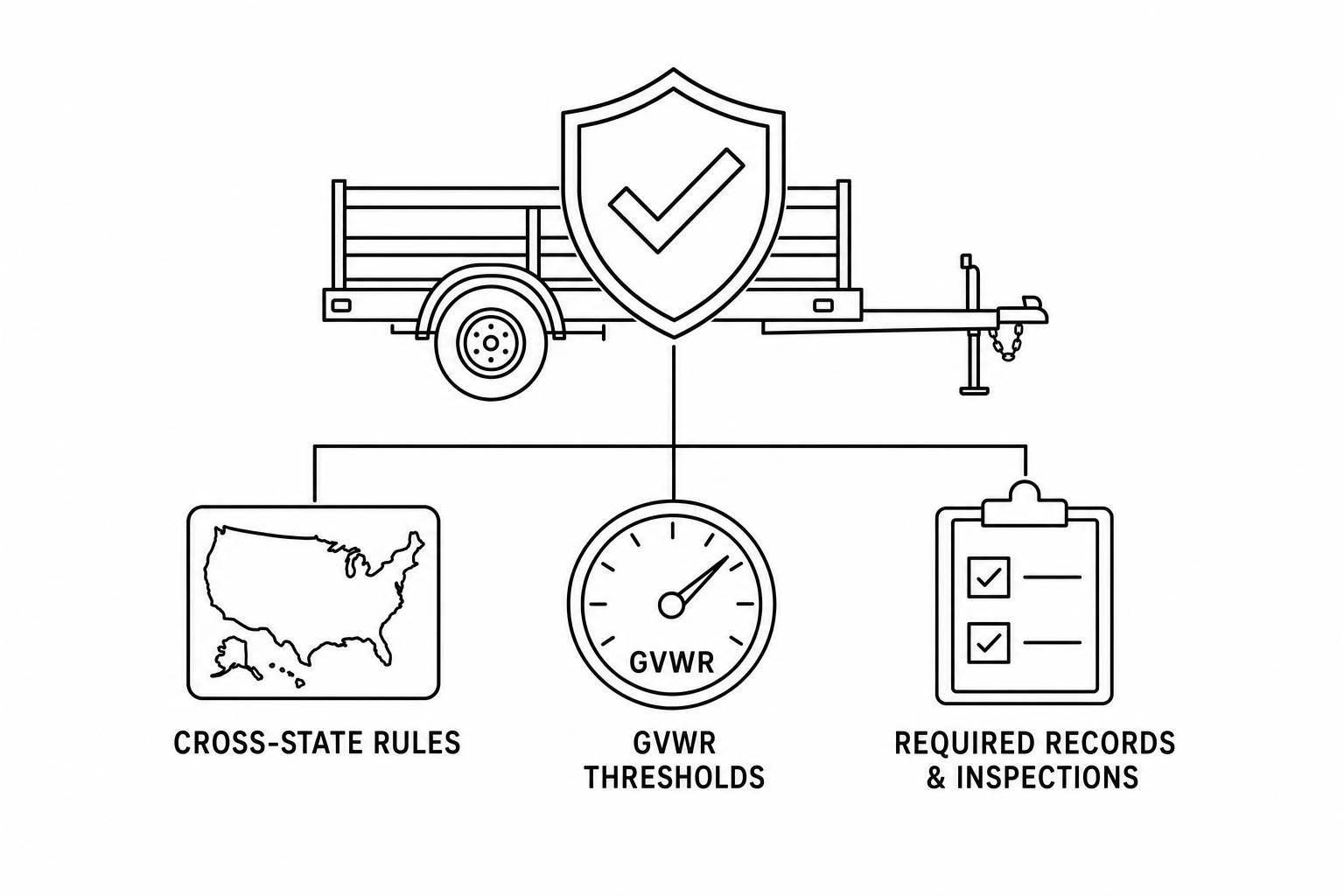
One missed state rule can turn a routine trailer rental into a claim, a fine, or an impound. In this guide, I boil the issue down to what matters most: _who insures what, when state weight rules kick in, and which records help defend your business if something goes wrong._
Here’s the short version:
- I need to treat business coverage and the renter’s auto policy as two separate pieces.
- I can’t assume one state’s brake, title, registration, or inspection rules work in another.
- Brake thresholds vary a lot, such as 1,500 lbs in California versus 4,500 lbs in Texas.
- Some states want trailer liability coverage for all registered trailers, while others tie it to weight, title, or business use.
- If a trailer is used in interstate for-hire hauling, federal liability rules may apply, including $750,000 minimum public liability in many cases.
- Poor records can cost more than insurance. A weak file can hurt claims, audits, and damage disputes.
The money risk is not small. Fines can run from $50 to more than $10,000, and the bigger hit may be a denied claim or out-of-pocket loss.
What I should verify before every rental:
- Liability: Does the renter’s policy cover attached use only?
- Physical damage: Who pays if the trailer is damaged, stolen, or hit while unhitched?
- State triggers: Do brakes, breakaway systems, title, registration, or inspection apply at this trailer’s GVWR?
- Use type: Is the trailer being used for personal hauling, business use, or interstate for-hire work?
- Proof: Do I have a current COI, signed agreement, tow vehicle details, and photo records?
Quick comparison
| Issue | What to check | | --- | --- | | Insurance split | Business policy for the trailer and company; renter policy often handles liability only while attached | | Weight rules | GVWR may trigger brakes, inspections, title, and registration | | State coverage rules | Some states require trailer coverage for all registered trailers; others do not | | Multi-state rentals | Use the strictest state on the route as the baseline | | Claims support | Keep ID, COI, photos, agreement, maintenance logs, and trailer papers |
If I run a self-service or multi-location fleet, the safest move is simple: set one strict standard, document every handoff, and verify state rules before the trailer leaves the lot.
Do Trailers Require Insurance? A Guide to 10 Types and Coverage Option
Core insurance rules trailer rental businesses need to know
Start with the basic coverage setup before you compare state rules. On paper, the rules look simple. In practice, most losses happen in the space between one policy and another.
Business policy vs. renter policy: who covers what
Both sides carry part of the risk, but they don't cover the same things. The rental business needs commercial insurance to protect the trailer and the business, a key step when starting a profitable trailer rental business. The renter's auto policy, by contrast, will often provide primary liability coverage only while the trailer is attached to the tow vehicle [4][7].
That split matters more than many operators think. A renter's personal auto policy will rarely pay for physical damage to the rental trailer itself [7][8].
Before release, require a Certificate of Insurance and line up the renter's limits with the trailer's replacement value [4].
Once those roles are clear, state thresholds determine when brakes, inspections, and liability minimums start to apply. Using a trailer rental safety checklist helps ensure these requirements are met before every trip.
How trailer type, weight, and commercial use affect the rules
GVWR drives brake, registration, inspection, and insurance triggers. Here's where those thresholds often land:
| Requirement | Common GVWR Threshold | Notable Variations | | --- | --- | --- | | Trailer Brakes | 3,000 lbs (federal baseline) | CA: 1,500 lbs; TX: 4,500 lbs [1] | | Breakaway System | 3,000–5,000 lbs | Required in TX, CA, OR [1] | | Registration | 750–2,000 lbs | FL: all trailers; TX: 4,000+ lbs [1] | | Annual Safety Inspection | 3,000 lbs+ | TX: 4,500 lbs; also PA, NY, VA [1] |
Commercial use can bring in separate federal liability rules. If the trailer is used for interstate for-hire hauling, FMCSA rules under 49 CFR Part 387 may apply. In many cases, for-hire interstate carriers hauling non-hazardous property must carry at least $750,000 in public liability [5].
That can change which insurance lines you need to check before handing over the trailer.
Common coverage terms in trailer rental operations
These are the four coverage types that show up most often in trailer rental work - and the ones to confirm with your broker before you assume you're covered:
- Commercial General Liability (CGL): Covers third-party bodily injury and property damage. A common starting limit is $1 million per occurrence [2][4]. It does _not_ cover damage to the trailer itself because of the "care, custody, and control" exclusion [4].
- Inland Marine (Rental Floater): Covers the trailer as an asset, including theft, fire, and collision while it's in the renter's possession, even when it's unhitched [2][4]. Typical cost: $200 to $600 per year per trailer [2][3].
- Commercial Auto Liability: Covers the owner's vehicle during delivery or retrieval. Personal auto policies usually exclude delivery for profit [2][4].
- Umbrella/Excess Liability: Sits above primary policy limits for major claims. A $1 million policy will often cost $500 to $1,200 per year [2].
With that baseline set, the next section breaks down state rules by region.
State-by-state roundup: insurance rules by region
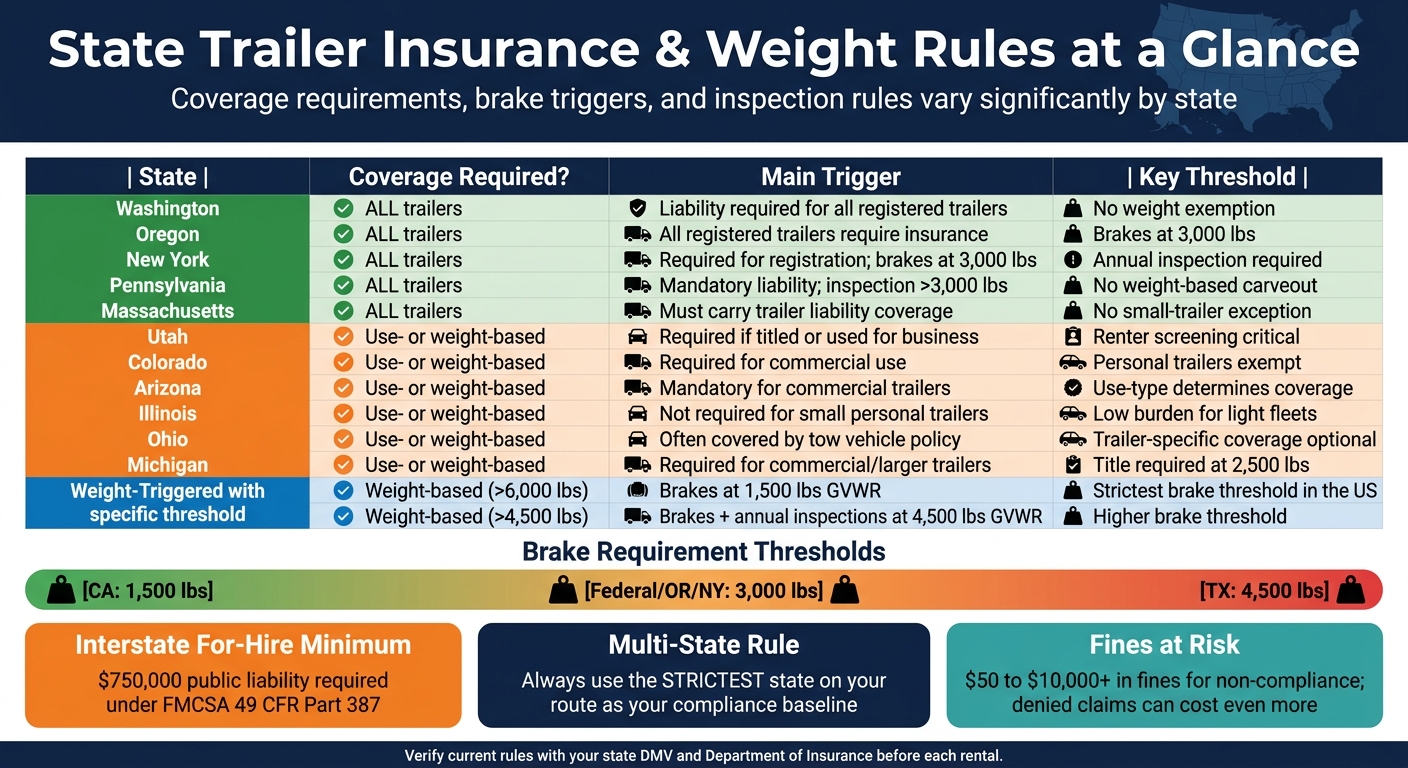
Trailer rules can change fast when you move from one state to the next. The core coverage split still matters, but these state-level rules can tighten things up in a hurry. The table below shows the main trigger points. The notes after that call out the rules most likely to affect how you rent out a trailer.
| State | Coverage Required? | Main Trigger | | --- | --- | --- | | California | Yes (>6,000 lbs) | Brakes at 1,500 lbs GVWR [1][6] | | Washington | Yes (All) | Liability required for all registered trailers [6] | | Oregon | Yes (All) | All registered trailers require insurance; brakes at 3,000 lbs [1][6] | | Utah | Use- or weight-based | Required if titled or used for business [6] | | Texas | Yes (>4,500 lbs) | Brakes and annual inspections required at 4,500 lbs GVWR [1][6] | | Colorado | Use- or weight-based | Required for business use or heavier trailers [6] | | Arizona | Use- or weight-based | Mandatory for commercial trailers [6] | | Illinois | Use- or weight-based | Not required for small personal trailers [1][6] | | Ohio | Use- or weight-based | Often comes from the tow vehicle policy; trailer-specific coverage is optional [6] | | Michigan | Use- or weight-based | Required for commercial/larger trailers; title required at 2,500 lbs [1][6] | | New York | Yes (All) | Required for registration; brakes at 3,000 lbs; annual inspection [1][6] | | Pennsylvania | Yes (All) | Mandatory liability; annual inspection for trailers >3,000 lbs [1][6] | | Massachusetts | Yes (All) | Must carry trailer liability coverage [6] |
Western states: California, Washington, Oregon, and Utah
California has some of the toughest trailer rules in the country. Brakes are required at just 1,500 lbs GVWR [1][6]. The business must carry trailer coverage once the trailer goes above 6,000 lbs. Under that mark, the renter's policy may carry the load instead. Check the latest rules with the [California DMV](https://www.dmv.ca.gov/portal/) and the [California Highway Patrol](https://www.chp.ca.gov/) (CHP).
Washington and Oregon take a broad approach. Both require liability coverage for all registered trailers, no matter the trailer weight [6]. That puts the coverage duty on the business from the start. Utah is narrower. Insurance is usually required only if the trailer is titled or used for commercial purposes, which makes renter screening and use records a big deal [6].
If a renter may cross through several Western states, plan around Washington and Oregon first. Their all-trailers rule is often the hardest one to work with.
Central, Southern, and Midwest states: Texas, Colorado, Arizona, Illinois, Ohio, and Michigan
Texas sets a clear weight trigger. Brakes and annual safety inspections kick in at 4,500 lbs GVWR, and annual inspections also apply to any trailer that already has brakes [1][6]. For current details, check with the [Texas DMV](https://www.txdmv.gov/) and the [Department of Public Safety](https://www.dps.texas.gov/home-page) (DPS).
Colorado and Arizona both tie coverage more closely to use. Commercial trailer use calls for coverage, but lighter personal trailers do not face a blanket rule [6]. That means the handoff process matters a lot. You need to know how the renter plans to use the trailer, not just what the trailer weighs.
Michigan works a bit differently. Coverage is required for commercial or larger trailers, and the title threshold is 2,500 lbs [1][6]. That lower title mark can pull more units in your fleet into title and coverage rules than you might expect, especially if you're comparing Michigan with nearby states.
Ohio is looser. In many cases, coverage comes through the tow vehicle policy, and separate trailer coverage is optional [6]. Illinois lands in a similar spot, with no coverage rule for small personal trailers [1][6].
Northeast and Mid-Atlantic states: New York, Pennsylvania, and Massachusetts
New York, Pennsylvania, and Massachusetts all require liability coverage. New York and Pennsylvania also add inspection rules.
New York requires proof of insurance before a trailer can be registered. The state also requires brakes at 3,000 lbs GVWR and annual safety inspections [1][6]. In plain terms, the business needs coverage in place before the trailer can legally hit the road.
Pennsylvania follows a close pattern. It requires liability coverage across the board and sets annual inspection requirements for trailers over 3,000 lbs, with no weight-based carveout for coverage [1][6].
Massachusetts also requires trailer liability coverage for all trailers, without a small-trailer exception [6].
For fleet operators moving trailers through this region, it makes sense to use the strictest state on your route as the baseline.
Confirm current filing rules with each state's Department of Insurance. Those rules can differ from DMV requirements [5].
Contracts, documentation, and multi-state compliance steps
Rental agreement clauses that reduce coverage disputes
Once you know the state rules, the next step is simple: put them into the contract.
A rental agreement should assign liability _before_ a claim ever happens. It should say who provides coverage, who pays for each type of loss, require a current COI before the trailer is released, and match coverage limits to the trailer’s value. It also helps to require initials next to damage liability, usage limits, and geographic limits, and to say that mechanical issues or damage must be reported at once.
The agreement should also spell out the GVWR limit for that exact trailer, ban hazardous materials and passengers, and require the renter to confirm that their tow vehicle has the right hitch class and ball size. Geographic limits matter too. If travel into Mexico isn’t allowed, write that plainly.
If you rent in California, add the state’s 55 mph towing speed limit right into the contract as a state-specific compliance term under CVC 22406 [1].
Records to keep for claims, audits, and state requirements
Even the best contract falls flat if the file is thin.
Your records back up claims and audits, so each rental should leave a full paper trail. Keep these items for every rental:
- Driver's license
- Current COI
- Pre- and post-rental photos
- Signed agreement
- Tow vehicle details
- Maintenance and inspection logs
Keep the registration and proof of insurance in a weatherproof holder on the trailer. A renter could get stopped in a state you didn’t expect, and those papers need to be there.
You should also track replacement cost, not purchase price, so depreciation doesn’t leave a claim gap [2][4]. And in states with annual inspection rules, such as Texas, New York, and Pennsylvania, inspection logs are often the first record an auditor or insurer will ask for [1].
How software can support state-specific insurance compliance
When you operate across state lines, scattered records can turn into a headache fast.
Lockii puts identity checks, digital agreements, post-rental photos, maintenance tracking, damage reports, and audit logs in one place across locations. That makes it much easier to keep compliance records current without doing all the legwork by hand.
Conclusion: What trailer rental operators should verify in every state
The rules above lead to one clear point: trailer compliance is not the same everywhere. State laws change from one place to the next, especially when it comes to brake cutoffs, registration, titling, and required liability coverage.
Before every rental, verify who carries liability, when brakes or inspections are required, what triggers titling and registration, and whether the state has any extra rules for commercial use. That’s why using the strictest-state approach is the safest way to operate.
In most cases, paying a bit more to over-comply costs less than dealing with a violation, a denied claim, or a problem after an accident in a stricter state. For interstate rentals, use the toughest rule in your service area as the baseline for brakes, lighting, and paperwork.
Before you enter a new market, confirm the current rules with the state DMV and Department of Insurance.