
Why PCI DSS Matters for Rental Software
March 17, 2026 · 11 min read
Why PCI DSS Matters for Rental Software
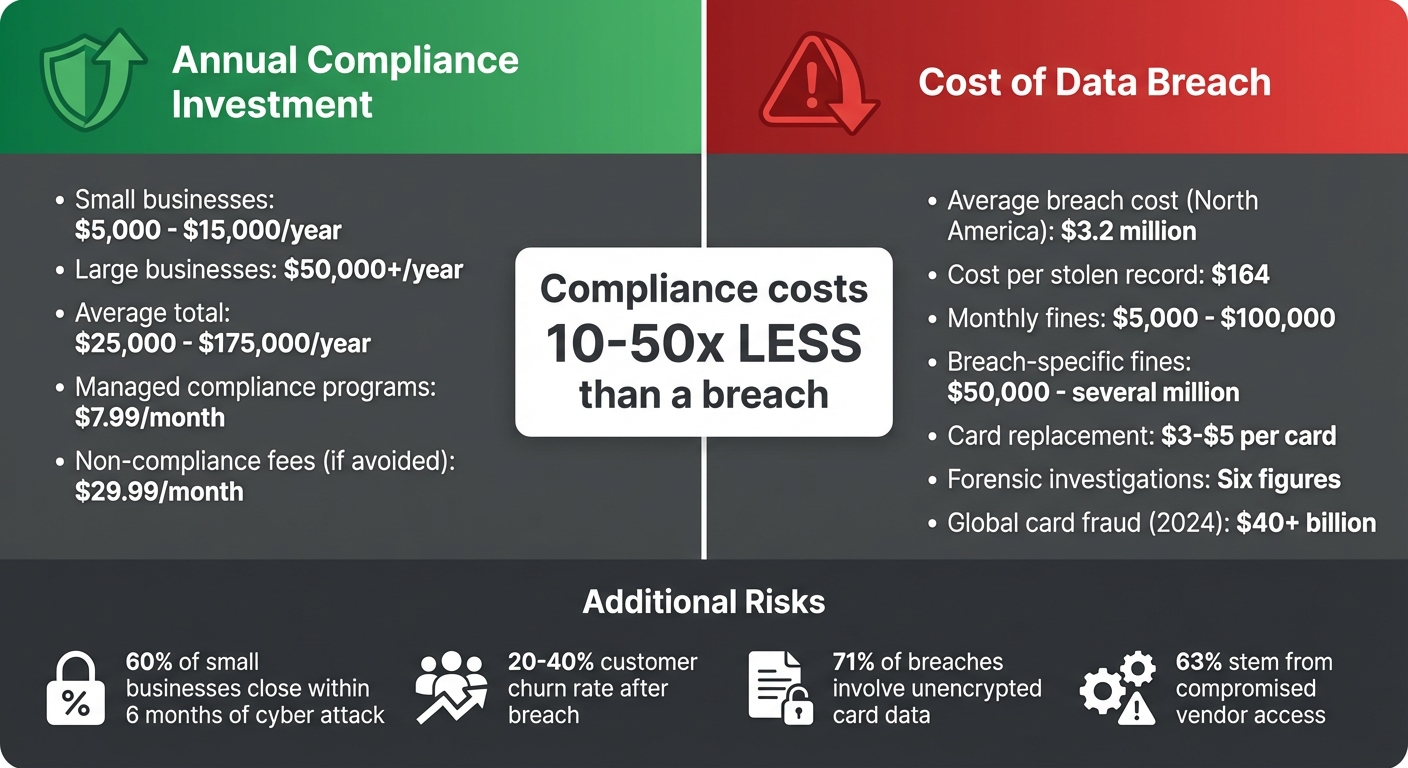
If your rental business accepts credit cards, PCI DSS compliance is non-negotiable. It’s a set of security standards designed to protect payment data and prevent costly breaches. Non-compliance can result in fines ranging from $5,000 to $100,000 per month, lawsuits, and even losing the ability to process payments. With global card fraud surpassing $40 billion in 2024, the stakes are high.
Here’s what you need to know:
- PCI DSS Basics: 12 requirements focused on securing payment data, like firewalls, encryption, and access controls.
- Risks for Rental Businesses: Repeat customers, high-value transactions, and contactless services make rental businesses prime targets for cyberattacks.
- Cost of Non-Compliance: Data breaches cost North American businesses $3.2 million on average, with additional penalties and legal exposure.
- Simplifying Compliance: Use PCI-compliant payment processors (e.g., Stripe) and tokenization to reduce risks and streamline requirements.
Neglecting PCI DSS can disrupt operations, damage your reputation, and hurt your bottom line. Use a contactless rental ROI calculator to see how secure, automated systems protect your margins. Investing in compliance is far cheaper than dealing with the fallout of a breach.
PCI DSS Explained: What It Is, Who Needs It, and How to Comply | pTrackly
sbb-itb-eb44693
The Risks of PCI DSS Non-Compliance for Rental Businesses
Overlooking PCI DSS requirements isn’t just a minor mistake - it’s a serious business risk that can disrupt your rental operations in a big way. The fallout extends far beyond technical issues, affecting your finances, reputation, and even your ability to process payments.
Fines and Legal Consequences
Failing to comply with PCI DSS standards can lead to immediate fines that escalate quickly. Payment processors and acquiring banks impose monthly penalties ranging from $5,000 to $100,000 until you resolve the issue [6][7].
If a data breach occurs while you’re non-compliant, the costs skyrocket. Breach-specific fines can range from $50,000 to several million dollars, depending on the severity [6]. For example, in 2024, a mid-sized retail chain faced over $2 million in fines after ignoring compliance issues flagged during an audit. This delay allowed hackers to exploit vulnerabilities, compromising millions of customer records and leading to millions more in lost revenue due to customer distrust [6].
But the penalties don’t stop there. You may also be responsible for card replacement costs (around $3–$5 per card), credit monitoring services, identity theft insurance for affected customers, and forensic investigations, which can easily run into six figures for mid-sized breaches [7][2].
Non-compliance also increases your legal exposure. Courts can use your failure to meet PCI DSS standards as evidence of negligence, opening the door to class-action lawsuits from customers whose data was compromised [6][7]. In one case from 2023, a small fintech startup was fined $15,000 per month by its acquiring bank for failing to meet encryption and secure data storage standards. The financial strain and loss of investor confidence nearly forced the company to close [6].
"A breach costs 10–50x more than compliance, financially, legally and reputationally." - RITC Cybersecurity [2]
These financial and legal risks are just the beginning. Non-compliance also makes your business an easier target for cybercriminals.
Higher Fraud and Data Breach Exposure
Falling short of PCI DSS standards puts your rental business at greater risk of fraud and data breaches. Research shows that 71% of card data breaches involve unencrypted card data or insecure credential storage, while 63% stem from compromised vendor or third-party access [2]. Non-compliance essentially signals to hackers that your systems are vulnerable.
Without safeguards like tokenization, your rental software might store or transmit raw card data. If breached, this information can be immediately exploited for fraudulent transactions. In one case from January 2025, a U.S. retail chain suffered a payment system breach that exposed over 120,000 customer credit card records. Hackers used stolen vendor credentials to install malware, resulting in six-figure forensic costs, emergency system rebuilds, and multiple lawsuits - all because basic PCI DSS measures like network segmentation weren’t in place [2].
Non-compliant businesses also tend to lack real-time monitoring and secure audit logs, which means breaches can go undetected for long periods. The longer a breach remains unnoticed, the more damage it can cause. This is particularly true for companies already solving labour shortages in rental businesses through automation, where lean teams may struggle to monitor security logs manually. For rental businesses, this translates into operational risks and a loss of customer trust that’s hard to rebuild.
The reputational impact can be devastating. According to data, 60% of small businesses close within six months of a cyber attack [6]. Once customers lose trust in your ability to protect their payment information, regaining their confidence becomes a steep uphill climb.
And the problems don’t stop at financial and reputational damage - non-compliance can also disrupt your day-to-day operations.
Business Disruptions
Non-compliance can bring your operations to a standstill. Payment processors may suspend or revoke your ability to accept credit card payments if they identify critical risks [9][11]. For rental businesses that depend on card transactions for bookings, extensions, and damage deposits, this could be catastrophic.
Even worse, you could end up on the MATCH List or Terminated Merchant File (TMF), which makes it nearly impossible to open new merchant accounts with other processors [10][11]. This blacklist can follow you even if you later achieve compliance, creating long-term challenges.
| Disruption Type | Impact on Rental Operations |
|---|---|
| Payment Processing Ban | Halts credit card revenue, forcing cash-only transactions |
| Merchant Account Deactivation | Loss of ability to process deposits or extensions |
| MATCH List Placement | Permanent difficulty opening new merchant accounts |
| Mandatory Forensic Reviews | Expensive investigations that drain resources |
If a breach occurs, your payment systems might be taken offline during the investigation, forcing you to delay rentals, restrict services, or halt transactions altogether [11]. Internal teams are often pulled away from their regular responsibilities to handle crisis management, creating bottlenecks across your business [11].
"Non-compliance can disrupt your ability to process transactions altogether... an operational roadblock with direct revenue implications." - Adam Lisowski, Senior Consultant, Risk Advisory Services, Freed Maxick [9]
Additionally, processors may impose higher transaction fees or monthly penalties (ranging from $20 to $50) for businesses that fall out of compliance [9]. These ongoing costs chip away at your margins, making it harder to compete with businesses that stay compliant.
PCI DSS Requirements and Security Practices for Rental Software
The risks tied to payment data breaches make it essential for rental businesses to follow PCI DSS standards. These aren’t just abstract rules - they’re actionable technical and operational measures designed to protect sensitive payment information at every stage of processing. By understanding these requirements, businesses can implement the right safeguards from the start.
Core PCI DSS Security Requirements
PCI DSS includes 12 core requirements that address areas like network security and access controls [12][4]. Key measures include:
- Setting up and maintaining firewalls to shield cardholder data.
- Encrypting all data transmitted over public networks with TLS 1.2 or higher, as older protocols no longer meet compliance [12][13].
- Limiting access to payment information strictly to those who need it.
- Assigning unique IDs to users to ensure accountability and prevent multiple logins [13].
- Masking card numbers, showing only the first six and last four digits, to protect sensitive details [4].
Regular security checks are also crucial. Conduct quarterly vulnerability scans and annual penetration tests to identify and address potential issues [12][1].
One strict rule is that businesses cannot store sensitive authentication data - such as CVV codes, full magnetic stripe data, or PINs - after authorization. Violating this rule significantly increases the risk of a breach [12]. While small businesses typically spend $5,000 to $15,000 annually on PCI compliance, larger companies may spend over $50,000. These costs pale in comparison to the millions a breach could cost.
PCI DSS requirements involve creating firewalls, encrypting data, and developing an information security management system. This process ensures that no data is compromised.
Using Tokenization to Simplify Compliance
Tokenization offers a practical way to ease PCI compliance. Instead of storing actual card numbers, rental software replaces the Primary Account Number (PAN) with a unique, non-sensitive token. The real card data is securely stored in a PCI-compliant vault managed by your payment processor [5][4]. This approach reduces your PCI scope, as stolen tokens cannot be reverse-engineered to uncover card details [5].
For rental businesses, tokenization is especially useful for handling additional charges, like fees for late returns or equipment damage. It allows you to process these charges using the stored token without requiring customers to re-enter their payment details, creating a smoother user experience.
"Since tokenization removes sensitive payment data from rental management systems, businesses can reduce their PCI scope and simplify compliance requirements." - Point of Rental [5]
Many businesses using tokenization can complete a simplified Self-Assessment Questionnaire (SAQ) instead of undergoing a full audit. For example, SAQ A applies to companies that fully outsource payment processing, ensuring no card data ever touches their servers. This is achievable when tokenization is paired with hosted payment pages [1][12].
Working with PCI-Compliant Payment Processors
Selecting a PCI-compliant payment processor, such as Stripe, shifts most PCI DSS responsibilities to the provider, freeing you to focus on your business instead of complex security tasks [14]. These processors handle essential security measures like tokenization and encryption, making compliance more manageable [5][1].
Using hosted payment pages - where card data goes directly from the customer’s browser to the processor without passing through your systems - offers maximum security and simplifies compliance [1]. This approach not only reduces your PCI scope but also protects your business from data breaches.
Partnering with a compliant processor can help you avoid non-compliance fees, which are typically around $29.99 per month until compliance is confirmed [1][8]. Some providers even offer managed compliance programs for about $7.99 per month, including help with questionnaires and vulnerability scans [8].
"PCI compliance and tokenization are not just regulatory requirements; they are essential security measures that protect customers, reduce liability, and enhance efficiency." - Cal Grant, Payments Leader, Point of Rental [5]
When choosing a payment processor, ensure it integrates seamlessly with your rental management software. This enables automated recurring billing and centralized transaction management [4]. Also, look for processors offering secure portals to simplify annual compliance tasks [1][8].
How Lockii Maintains PCI Compliance
Lockii has designed its system to ensure sensitive payment data never interacts with your servers. By using secure integrations and automation for rental operations, it significantly reduces the challenges of staying PCI compliant. Here’s a closer look at how Lockii secures payment processing through its partnership with Stripe.
Encrypted Payment Processing Through Stripe
Lockii exclusively relies on Stripe, a PCI-certified payment processor, to handle all payment transactions. Customer card details are tokenized and sent directly from the browser to Stripe, meaning your business never stores or processes sensitive payment data. To maintain compliance, manual card entry or MOTO (Mail Order/Telephone Order) payments are not allowed. Skipping this process transfers full legal and financial liability to the operator. With this setup, businesses can also process additional charges, such as late fees, using tokens. This approach keeps operations in the lowest PCI compliance tier, simplifying requirements.
Audit Logs and Secure Data Handling
Lockii ensures a secure and traceable system by recording every action in Item and Booking Audit Logs. These logs provide a digital trail that aligns with PCI DSS secure record-keeping standards [15]. The platform only stores necessary customer information, such as names, emails, and phone numbers. For handling sensitive documents like driver’s licenses, Lockii uses PCI-certified third-party services [16].
Secure Contactless Operations at Scale
Lockii enhances security and efficiency through its contactless operations. It generates smart lock codes that are valid only for the duration of each rental [17]. Customers use these time-limited codes to pick up equipment, eliminating the need for in-person staff involvement. GPS tracking and return photos provide additional verification for every transaction [15]. This automation allows businesses to manage over 10 locations effectively, with 95% of bookings completed without any human intervention.
"Lockii has been a game-changer for our business. It's allowed us to operate fully automated, 24/7 trailer rentals and scale that side of our operation with confidence." - Yvann Karamoko, Operator, The Trailer Co [15]
Conclusion
PCI DSS compliance acts as both a financial safeguard and an operational necessity, protecting rental businesses from fraud, data breaches, and hefty legal penalties. The financial risks of non-compliance are stark: the average data breach in North America costs $3.2 million, or about $164 per stolen record. In contrast, annual compliance costs typically range between $25,000 and $175,000 - a fraction of the potential fallout from a breach [2]. These numbers clearly show that investing in compliance is far more cost-effective than dealing with the aftermath of a security incident.
Beyond preventing disasters, secure payment systems also fuel business growth. Adhering to PCI standards helps companies retain their merchant privileges, avoid monthly fines that can range from $5,000 to $100,000, and maintain the trust needed for B2B partnerships and vendor agreements [3]. Technologies like tokenization further simplify compliance by removing sensitive data from your systems, reducing audit burdens, and allowing businesses to focus on scaling instead of continually managing security risks [5].
Key Takeaways
PCI DSS compliance is more than just risk mitigation - it’s a strategic asset that can drive growth. Failing to comply introduces cascading risks, including costly forensic investigations, mandatory system upgrades, and a customer churn rate of 20% to 40% after a breach [2].
Using PCI-compliant payment processors like Stripe can make compliance much easier. When card data is routed directly through certified processors without ever touching your servers, businesses qualify for simpler self-assessment questionnaires and avoid the complexities of storing sensitive information [1].
By combining tokenization, detailed audit logs, and strict access controls, businesses can build a security framework that not only prevents unauthorized access but also supports seamless, automated operations at scale.
Lockii serves as a prime example of how compliance and automation can work hand in hand. By exclusively integrating with Stripe for encrypted payment processing, maintaining detailed audit logs, and eliminating manual card entry, Lockii enables rental businesses to operate around the clock with minimal staffing. This approach highlights how strong security practices can support smooth, contactless rental operations across multiple locations.