
Protecting yourself from rental fraud with stripe
May 1, 2026 · 12 min read
Protecting yourself from rental fraud with stripe
Rental fraud is a growing concern for self-service businesses. Fraudsters exploit stolen cards, fake IDs, and other tactics to steal equipment or avoid payments. Without in-person interactions, verifying identities becomes harder, leaving businesses exposed to chargebacks, dispute fees, and lost assets.
Key Takeaways:
- Stripe Radar: Detects and blocks suspicious payments using real-time risk scores and customizable rules.
- Identity Verification: Tools like Lockii and Stripe Identity confirm customer identities through biometrics and document checks.
- Fraud Patterns: Watch for rapid transactions, mismatched data, and unusual customer behavior.
- Operational Safeguards: Clear refund policies, GPS tracking, and monitoring customer activity help reduce risks.
Combining payment security with identity verification and operational measures can help protect your rental business from fraud while maintaining customer trust.
Prevent Stripe Disputes: A Step-By-Step to Protect Your Stripe Account Against Disputes
sbb-itb-eb44693
Using Stripe to Prevent Payment Fraud
Stripe Radar acts as a real-time fraud detection tool, assigning each payment a risk score between 0 and 99. This score is based on thousands of signals gathered across Stripe's network [7][9]. By default, transactions with a score of 75 or higher are blocked, while those scoring 65 or above are flagged for manual review [9]. The real advantage, however, lies in creating custom rules tailored specifically to your rental business.
It's important to understand how rule hierarchy works. An "Allow" rule will override any block or review rules you’ve set up, which can leave you vulnerable to high-risk transactions [2][8]. Use these "Allow" rules sparingly, focusing instead on blocking or reviewing suspicious payments. Here’s how you can configure these rules effectively.
How to Set Up Stripe Radar Rules
To create rules, navigate to the Stripe Dashboard, click Rules, and then select + Add rule [2]. Rules follow a specific format: {action} if {attribute} {operator} {value}. For example, to block prepaid cards, you would use: Block if :card_funding: = 'prepaid' [2][5].
Before enabling any rule, test it using the Test rule feature. This allows you to evaluate its performance against the last six months of transaction data [2][10]. If the rule successfully blocks fraudulent payments with minimal false positives, you can confidently activate it. These rules are critical for safeguarding your rental income by filtering out risky transactions. This forms a core part of a robust rental service agreement designed to protect both the business and the customer.
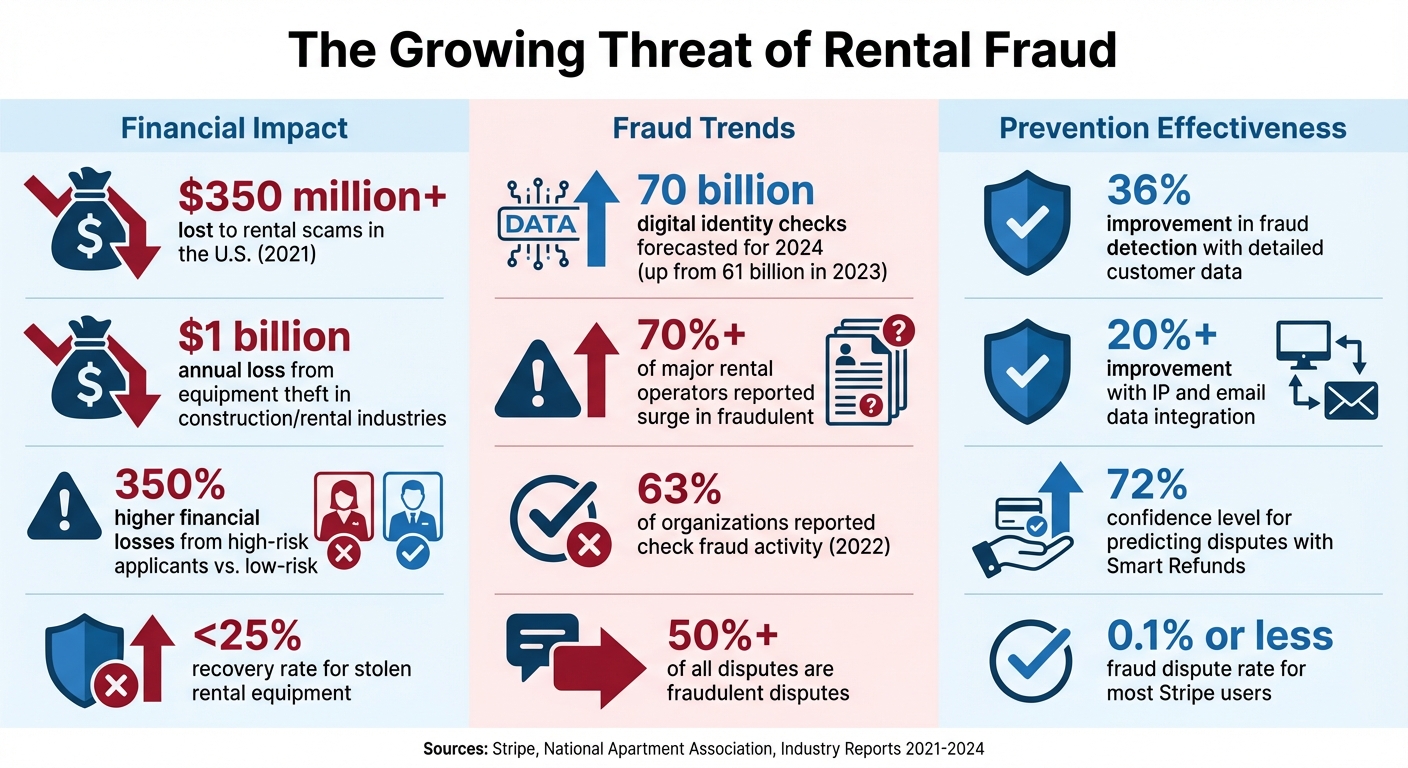
Incorporating customer IP and email data can improve fraud detection by over 20% [4]. If your business uses direct API integrations, ensure Stripe.js is deployed on every page of your website - not just the checkout page. This enables Radar to identify unusual browsing behaviors [4].
Creating Custom Rules for Rental Businesses
To address fraud patterns specific to rental businesses, you can customize rules further. For instance, to combat card testing - where fraudsters make rapid, small transactions to verify stolen cards - you can set up velocity rules like: Block if :total_charges_per_ip_address_hourly: > 1 [8].
For high-value rentals, adding an extra layer of authentication can help. Use 3D Secure for payments exceeding a certain amount: Request 3D Secure if :amount_in_usd: > 500 [2]. With 3D Secure authentication, liability for fraud-related disputes often shifts from your business to the card issuer [2][9]. You can adjust the dollar threshold to match your typical rental values.
Other useful rules include:
- Blocking payments if billing verification fails:
:address_zip_check: != 'pass' or :cvc_check: != 'pass' [8].
- Blocking transactions where the card's country doesn’t match the IP address:
:card_country: != :ip_country: [5].
For added convenience, use Radar Assistant, an AI tool that translates plain English into Radar rule syntax [2][10]. For example, typing "Block payments from outside the US over $1,000" will generate the appropriate rule format. You can also pass custom data as metadata, such as rental_duration or vehicle_class, and create rules around it. For instance: Review if ::rental_duration:: > 30 [5].
"With Radar rules and 3DS, we can block, review, and allow payments based on predefined criteria - significantly reducing fraud on our platform." - Stripe Case Study [10]
Verifying Customer Identity to Prevent Fraud
Protecting against payment fraud is only part of the equation. Even with robust Stripe Radar rules, fraudsters can still exploit stolen identities, create fake accounts, and make off with valuable equipment. The numbers speak for themselves: digital identity checks are forecasted to exceed 70 billion in 2024, a sharp increase from 61 billion in 2023 [11]. This growth underscores the growing importance of identity verification in combating account takeovers and fraudulent bookings.
Basic photo uploads just don't cut it anymore. Advanced systems now rely on machine learning and biometric tools to spot fake IDs, tampered images, and other deceptive tactics. Biometric verification, for instance, compares a government-issued ID photo with a live selfie to ensure the person booking is the same as the ID holder [11][12]. These rigorous identity checks are a vital complement to payment fraud defenses.
Using Lockii for Identity Verification
Lockii's identity verification system goes beyond the basics by employing a multi-layered approach to confirm customer identities. By seamlessly integrating with Stripe Identity, Lockii can validate government-issued IDs from over 120 countries [12][14] while keeping the booking process smooth and uninterrupted. As part of the process, customers receive an automated identity verification request after booking, ensuring their credentials are confirmed without creating friction in the booking flow [15]. This method strikes a balance between providing a seamless user experience and catching fraudulent bookings before equipment is handed over.
Lockii also maintains an automated blocklist that flags and rejects future verification attempts using documents or facial data previously identified as fraudulent [13]. This proactive approach helps prevent repeat offenses.
Adding Stripe Identity for Extra Security
To further enhance security, Stripe Identity works alongside Lockii’s tools to add another layer of protection. It performs five key checks: verifying government-issued documents, selfies (biometric data), ID numbers, addresses, and phone numbers [14]. Stripe Identity uses advanced AI technology, including barcode decoding and facial recognition, to detect and block "presentation attacks."
"To prevent 'presentation attacks' – fraudster using pictures of stolen documents or someone else's face, Stripe uses computer vision and AI algorithms to ensure the user captured an image of an actual document" [14].
This combination of AI and biometric verification creates a powerful barrier against identity fraud, ensuring that only legitimate customers gain access to your services and equipment.
Monitoring Transactions and Handling Disputes
Real-Time Transaction Monitoring with Stripe
Stripe Radar uses AI to evaluate transactions in real time, assigning them a risk level - Normal, Elevated, or Highest. This quick assessment helps rental businesses identify potential fraud before releasing expensive equipment [2][6].
The system spots suspicious patterns, such as multiple rapid attempts from the same IP or card, and flags them for review [1][8]. Transactions marked "Elevated" or matching custom "Review" rules are sent to a priority queue for manual inspection before being processed [17]. During this review, rental-specific data - like equipment type, pickup urgency, or customer history - can be passed as metadata to trigger customized fraud rules [2][8]. Including extra fraud signals, such as IP addresses and customer emails, can boost fraud detection accuracy by 36% [4].
For high-value rentals, Stripe's "auth and capture" flow is a smart choice. This approach authorizes a hold on funds for up to 7 days, giving you extra time to verify the transaction for fraud before capturing the payment [16]. Additionally, Smart Refunds can predict the likelihood of a transaction turning into a dispute within hours of payment, with a confidence level of 72% at the "Very High" setting [17]. Transactions flagged by this system are funneled into a review queue, simplifying dispute management.
How to Manage Disputes Effectively
Strong real-time monitoring not only reduces fraud but also helps manage disputes more efficiently. Acting quickly and staying organized is essential when disputes occur. Card networks focus on dispute volume rather than outcomes, so keeping disputes low is critical for account health [18]. Most Stripe users experience fraud disputes on just 0.1% or less of their transactions [3], but even a slight increase can lead to account reviews.
If a transaction is confirmed as fraudulent, process a fraud refund immediately through the Stripe Dashboard. This avoids dispute fees and prevents the transaction from affecting your dispute rate [16]. Since fraudulent disputes make up over 50% of all disputes [18], early detection is key.
When responding to a dispute, keep your evidence clear and concise. Organize it chronologically and group related items - like receipts, delivery logs, and customer communications. Add short summaries to improve clarity [18]. Only include relevant excerpts of policies or terms, as lengthy documents are often ignored. Highlight specific policy violations in your evidence [18]. Submit your evidence in PDF, JPEG, or PNG formats, staying within the 4.5MB total size limit. For Mastercard disputes, keep your evidence under 19 pages [18].
Stripe provides a 5-dot scale to estimate your chances of winning a dispute: 5 dots mean a 60% likelihood of success, while 1 dot indicates just 5% [18]. Use tools like AVS (Address Verification System) and CVC checks to confirm the cardholder's authorization. For repeat customers, Stripe's advanced verification methods, such as Visa Compelling Evidence 3.0, can help counter "friendly fraud" claims [16][18].
Other Ways to Prevent Rental Fraud
Protecting your rental business goes beyond securing payments and verifying identities. Operational strategies and advanced monitoring tools can add extra layers of security.
Creating Clear Refund and Cancellation Policies
Having transparent refund and cancellation policies can help reduce fraud risks. In 2021 alone, rental scams in the U.S. led to over $350 million in losses [19].
Make sure your refund and cancellation policy is fully displayed at checkout - not just as a link - and require customers to actively confirm their agreement before completing their purchase. This type of "click-wrap agreement" can strengthen your position during disputes with card issuers [16].
"Include a clear description of your refund and cancellation policies in your terms of service. You can require your users to agree to your terms of service to increase the likelihood that card issuers respect your policies in the event of a dispute." - Stripe [16]
Another key step is using a clear and recognizable statement descriptor, such as your business name or domain (5–22 characters), so customers can easily identify charges on their bank statements [16]. If a payment turns out to be fraudulent, Stripe's "Refund as fraud" feature can help you avoid dispute fees and maintain a low dispute rate [16].
Given that 63% of organizations reported check fraud activity in 2022 [19], it's critical to verify that checks have fully cleared before issuing refunds. Train your team to reject checks written for incorrect amounts to avoid potential scams [19].
Beyond setting clear policies, leveraging technology can further secure your assets.
Using GPS Tracking to Verify Returns
GPS tracking offers a reliable way to confirm returns and protect against theft. The construction and rental industries lose about $1 billion annually to equipment theft, and fewer than 25% of stolen items are ever recovered [22][23]. Real-time tracking provides a clear audit trail, reducing risks tied to false return claims.
Tools like Lockii's GPS tracking system can automatically confirm that equipment or vehicles are returned to the correct location. You can set up geofences around return areas and receive instant alerts when assets enter or leave these zones [22][23]. Historical tracking data, complete with timestamps, can help counter disputes about return times or locations. For high-value assets, consider installing a secondary "hidden" tracker, as thieves may attempt to disable the primary system.
Modern GPS trackers can also monitor the condition of items upon return, ensuring they meet agreed-upon standards [22][23]. Some battery-powered trackers even last up to six years without needing a recharge, offering long-term reliability [21].
Monitoring Customer Behavior Patterns
Tracking customer behavior can help identify fraud before it results in financial loss. Unusual patterns often signal potential fraud. For instance, Stripe Radar can detect high-velocity activity, such as multiple payment attempts using the same card, email, or IP address within a short period [1][8]. Advanced fraud detection models show that analyzing IP addresses can improve fraud detection by 12%, while email address data adds an 11% boost [4].
Be vigilant for inconsistencies, like customers using the same email but different names across transactions, or new accounts placing unusually large orders [1][8]. Disposable emails can also be flagged using attributes like seconds_since_email_first_seen [24][5]. Orders consisting solely of high-value items or multiples of the same product may also indicate fraudulent intent [1].
You can set up custom Stripe Radar rules to flag or block transactions based on specific behaviors. For example, flag IP addresses attempting more than three charges per hour or accounts making sudden large purchases after a period of inactivity [8]. Adding custom metadata - such as rental duration or equipment type - can also trigger extra verification for high-risk transactions [8][5].
"Because Stripe users are responsible for fulfilling orders for customers and possess the most information about their customer at the time of purchase, they're best equipped to determine whether or not a payment is potentially fraudulent." - Stripe Documentation [1]
Watch for logistical red flags, such as last-minute requests to change shipping addresses or demands for rush delivery - common tactics used by fraudsters to receive goods before a stolen card is flagged [1]. Suspicious communication patterns, like overly scripted responses, may also indicate coordinated fraud attempts. Using Stripe Customer objects to track purchasing behaviors over time can help identify irregularities in customer activity [4].
Conclusion
How Payment and Identity Tools Work Together
Safeguard your rental business by ensuring both customer identity and payment legitimacy are verified. Tools like Lockii help build trust during onboarding by using biometric matching and document forensics to confirm that renters are real and traceable. On the payment side, platforms like Stripe Radar analyze transaction risks in real time, identifying stolen cards, suspicious IP addresses, and high-frequency attempts [2][27].
By integrating these systems, you can pass identity verification data to Stripe as custom metadata. This allows for more precise security measures, such as requiring extra authentication for unverified users or high-value transactions [2][8]. Sharing detailed customer data can boost Stripe's fraud detection accuracy by up to 36% [4]. Additionally, enabling 3D Secure shifts most fraud-related dispute liabilities to the card issuer [2][3]. This streamlined integration not only enhances fraud detection but also strengthens your overall operational defenses.
Building a Fraud-Resistant Rental Business
A unified defense strategy helps your business proactively reduce fraud losses. Preventing fraud early is far more effective than addressing issues after the fact. High-risk applicants can cost operators up to 350% more, highlighting the importance of robust controls [25]. In 2023, over 70% of major rental operators reported a surge in fraudulent applications, and rental scams collectively cost Americans more than $350 million in 2021 [20][19].
"Applicants with an elevated risk of fraud cause financial losses to operators that are 350% higher than those without fraud risk." – National Apartment Association [25]
To build a fraud-resistant rental business, combine automated identity verification, real-time payment monitoring, GPS tracking, and clear policies into one cohesive system. Tools like Lockii and Stripe Radar enable consistent, objective customer screening, reducing the risk of bias while protecting your revenue [20][26]. By pairing vigilant oversight with advanced technology, you can safeguard both trust and profitability.