

Real-Time ID Verification for Trailer Rentals
February 23, 2026 · 11 min read
Real-Time ID Verification for Trailer Rentals
Fraud, inefficiency, and frustrated customers are common challenges for trailer rental businesses. Real-time ID verification offers a fast, automated solution that addresses these issues by integrating advanced identity checks directly into the booking process. Here's what you need to know:
- Fraud Prevention: Automatically flags fake or suspended licenses by cross-checking with DMV databases.
- Efficiency Boost: Eliminates manual ID checks, saving time and reducing staff workload.
- 24/7 Rentals: Enables contactless pickup with instant verification and secure digital lock codes.
- Customer Convenience: Simplifies the rental process with mobile-first tools, ensuring a smoother experience.
Getting Your Trailer Rental Business Ready for Real-Time ID Verification
What Real-Time ID Verification Is
Real-time ID verification is a process that confirms a customer's identity instantly during a transaction using advanced technology instead of manual checks. Here’s how it works: customers upload a government-issued photo ID - like a driver’s license or passport - using their smartphone, then take a live selfie. From there, sophisticated algorithms kick in. These systems scan the ID, extract data with optical character recognition (OCR), verify security features (like holograms), and cross-check the information with government databases to ensure the person booking matches the ID they provided [3][4][7][10].
To prevent fraud, liveness detection ensures the individual is physically present during verification, blocking the use of stolen photos [7]. The entire process is quick, automatic, and integrated into the booking flow, meaning there’s no need for staff intervention.
For trailer rental businesses, this technology allows customers to complete their transactions entirely online, eliminating the need for an in-person visit to a rental location.
Evaluating Your Business Requirements
Before jumping into real-time ID verification, it’s crucial to evaluate your business needs in three key areas: fraud prevention, labor efficiency, and customer experience.
Start by reviewing your history with fraud. Have you faced issues with fake IDs, stolen identities, or missing equipment? This will help you determine the level of security your business requires [8].
Next, think about how much time your team spends on manual ID checks or answering support calls related to bookings. Real-time verification can automate these tasks, freeing up your staff’s time [4]. If you’re currently juggling multiple systems for bookings, payments, and verification, you might also be wasting resources that could be better used elsewhere.
Finally, consider what your customers expect. Today’s renters want fast, contactless booking options. Long verification processes or limited office hours can frustrate potential customers and push them toward competitors [4]. If you’re looking to offer 24/7 rentals or expand to new locations without hiring more staff, automated verification isn’t just helpful - it’s essential. This evaluation will guide you toward the best system for your specific needs.
Selecting the Right Technology Platform
Once you’ve clarified your business needs, the next step is choosing a technology platform that addresses them. The ideal platform should go beyond basic ID verification and streamline your entire rental process. By combining identity verification with booking management, payments, and self-service options, you can avoid the hassle of managing multiple disconnected systems - a common challenge for trailer rental businesses [5].
Look for solutions tailored to rental operations that support 24/7 contactless pickups. A good system will verify customer identities and only release digital lock codes after successful verification [1]. This ensures no one gains access to your trailers without proper confirmation.
One example is Lockii, a platform designed specifically for trailer rental businesses. Lockii integrates real-time ID verification with features like booking management, GPS tracking, damage monitoring, maintenance scheduling, and audit logs - all in one place [5]. This level of integration not only reduces labor demands but also makes it easier to scale your operations to multiple locations without needing staff on-site.
When evaluating platforms, prioritize mobile-first designs since most customers will use their smartphones for verification [9]. Choose a system with fast verification times - ideally under 10 seconds for low-risk users - to keep customers engaged. Features like assisted image capture with real-time feedback can also help users submit correct photos the first time [9]. Finally, ensure the platform handles compliance updates automatically, so your team can focus on customer service instead of technical upkeep [9].
sbb-itb-eb44693
KYC DEMO - How KYC Identity Verification Works in Real-Time
How to Set Up Real-Time ID Verification for Trailer Rentals
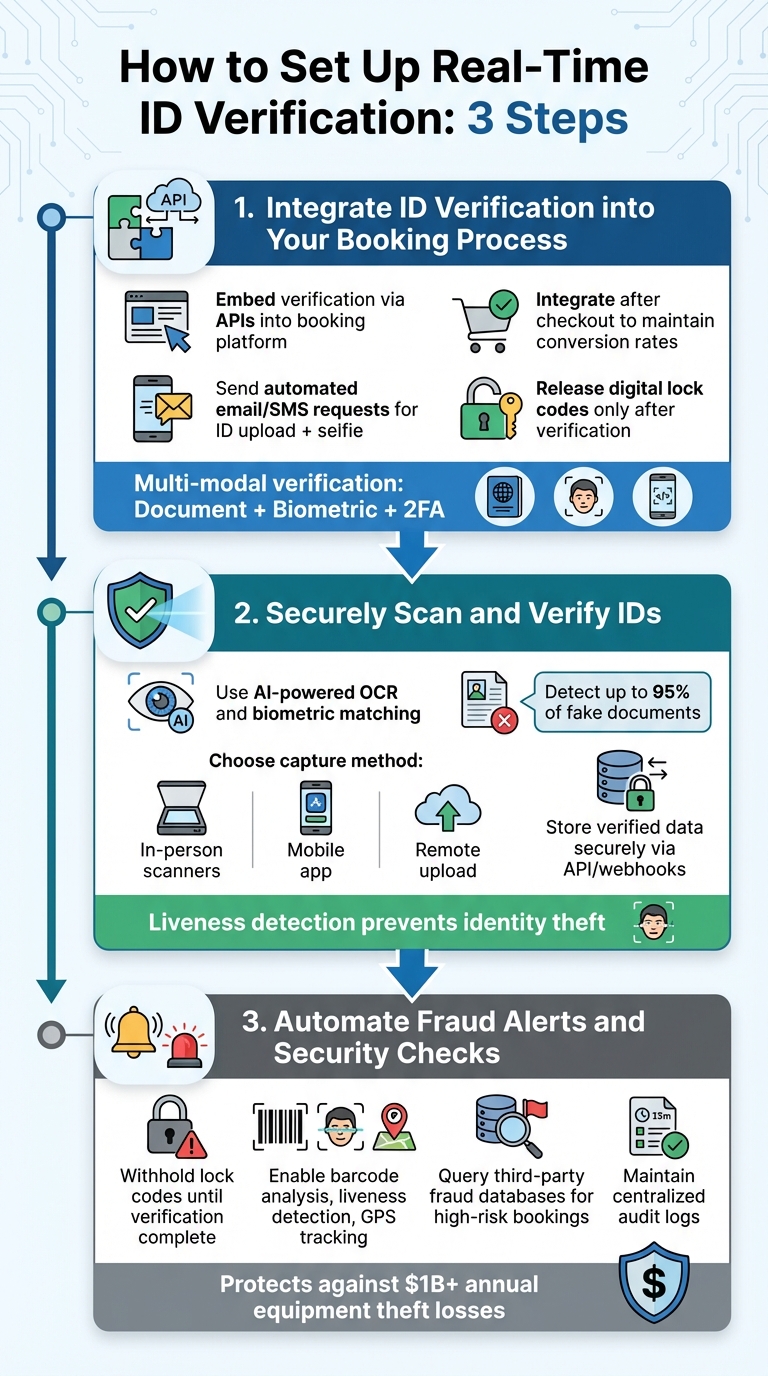
Step 1: Integrate ID Verification into Your Booking Process
Start by embedding ID verification directly into your online booking process. This is a critical step when building a contactless rental process. Many verification services offer APIs that can seamlessly connect to your existing booking platform or mobile app, ensuring a straightforward customer experience [2]. To keep conversion rates high while adding a layer of security, integrate the verification step after checkout. This ensures that only verified customers can access your equipment [2].
Once a booking is made, the system automatically sends a request - via email or SMS - for the customer to upload a government-issued ID and take a selfie. Access instructions, such as digital lock codes, are only shared after the ID is successfully verified [1]. This approach keeps the process simple for legitimate users while blocking unauthorized access.
For enhanced security, implement a multi-modal verification system. This combines document verification (scanning driver’s licenses or passports), biometric checks (facial recognition with liveness detection), and two-factor authentication [2][12]. Advanced scanning tools can even extract data from IDs directly into your rental agreements, reducing manual errors and saving time for your team [12]. Once this step is in place, the next focus is on securely capturing and verifying ID data.
Step 2: Securely Scan and Verify IDs
After integrating ID verification, ensure that the process for capturing ID images is secure and efficient. Use AI-powered tools like OCR (Optical Character Recognition) and biometric matching with liveness detection to validate IDs and automatically link the data to customer profiles [12][13]. These technologies are highly effective, detecting up to 95% of fake documents [12].
You have three main options for capturing ID images:
- In-person hardware scanners for counter-based rentals.
- Mobile app uploads for field operations.
- Remote uploads during online bookings.
For businesses scaling with contactless models, the remote upload option is ideal. Customers simply use their smartphone to photograph their ID, and the system takes care of the verification process [12][13].
Biometric matching ensures that the person presenting the ID is its rightful owner, significantly reducing the risk of identity theft [2][12]. All scanned ID data is securely stored in the customer’s profile via API or webhooks, creating a permanent record linked to each rental agreement [12][13].
"By documenting and securely storing a customer's verified government-issued ID, you increase asset security and streamline rental agreement creation." - integraRental [13]
With this secure setup, the next step is to automate fraud detection and maintain ongoing security.
Step 3: Automate Fraud Alerts and Security Checks
Set your system to withhold digital lock codes until verification is completed. Incorporate features like barcode analysis, liveness detection, and GPS-linked notifications to monitor for suspicious activity in real time [1][12]. Additionally, use centralized audit logs to track anomalies and ensure accountability.
For bookings flagged as high-risk, configure your system to query third-party databases that cross-reference customer information against fraud records. This step helps identify and block individuals with a history of fraudulent activity [12].
Maintaining a detailed record of each rental - from initial verification to final return - helps deter theft and streamline operations. The mere presence of an ID verification system can discourage potential criminals. With annual losses from stolen construction and farm equipment exceeding $1 billion, having a robust verification process can make a significant difference [12].
"Lockii has been a game changer for our trailer rental business. We now offer fully automated, contactless rentals. It's streamlined, secure, and exactly what our business needed to jump in front of our competitors!" - Mario Clewlow, Hitch Haul [1]
How Lockii's Real-Time ID Verification Helps Trailer Rental Businesses
Lockii's real-time ID verification brings a layer of security, efficiency, and convenience to trailer rental operations, streamlining processes while safeguarding assets.
Better Fraud Prevention and Security
Lockii ensures every ID is verified before releasing digital lock codes. This real-time process helps block unauthorized access to trailers, protecting your business from potential fraud.
The system also includes built-in fraud detection, flagging high-risk transactions immediately. Each rental is logged with GPS tracking and return photos, creating a traceable security record. This comprehensive setup minimizes risks like theft and misuse, giving you peace of mind.
Simpler Operations and Lower Costs
Beyond security, Lockii simplifies day-to-day operations and cuts costs significantly.
The automated ID verification process takes just 10 seconds, instantly generating and sending lock codes to customers once completed. This enables 24/7 self-service at multiple locations without requiring on-site staff.
Roughly 95% of bookings through Lockii are fully automated, allowing customers to manage extensions and payments online via a self-service portal. This reduces the need for support calls and administrative tasks. Businesses using Lockii often manage over 10 locations, scaling their operations without the high labor costs or real estate needs of traditional rental setups.
Since switching to Lockii, things have gotten so much easier. I was juggling three different systems before, and now it's all in one place. It saved me significant time and reduced stress.
Better Customer Experience
Lockii’s real-time verification doesn’t just protect your assets - it also transforms the rental process into a smooth, customer-friendly experience.
Using their smartphones, customers can complete verification in under five minutes with step-by-step guidance. This quick process eliminates the need for office visits or waiting, offering instant access to trailers.
For added convenience, QR codes and NFC tags on trailers let walk-up customers complete bookings and verification on-site. Once verified, they receive automated SMS and email instructions with their access codes, enabling pickups at any time. This contactless approach makes rentals more convenient while maintaining security.
It's allowed us to operate fully automated, 24/7 trailer rentals and scale that side of our operation with confidence.
Common ID Verification Setup Mistakes and How to Fix Them
Avoiding common missteps in your ID verification setup is crucial for ensuring a smooth and secure rental experience. Even small mistakes can lead to lower conversion rates and security vulnerabilities. Let’s dive into three frequent pitfalls and how to address them effectively.
Mistake 1: Not Teaching Customers How to Use the System
Assuming customers instinctively know how to navigate the ID verification process can backfire. Unclear instructions often lead to abandonment rates of 20-30%[4][9].
To counter this, provide clear, step-by-step on-screen instructions. Include visual examples that show how to position IDs correctly, ensure proper lighting, and take a clear selfie. Adding guided prompts or demo videos can significantly improve the experience - helping customers complete verification in under two minutes[3]. This not only boosts completion rates but also reduces the volume of support requests.
Proper communication and guidance go a long way, but the system itself needs to function flawlessly, which brings us to the next point.
Mistake 2: Skipping System Testing
Overlooking thorough testing can lead to major operational headaches. One rental platform discovered a 15% failure rate in verifications due to lighting issues before implementing adequate testing[3][11]. Other common problems include integration bugs, false positives in fraud detection, and delays during high-traffic periods - all of which can block legitimate customers and hurt your revenue.
To avoid these issues, test your system rigorously across various devices, lighting conditions, and usage scenarios. Confirm that it can handle peak traffic smoothly and accurately read IDs. By addressing potential glitches upfront, you’ll prevent customer frustration and ensure the system performs reliably when it matters most.
Once your system is tested, it’s essential to address compliance to protect both your business and your customers.
Mistake 3: Ignoring Data Security Rules
Neglecting data security compliance can lead to severe legal and financial consequences. For example, violations of the California Consumer Privacy Act (CCPA) or the Fair Credit Reporting Act (FCRA) can result in fines of up to $7,500 per infraction[4][6]. Beyond the financial penalties, failing to secure customer data erodes trust - 70% of consumers avoid platforms they perceive as insecure[4].
To stay compliant, document your data protection measures, conduct regular reviews of your security protocols, and securely store verified information. These practices safeguard your business from liability while reassuring customers that their personal information is in good hands. Building this trust is critical for long-term success.
Conclusion
Real-time ID verification is changing the game for trailer rental businesses by boosting security, cutting manual checks to under 10 seconds[3], and enabling 24/7 contactless rentals. By incorporating ID document scanning, selfie matching, and fraud alerts directly into the booking process, you can safeguard valuable equipment from theft and fraud while staying compliant with local regulations.
The benefits go beyond just security. Automation slashes labor costs and reduces administrative tasks, making it possible to scale operations across multiple locations without significantly increasing staff or overhead. With automated verification systems, managing over 10 locations becomes feasible, freeing up resources to focus on growth instead of time-consuming manual processes.
On top of operational improvements, customer experience gets a major upgrade. Mobile-first verification through app-based scanning allows renters to handle the entire process on their schedule, picking up trailers whenever it’s convenient for them. This level of convenience enhances trust and professionalism, which can directly boost booking rates and lead to more positive reviews.
However, success depends on proper execution. Ensure you provide clear instructions for customers, thoroughly test the system across devices, and comply with data security standards to avoid penalties[4]. Following these steps will give your business a competitive edge, setting you up for long-term growth in an increasingly automated industry.
Lockii offers an all-in-one solution by combining real-time ID verification with digital locks, GPS tracking, and self-service tools tailored for trailer rentals. Businesses like Hitch Haul and Empire Trailer Hire have already leveraged this platform to streamline their operations and expand efficiently. With Lockii, you get everything you need - security, automation, and customer convenience - in a single, seamless system designed to help your trailer rental business thrive.