
Self-Service Extensions for Trailer Rentals
June 18, 2026 · 11 min read
Self-Service Extensions for Trailer Rentals
Managing trailer rentals just got easier. Self-service systems now allow customers to extend rentals online anytime, eliminating delays and reducing staff workload. These platforms handle availability checks, payments, and scheduling automatically, ensuring efficiency and convenience for both businesses and customers.
Here’s what you need to know:
- Manual vs. Self-Service: Traditional methods rely on staff availability, causing delays. Self-service systems are available 24/7, processing requests in minutes.
- Payment Handling: Automated systems trigger payments instantly during the extension request, unlike manual setups that delay billing until return.
- Fleet Management: Automation prevents double bookings and ensures maintenance schedules are followed, reducing errors.
- Customer Experience: Self-service options improve accessibility and reduce support needs, allowing businesses to focus on growth.
For rental operators, platforms like Lockii streamline operations by integrating digital locks, automated billing, and scheduling safeguards, making it easier to scale efficiently. If you’re still relying on manual processes, it’s time to consider ways to automate rental business operations for a faster, more reliable rental experience.
Extension Methods and Workflow
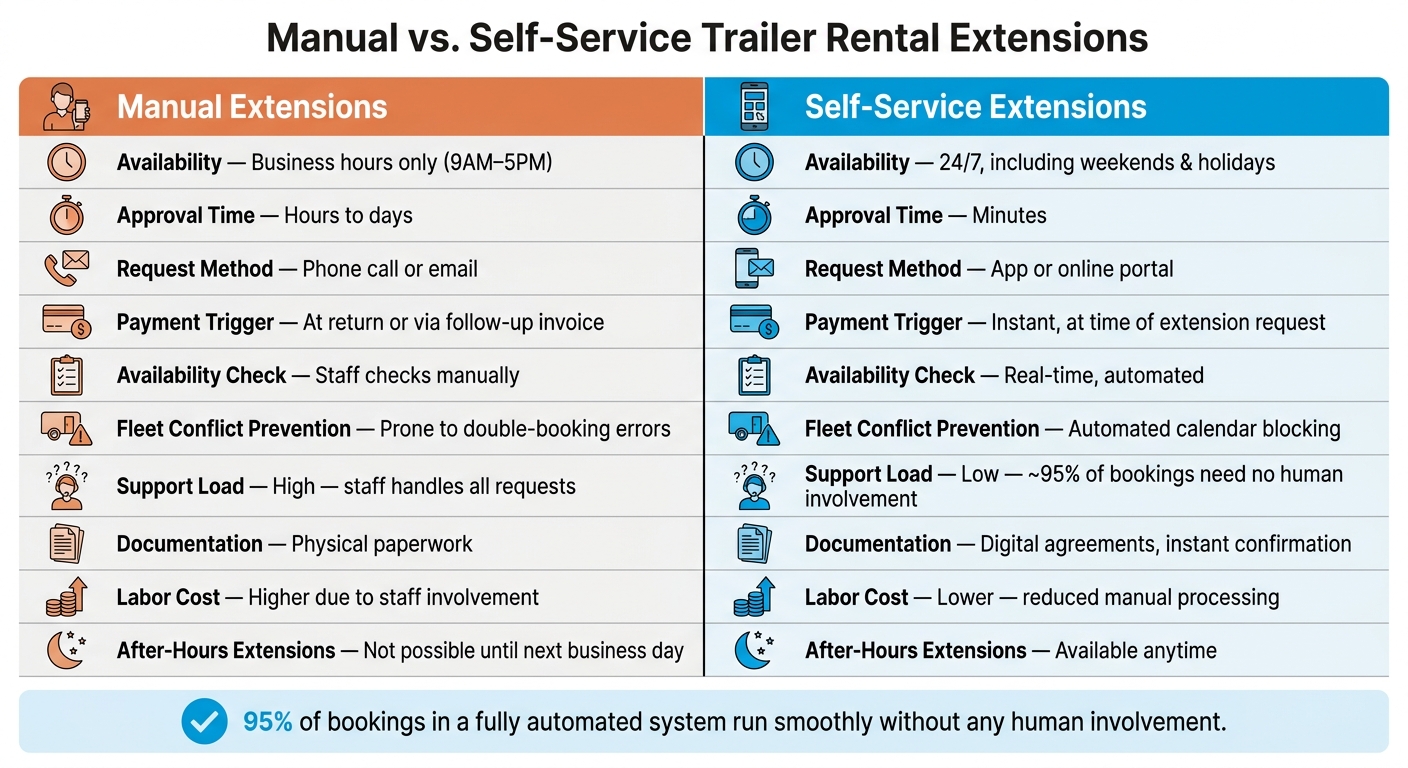
Traditional workflows depend heavily on staff availability, meaning they’re confined to business hours. Customers must call or email, wait for someone to check availability, and then wait again for payment to be processed. Any requests made outside business hours are left pending until the next workday. These delays are a key reason many businesses are shifting toward automated systems that save costs.
Self-service systems, on the other hand, let customers handle extensions instantly through an app or online portal. Automated checks and payment processing ensure the entire process is completed in minutes, no matter the time of day. Here’s a quick look at how the two systems compare:
| Step | Manual Method | Self-Service System | | --- | --- | --- | | Request Method | Phone call or email | App or customer portal | | Approval Time | Hours to days (business hours only) | Minutes (24/7) | | Availability Check | Staff checks manually | Real-time, automated | | Payment Processing | Invoiced or manual | Automated, secure online | | Documentation | Physical paperwork | Digital agreements and forms |
For multi-location trailer rental operators, these automated workflows are a game-changer. Extensions are confirmed in minutes, reducing risks like lost revenue from delayed approvals [4].
"With our new booking software... we are still able to get you your trailer when you need it", - M&S Trailer Rentals [3]
The value of 24/7 accessibility is especially clear for businesses managing multiple locations. Lockii’s contactless hire model, for instance, combines digital locks with automated workflows, allowing customers to pick up, return, or extend rentals at any time. This not only reduces the need for on-site staff but also addresses the operational challenges discussed earlier. By focusing on round-the-clock efficiency, Lockii provides the tools rental businesses need to thrive and grow.
Pricing and Billing Logic
Setting the right pricing for rental extensions is just as crucial as allowing extensions in the first place. Two common pricing models are fixed extra-day charges and daily rate logic, and each suits different types of rental operations.
With fixed pricing, the cost for an extra day stays the same no matter what the original rate was. For instance, U-Haul charges a flat $20 per day for trailer extensions on one-way moves [6]. This straightforward approach works well for longer trips, especially when plans can be unpredictable. On the other hand, local rental operators often rely on a daily rate system. Hitch Haul, for example, uses a tiered pricing structure: $120 for 24 hours, $325 for three days, and $630 for a week. Longer rentals come with discounts of up to 25%. However, if a customer extends their rental mid-way, the daily rate typically applies instead of the discounted tiers. These pricing strategies highlight the differences in how manual and automated billing systems handle extensions.
"Our rental process is simple. No deposit, no hidden fees."
Manual vs. Automated Billing Triggers
The biggest difference between manual and automated systems lies in when the payment is triggered. In manual setups, payment for an extension is often collected at the time of return or through a follow-up invoice. This delay can create uncertainty for both the customer and the business. Automated systems, however, streamline the process by requiring immediate payment when an extension is requested. For example, Lockii handles this seamlessly: customers log into the portal, pay the additional amount via Stripe, and receive updated digital paperwork instantly - all without needing staff intervention [7]. This real-time payment system not only builds trust but also boosts operational efficiency, aligning perfectly with automated trailer hire systems.
| Feature | Manual Billing | Self-Service Billing | | --- | --- | --- | | Billing Trigger | At return or via follow-up invoice | At time of extension request | | Payment Method | Phone, in-person, or invoiced | Automated online payment | | Transparency | Varies; prone to miscommunication | Itemized, instant digital confirmation | | After-Hours Extensions | Not possible until next business day | Available 24/7 |
Non-Refundable Extension Policies
It's important to note that most providers don’t refund unused time if a trailer is returned early after an extension has been paid [5]. This applies whether the extension was arranged manually or through a self-service platform. To avoid misunderstandings, customers should only extend their rental for the time they truly need. Clear communication of these non-refundable terms during checkout helps prevent disputes and ensures transparency, fostering trust between the business and its customers.
Fleet Availability and Scheduling Controls
Managing fleet availability is just as important as handling automated extension requests. When a customer extends their trailer rental, the system must immediately block that unit for the updated time frame. If this step is skipped, the trailer could accidentally get double-booked. This is especially problematic for high-utilization fleets, where even one scheduling conflict can disrupt multiple downstream reservations, leading to cancellations or reassignments.
Automated systems are far better at handling these situations than manual processes. A manual approach requires staff to check the calendar, ensure no conflicts, and then update the schedule. This process is slow, prone to errors, and unworkable for handling off-hours extensions. In contrast, an automated system processes everything in real time. For example, platforms like Lockii instantly verify trailer availability against the master calendar. If there’s a conflict, the system disables the extension option, ensuring no overlaps occur.
To make automation effective, operators need to set guardrails. These include cutoff rules, such as disallowing self-service extensions if another booking begins within four hours, and turnaround buffers, which allocate 30 to 60 minutes for cleaning and inspections between rentals. These rules can also be tailored by location. For instance, a busy urban yard might enforce stricter limits than a quieter rural site. Lockii’s multi-location architecture supports these adjustments, allowing rules to reflect actual demand rather than applying a blanket policy.
Maintenance scheduling is another critical component. Trailers that require servicing should never be available for extensions. Lockii addresses this by treating maintenance slots as fixed calendar events, just like confirmed bookings. If a trailer has a reported issue or a scheduled service during the requested extension period, the system flags the conflict automatically. This ensures that safety and compliance are prioritized without requiring staff to manually cross-check schedules.
Audit logs provide the final layer of control. Every extension request - whether approved or declined - is timestamped and linked to the trailer ID, the user who initiated the request, and the reason for the system’s decision. These logs are invaluable for resolving disputes, such as when a customer claims they extended their rental but lost access after the original end time. Lockii’s Item Audit Logs and Booking Audit Logs document the entire sequence of events, helping operators resolve issues quickly. They also reveal patterns, like frequent extension denials at specific times, which could indicate the need for more trailers or adjusted rental durations.
These integrated scheduling controls not only prevent conflicts but also enhance the customer experience by ensuring smooth, transparent rental extensions.
| Safeguard | What It Does | Scheduling Impact | | --- | --- | --- | | Cutoff rules | Blocks extensions too close to the next booking | Protects future reservations and ensures buffer time | | Maintenance blocks | Fixes service slots as unchangeable calendar events | Prevents extensions from bypassing safety checks | | Audit logs | Tracks all changes with timestamps | Facilitates dispute resolution and operational review | | Automated notifications | Alerts staff to short turnarounds; confirms extensions to customers | Keeps everyone informed with minimal manual effort |
Customer Experience and Support Load
Trailer rental customers often run into challenges when they need extra time - like late on a Sunday - only to discover that traditional rental businesses stick to regular hours (usually 9 AM–5 PM). Without a self-service option, they’re left with two choices: return the trailer on time or deal with late fees. Worse, there’s no quick way to request an extension. Self-service extensions solve this issue by letting customers manage their rentals whenever it’s convenient for them.
This self-service approach doesn’t just make life easier for customers - it also reduces the need for live customer support.
Take Freetrailer Group, for example. They operate a fully self-service trailer rental system and delivered an impressive 198,248 rentals in May 2026, even hitting a daily record of 10,311 rentals. Group CEO Thomas Zeihlund credited their success to their streamlined system:
"The strong performance... confirms that our team is ready to deliver a great user experience through a well-functioning trailer fleet, high system uptime... and excellent support for the relatively few customers who require assistance from our customer service team." [8]
Their results show how self-service extensions simplify operations, with only a small number of customers needing live support.
Automation tools like SMS and email reminders also help keep support requests low. For instance, Lockii automates communication by sending timely notifications before rentals expire, allowing customers to act quickly.
Additionally, customer portals give users the ability to view and adjust bookings themselves, while integrated AI tools handle common questions. This level of transparency reassures customers and prevents unnecessary support calls.
With these efficiencies in place, support teams can focus on higher-priority tasks. For trailer rental businesses with multiple locations or extended hours, cutting down on manual support isn’t just helpful - it’s key to growing successfully.
Pros and Cons
When it comes to trailer rental operations, both manual and automated self-service extension methods bring their own set of strengths and weaknesses. However, their differences in speed, cost, and customer experience become especially important when managing operations across multiple locations. This is a critical step when you start your automated trailer rental business. Below is a side-by-side comparison of the key benefits and challenges associated with each approach.
| Feature | Manual Extensions | Automated Self-Service Extensions | | --- | --- | --- | | Availability & Speed | Limited to traditional business hours; response time depends on staff availability | Available 24/7, including weekends and holidays - completed in just a few clicks [1] | | Labor Cost | Higher labor costs due to staff involvement for approvals and payment processing [2] | Lower costs by reducing manual processing requirements [2] | | Pricing Accuracy | Prone to inconsistencies and human error in pricing [2] | Automated systems ensure consistent rates, including weekend and seasonal adjustments [2] | | Fleet Visibility | Requires manual tracking and calendar checks [1] | Real-time updates through fleet scheduling software [1] | | Turnaround Costs | Shorter rental durations lead to more frequent turnaround cycles [2] | Longer rentals reduce turnaround frequency and related costs [2] | | Customer Experience | Offers a personal touch, ideal for complex or high-value scenarios [1] | Provides convenience and control, best suited for routine extensions [1] | | Support Load | Higher, as customers must directly interact with staff | Lower, since most requests are handled without human intervention |
The standout benefit of automation is efficiency:
"Trailer rentals give business owners the chance to manage the demands on their day-to-day operation without placing disproportionate burdens on their facilities or their people."
Even so, manual extensions still hold their place. For complex cases - such as a customer needing a trailer replacement or addressing damage - a human touch remains essential. Solutions like Lockii strike a balance by offering fully automated self-service options while also integrating AI-assisted tools for situations that require personalized attention.
Conclusion
Self-service extensions in trailer rentals are reshaping the industry. They reduce costs and lower support demands, and give customers the freedom to manage their rentals - evidenced by the fact that around 95% of bookings in a fully automated system run smoothly without any human involvement [7]. While manual processes are still needed for rare, complex cases, they often create unnecessary hurdles for routine extension requests. Adopting automation allows trailer rental businesses to expand into new locations without the need for a proportional increase in staff.
To maximize these advantages, businesses looking to modernize should consider a platform that handles every stage of the rental process. Lockii is designed for this purpose, offering features like self-service extensions, GPS tracking, automated billing, identity verification, and AI-powered customer support - all in one system. It’s a complete solution tailored for contactless trailer rentals across multiple locations, making operations smoother and enabling growth.
"Our mission is to democratize self-service rental technology so anyone can build and scale their own self-hire business - without needing a million-dollar software budget." - Lockii [7]
If your business is still managing extensions manually, you're likely wasting both time and money. Automation isn’t just a nice-to-have anymore - it’s the smarter, more efficient way to stay competitive.