
Self-Service Analytics vs. Traditional Reporting
May 17, 2026 · 11 min read
Self-Service Analytics vs. Traditional Reporting
When running a rental business, choosing the right data tool can greatly impact decision-making. Here's the key difference: traditional reporting provides pre-scheduled, structured reports with high accuracy, while self-service analytics offers real-time insights directly to managers for faster actions.
- Traditional Reporting: Best for accuracy, compliance, and financial audits but slow and dependent on IT.
- Self-Service Analytics: Ideal for real-time decisions, scalable across locations, and user-friendly for managers.
Quick Comparison:
| Feature | Traditional Reporting | Self-Service Analytics |
|---|---|---|
| Users | IT teams, analysts | Managers, team leads |
| Speed | Days to weeks | Seconds to minutes |
| Scalability | Limited by IT capacity | Expands easily across sites |
| Customization | Requires coding (e.g., SQL) | Drag-and-drop tools |
| Best Use Case | Audits, compliance, trends | Day-to-day operations |
For rental businesses, a hybrid approach combining both methods can provide the best balance of accuracy and speed. Tools like Lockii support this by ensuring clean, reliable data for both reporting and real-time dashboards.
How Traditional Reporting Works in Rental Businesses
The Basics of Traditional Reporting
Traditional reporting relies on a structured, IT-driven process. Here's how it works: data is collected from various sources like booking systems, payment processors, and maintenance logs. This data is then cleaned, organized, and stored in a centralized warehouse. From there, analysts create standardized reports that are distributed on a fixed schedule - usually weekly or monthly.
This approach ensures everyone in the organization works from the same "single source of truth." The numbers are consistent, defined uniformly, and presented reliably every time. This consistency is the backbone of traditional reporting and one of its greatest strengths.
What Traditional Reporting Does Well
Traditional reporting shines when it comes to accuracy and consistency. Since technical analysts carefully vet the data before it reaches decision-makers, the risk of acting on incorrect information is minimal. As the Scoop Team explains:
"Traditional BI isn't broken across the board. It still earns its place in environments where governance, accuracy, and compliance are non-negotiable." [4]
For rental businesses, this level of precision is crucial for tracking high-stakes metrics like annual revenue per location, equipment utilization rates, damage rates, and compliance documentation. These are areas where getting the numbers wrong simply isn't an option, and traditional reporting delivers dependable results. However, as operational demands grow, the limitations of this model become more apparent. Many companies turn to automating rental business operations to overcome these manual reporting hurdles.
Where Traditional Reporting Falls Short When Scaling
The challenges of traditional reporting become evident as businesses scale. For rental companies operating 24/7 across multiple locations, traditional reporting's limitations can create bottlenecks. The process typically functions on a request-based model: a manager identifies a need, submits a request to IT or an analyst, and then waits. In many cases, generating a new report can take anywhere from 3 to 6 weeks [5]. For fast-moving, multi-location operations, this delay can be a major obstacle.
While the focus on accuracy is valuable, the time it takes to produce reports often hampers timely decision-making. Another drawback is the complexity of traditional reporting tools. Many require SQL knowledge or advanced data modeling skills, which most operational staff lack. This is why approximately 90% of traditional BI licenses go unused [4].
For rental businesses managing multiple locations, these issues can quickly escalate. If a booking system changes or a new location is added, the existing reporting pipeline may break entirely, requiring weeks of IT intervention to fix [4]. This rigidity makes traditional reporting less effective for businesses that need to adapt quickly to changing conditions.
sbb-itb-eb44693
Self-Service Analytics for Contactless Rentals
What Self-Service Analytics Is
Self-service analytics gives frontline managers the power to dive into data instantly. They can open a dashboard, type a query, and get real-time insights from your rental software - no waiting on IT. Tools like drag-and-drop dashboards, ad hoc queries, and natural language queries (NLQ) make this possible. For example, with NLQ, a team member might ask, "Which rental location had the highest utilization last week?" and get an immediate answer - no coding or SQL knowledge required. This kind of instant access is a game-changer for quick decision-making, especially in multi-location contactless rental businesses.
"To be data-driven means everyone should ask questions and have access to tools and data to pursue answers." - Isaac Sacolick, Former CIO [6]
What Self-Service Analytics Does Well
One of the standout benefits is speed. Traditional reporting can take days or even weeks to generate, but self-service analytics delivers answers in seconds or minutes.
These tools also shine in real-time monitoring. Managers can track asset utilization as it happens, identify checkout issues, and set up automated alerts for anomalies. This means local managers can access critical data on their own, without needing to rely on central IT teams.
What You Need for Self-Service Analytics to Work
While speed and accessibility are essential, the real success of self-service analytics depends on data quality. Poor data can be a costly problem - businesses lose an average of $12.9 million annually due to bad data [1]. Even a single instance of inaccurate information can undermine trust in the system.
In the fast-paced world of contactless rentals, ensuring data integrity is crucial. To fully leverage the benefits of self-service analytics, three key elements are necessary:
- Clean, certified data: Automated quality checks should flag any anomalies right away to maintain reliable data.
- A semantic layer: This translates raw data into clear, consistent business metrics. For example, "utilization rate" should mean the same thing across all reports.
- Role-based access control (RBAC): This ensures that managers only see the data relevant to their specific location or fleet, keeping sensitive company-wide data secure.
Platforms like Lockii are designed to provide the structured data that self-service analytics tools rely on. Features such as booking audit logs, GPS tracking, identity verification timestamps, and hire-end photos ensure a steady flow of accurate, automated data. This data feeds directly into a semantic layer, eliminating the need for manual cleanup. With every completed booking, the system builds a stronger foundation for analytics, making it easier for businesses to stay on top of their operations.
Self-Service Analytics vs. Traditional Reporting: A Direct Comparison
Comparison Table: Key Differences
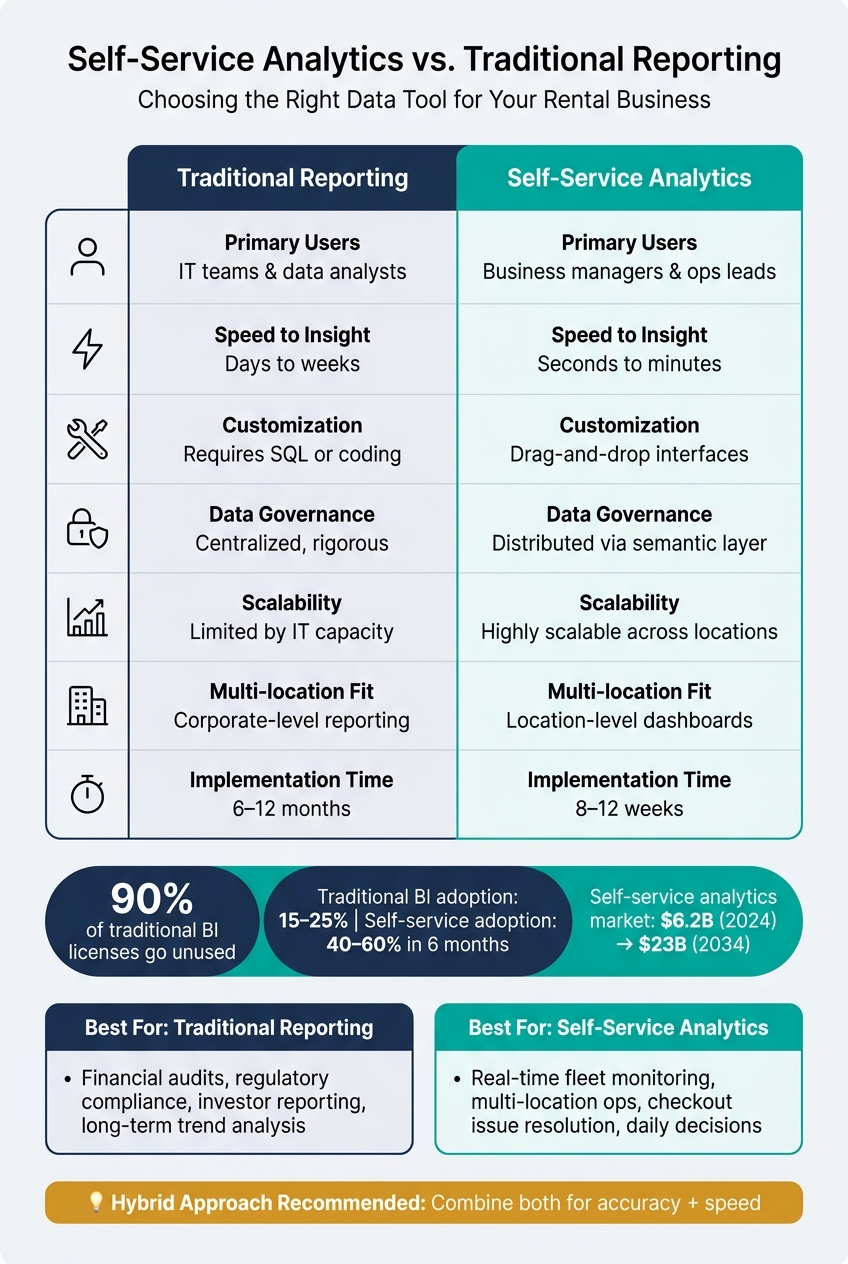
To build on the earlier discussion about speed and scalability, here’s a side-by-side comparison of traditional reporting and self-service analytics across key dimensions:
| Dimension | Traditional Reporting | Self-Service Analytics |
|---|---|---|
| Primary Users | IT teams and data analysts | Business managers and operations leads |
| Speed to Insight | Days to weeks (request-based) | Seconds to minutes (on-demand) |
| Customization | High, but requires SQL or coding | High autonomy via drag-and-drop interfaces |
| Data Governance | Centralized, rigorous control | Distributed, supported by a semantic layer |
| Scalability | Limited by IT staff capacity | Highly scalable across locations |
| Multi-location Fit | Best for consolidated corporate reporting | Best for location-level dashboards |
| Implementation Time | 6–12 months | 8–12 weeks |
The gap in adoption between these two approaches is quite noticeable. Traditional BI systems typically see adoption rates of just 15–25% across organizations. In contrast, self-service platforms can achieve adoption rates of 40–60% within six months [5]. Below, we’ll look at scenarios where each approach delivers the most value.
"With traditional BI, the business can only ask and answer questions as quickly as its skilled analysts are able to work." - Chris Tozzi, Freelance Writer and IT Professor [2]
When Traditional Reporting Is the Better Fit
Traditional reporting shines in structured, high-stakes scenarios where precision is critical. For instance, if your rental business needs to handle financial audits, meet regulatory compliance requirements, or provide long-term trend analyses for investors, this method is ideal. Its centralized and controlled data pipelines ensure that every figure is thoroughly verified before reaching stakeholders - an absolute must where accuracy is non-negotiable [5].
This approach also excels at managing complex, fragmented data. It consolidates information from multiple systems - like ERPs, payment processors, and CRMs - into a single, reliable source of truth [2]. This capability is crucial when addressing large-scale, multifaceted reporting needs.
When Self-Service Analytics Is the Better Fit
For day-to-day operations - especially in multi-location, contactless rental businesses - self-service analytics is the better option. Local managers can access real-time data to monitor fleet utilization, address checkout issues as they arise, and take immediate action without waiting for IT support. This speed is critical when, for example, a trailer sits idle or a digital lock malfunctions at a remote site.
Self-service analytics also scales effortlessly. Adding a new rental location doesn’t require hiring more analysts; instead, managers at the new site can utilize the same dashboard framework already in use. Tools like Lockii make this seamless by capturing structured, audit-ready data - everything from bookings and GPS pings to identity verifications and hire-end photos - and feeding it directly into self-service dashboards. These real-time insights ensure that your business stays agile and grows efficiently, without falling behind operationally.
"The question isn't which approach is better - it's which approach aligns with your organization's current state, strategic priorities, and readiness." - Promethium.ai [5]
Domo Solutions: Mastering Self-Service Analytics On Your Data Warehouse
Picking the Right Analytics Approach for Your Rental Business
Aligning your analytics strategy with your business goals is essential for ensuring smooth operations and long-term success.
Matching Analytics to Your Business Goals
The choice between traditional reporting and self-service analytics depends on your specific objectives. Traditional reporting works best for tasks like financial audits, investor updates, or regulatory compliance, where accuracy and controlled processes are key. Every number is verified before it reaches stakeholders, ensuring reliability [5]. On the other hand, self-service analytics is ideal for operational goals like expanding rental locations, enhancing asset utilization, or minimizing equipment downtime. It empowers managers to get answers quickly without relying on IT support.
If your focus is on analyzing historical data, traditional reporting is the way to go. But for solving real-time issues, self-service analytics provides quicker, actionable insights [4].
Using Both Approaches Together
Adopting a hybrid model combines the strengths of both methods, offering a balance between comprehensive oversight and quick decision-making. Most rental businesses benefit from this approach, using traditional reporting for high-level financial tracking and self-service analytics for day-to-day operations [5].
For example, you can generate monthly profit and loss statements and compliance reports through a centralized system while equipping location managers with real-time dashboards to monitor fleet availability and booking trends. A shared semantic layer - defining key metrics like "downtime" or "utilization rate" consistently - ensures that operational data aligns with official reports [3].
"Modern BI is not about dashboards or tools - it's about building a system where data is both trusted and instantly accessible across the organization." - Deepak Singh, SEO & Content Writer, Supaboard [1]
Lockii supports this hybrid model by automatically capturing structured, audit-ready data such as booking logs, identity verifications, GPS tracking, hire-end photos, and maintenance records. This clean, well-organized data feeds directly into operational dashboards, making it easier to maintain the hybrid approach as your business grows. The result? Improved operational efficiency and a solid foundation for long-term expansion.
Conclusion
Selecting the right analytics approach can make or break a business, especially in industries like contactless rentals where speed and precision are non-negotiable. Traditional reporting offers the accuracy needed for financial oversight, while self-service analytics delivers the quick, actionable insights that keep daily operations running smoothly.
However, traditional business intelligence (BI) often faces hurdles like tight budgets and lengthy timelines. Meanwhile, the self-service analytics market is projected to grow from $6.2 billion in 2024 to $23 billion by 2034 [5], signaling a shift toward faster and more accessible data solutions. Traditional methods excel in providing controlled, consistent data for compliance, but self-service analytics shines in enabling operational flexibility. Lockii bridges this gap, offering a tailored solution for multi-location contactless rental operations.
For contactless rental companies, delays in accessing data can lead to booking issues, equipment downtime, and failed checkouts. As Jason James, CIO at Net Health, puts it:
"The speed of business and competition now requires that stakeholders have quick access to meaningful data to make decisions." [6]
Lockii ensures businesses have both the structured, audit-ready data they need - like booking logs, identity verifications, GPS events, hire-end photos, and maintenance records - and the real-time insights required for immediate decision-making. This dual capability empowers managers to act quickly while giving owners the records necessary for financial oversight. By blending traditional and self-service analytics, rental businesses can streamline operations, scale efficiently, and make smarter decisions. To see the financial impact of these improvements, you can use a contactless rental ROI calculator.
Ultimately, the right choice depends on your business priorities, but democratized data access is key to growing faster and operating smarter.