Scalable Marketing Tools for Multi-Location Rentals
May 29, 2026 · 13 min read
Scalable Marketing Tools for Multi-Location Rentals
Running multiple rental locations can quickly become overwhelming without the right systems in place. The biggest challenges include inconsistent lead management, fragmented customer communication, and duplicated workflows. These issues lead to missed opportunities, wasted time, and a disjointed customer experience. The solution? Automation.
Here’s what automation can do for you:
- Streamline lead management: Capture and manage inquiries centrally, reducing errors and missed bookings.
- Unify communication: Ensure consistent messaging across locations with automated emails, SMS, and templates.
- Eliminate repetitive tasks: Automate booking confirmations, payment processing, and identity verification.
- Enable 24/7 operations: Offer self-service options like digital lock codes and customer portals for contactless rentals.
- Centralize data: Gain a clear overview of performance across all locations from a single dashboard.
With tools like Lockii, you can manage bookings, communication, and inventory seamlessly across multiple locations. This allows you to expand your business without adding staff, improve customer satisfaction, and increase revenue by up to 10% within months. If you’re struggling to grow efficiently, automation might be the game-changer you need.
Marketing Problems When Scaling Multi-Location Rentals
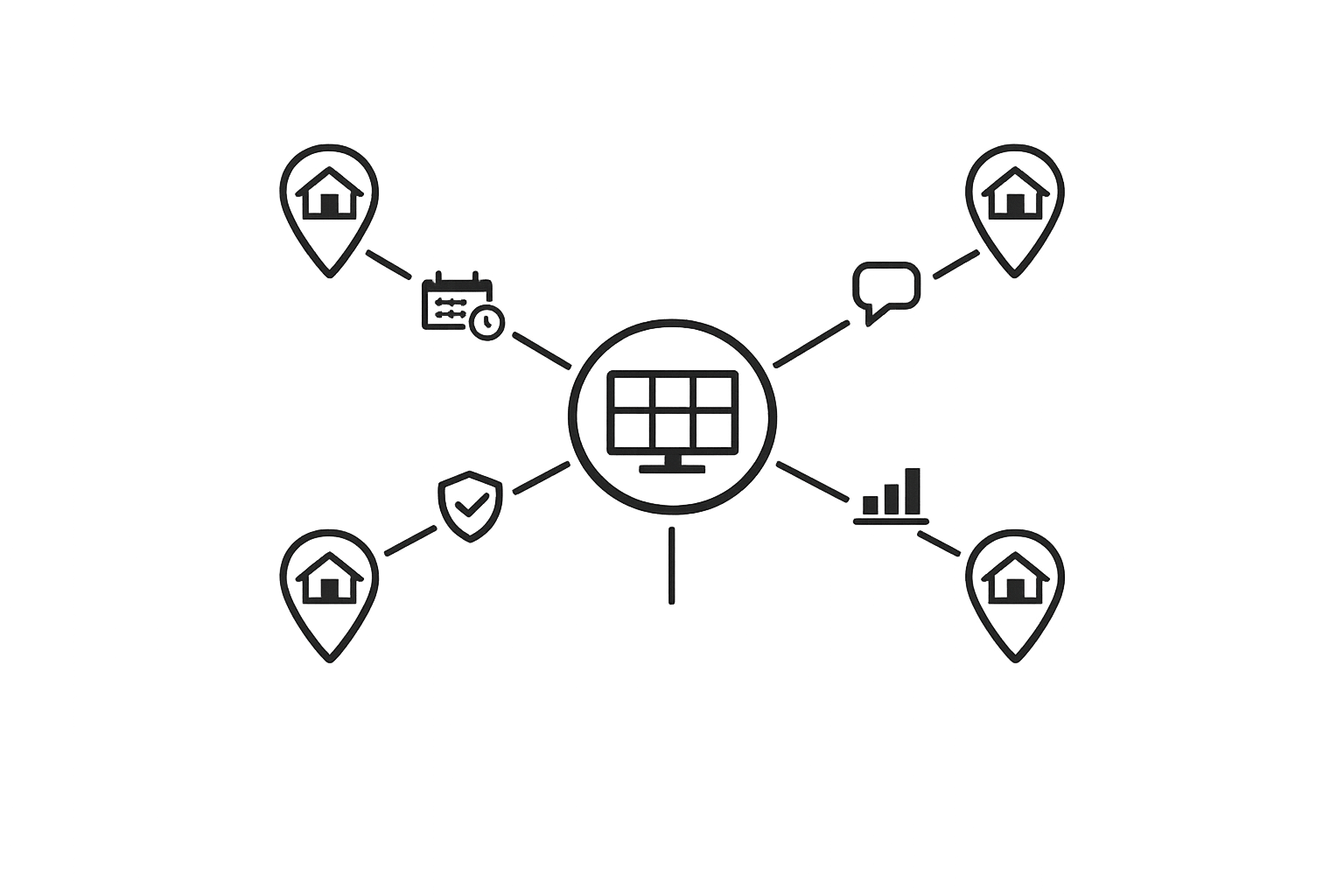
Expanding rental operations across multiple locations often reveals gaps in marketing and operational efficiency. These issues highlight the importance of automated systems for managing multi-location rentals. Common challenges include inconsistent lead management, fragmented customer communication, and duplicated workflows.
Inconsistent Lead Handling Across Locations
When locations handle inquiries differently, leads often slip through the cracks. Customers may experience slow responses or, worse, no response at all. Modern rental automation platforms can address this by managing up to 95% of bookings without human intervention [3]. Businesses sticking to manual processes risk losing a significant portion of potential revenue. These inconsistencies also extend to customer interactions, creating further inefficiencies. Automation offers a way to fix these problems and ensure smoother operations.
Fragmented Customer Communication
When communication methods vary by location, it creates confusion for customers. For example, one branch might confirm bookings via email, another through SMS, and a third over the phone. This lack of uniformity can damage trust in your brand. Managing these channels manually also increases the likelihood of errors and customer dissatisfaction. Hayden Given, Owner of 208 Trailer Rental, shared his perspective: [2]
"We've even had customers switch over from competitors specifically because their system was too complicated. This CRM has made a noticeable difference in both customer experience and conversions."
Automation can streamline communication, providing a consistent and reliable experience for customers.
Duplicated Work and Data Silos
Without a unified system, teams often find themselves repeating tasks like manually entering bookings or sending follow-ups. This duplication wastes time and makes scaling more difficult. Additionally, data silos - where information is spread across spreadsheets or disconnected tools - make it nearly impossible to get a clear view of overall performance. This lack of visibility hinders the ability to identify trends, address underperforming locations, or make smart investment decisions. Matt Cole, Founder of Empire Trailer Hire, explained the impact of fragmented systems: [2]
"I was juggling three different systems before, and now it's all in one place. It's saved me a heap of time and stress, and I can actually focus on running the business again."
By centralizing operations, automation eliminates duplicated work and consolidates data, enabling better decision-making.
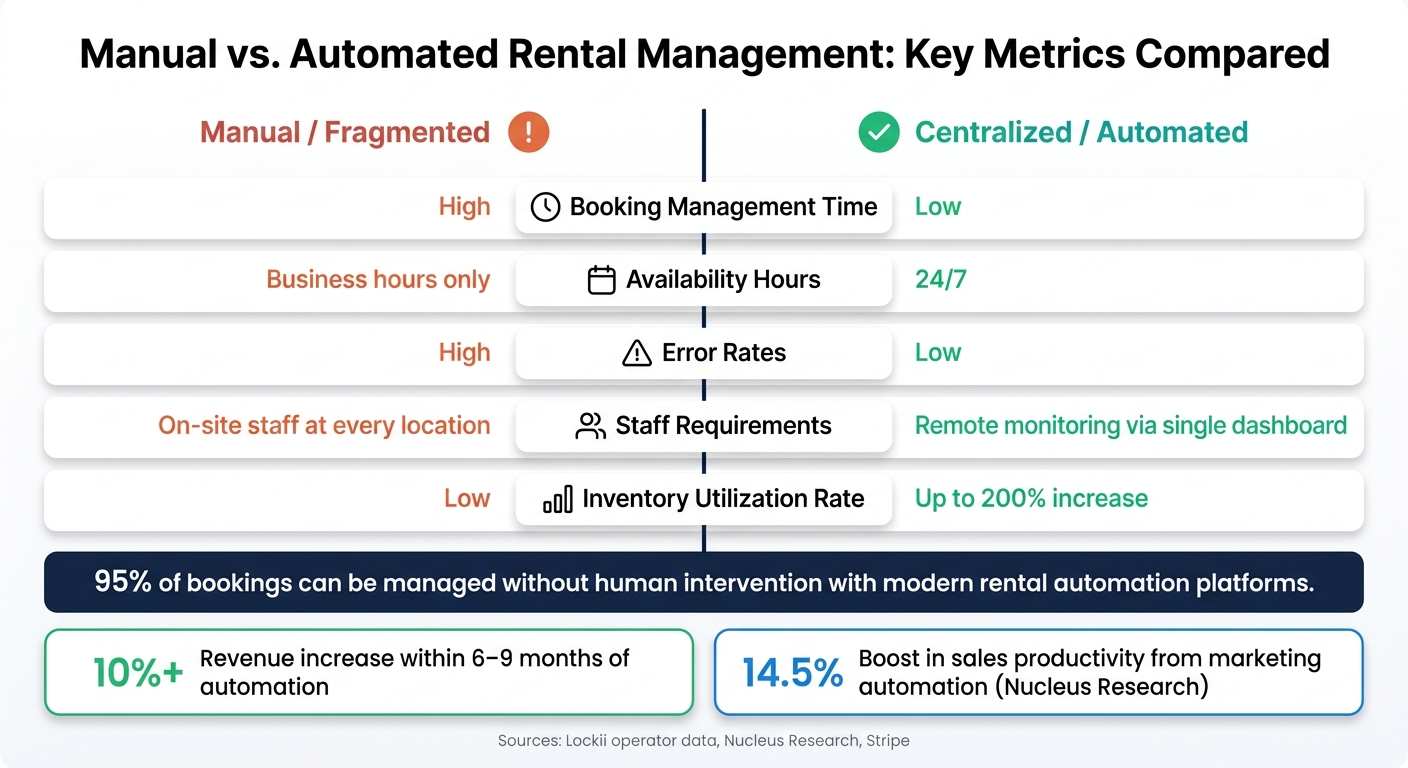
The table below highlights key differences between manual and centralized processes:
| Metric | Manual / Fragmented | Centralized / Automated |
|---|---|---|
| Booking management time | High | Low |
| Availability hours | Business hours only | 24/7 |
| Error rates | High | Low |
| Staff requirements | On-site staff at every location | Remote monitoring via single dashboard |
| Inventory utilization rate | Low | Up to 200% increase [1] |
What Scalable Marketing Automation Must Do
To address the challenges of managing multiple locations, scalable automation needs to seamlessly integrate lead capture with customer communication. As businesses expand, systems must handle higher volumes without requiring additional staff. Without automation, adding locations only amplifies existing operational hurdles.
Automated Lead Capture and Management
One of the core components of scalable automation is embedding booking widgets on each location's webpage. These widgets do more than collect contact details - they provide real-time availability, pricing details, and directly feed booking information into a centralized system the moment a reservation is completed. This eliminates the need for manual data entry and follow-ups, saving time and reducing errors.
A single widget template can be replicated across all locations. Global settings remain consistent, but each location can customize details like inventory, pickup instructions, or deposit amounts. Once a lead is captured, automated workflows kick in, sending confirmation messages, identity verification links, and processing payments. Businesses that implement such systems often experience a revenue increase of over 10% within six to nine months. This automation not only simplifies lead management but also creates a solid foundation for unified communication across locations.
Centralized Customer Communication
After capturing leads, clear and consistent communication becomes crucial. When individual locations use separate email accounts or phone numbers, inconsistencies can confuse customers. A centralized messaging system solves this by managing all SMS and email communications across locations. Shared templates can automatically populate key details like addresses, pickup times, and instructions, ensuring consistency.
This approach is especially critical for time-sensitive updates. For example, 48% of consumers prefer SMS for urgent notifications, and SMS open rates hover around 98%, far surpassing email. For businesses with contactless systems, sending a digital lock code via SMS just 30 minutes before a pickup isn’t just convenient - it’s what customers expect for reliability and immediacy.
Location-Specific Booking Workflows
Centralized systems don’t mean sacrificing flexibility. Each location can still operate with its unique settings, such as different inventory, pricing, or verification requirements. Scalable automation accommodates these variations through location-specific configurations rather than creating entirely separate systems for each site.
A shared workflow engine makes this possible. It ensures consistent booking processes while adapting to local needs. For instance, one location might send a digital lock code automatically, while another might require customers to visit a staffed counter during business hours. Tools like Lockii are designed for this model, providing a single interface to manage booking rules, digital lock integrations, and access workflows across multiple locations. This unified yet adaptable system ensures smooth operations and supports a scalable marketing strategy across all locations.
Scalable Marketing Tools for Multi-Location Rentals
When managing rentals across multiple locations, having the right tools makes all the difference. Here’s a breakdown of essential tools that tackle key challenges and work together as a cohesive system for marketing and operations.
Booking Widgets for Lead Capture
An embeddable booking widget simplifies online bookings by acting as your digital front desk. Whether it’s placed on your website, a location-specific landing page, or a partner site, it allows customers to check availability, view pricing, and book instantly - no phone calls or emails required. Bookings are automatically logged into a centralized system, tagged by location, asset, and source, giving you a clear view of which locations and campaigns are driving revenue.
For multi-location operators, the beauty lies in scalability. A single widget template can be deployed across all locations, eliminating the need for separate systems or manual tracking for each branch.
Automated Customer Communication and Management
Once a booking is made, automation steps in to handle communication. Customers receive immediate confirmations and timely reminders (24 hours and 2 hours before pickup). For contactless rentals, digital lock codes are sent just before arrival. After the rental ends, automated follow-ups encourage customers to complete surveys, upload return photos, and leave reviews.
A self-service customer portal further streamlines operations. Renters can manage their bookings 24/7 - extending rentals, updating payment details, or reviewing pickup instructions - without needing to contact support. This feature aligns with growing consumer expectations, as Salesforce reports that 76% of customers expect seamless interactions across all touchpoints.
Identity Verification and Fraud Prevention
For unattended or 24/7 rental locations, verifying customer identities is critical to preventing theft, non-returns, and payment disputes. A TransUnion study highlights the growing risk of identity fraud in mobility and travel, with losses increasing at double-digit rates annually.
Integrated verification tools simplify this process by automating ID scanning, selfie matching, and payment validation during booking. Only verified customers receive lock codes, significantly reducing risks. Stripe notes that businesses using these verification workflows see a 20–50% drop in fraudulent chargebacks [4].
AI-Powered Customer Support Tools
Rental businesses often face repetitive customer inquiries - like "Where's my booking?" or "Can I extend my rental?" AI-powered support tools handle these questions by pulling precise, context-specific answers directly from booking and policy data. This ensures 24/7 coverage without relying on generic FAQs.
The financial benefits are clear. Juniper Research projects that AI chatbots will save businesses over $11 billion annually in customer service costs by 2027. For multi-location rental operators, this kind of automation minimizes staffing needs while ensuring customers get quick answers to straightforward questions. Complex issues can still be escalated to human support when necessary.
Multi-Location Management with Lockii
Lockii brings all these tools under one roof, creating a streamlined platform for managing rentals across multiple locations. Lockii combines booking widgets, automated communication, identity verification, a self-service customer portal, AI support, GPS tracking, maintenance tracking, and detailed audit logs - all accessible from a single dashboard.
GPS tracking and audit logs are especially useful for managing distributed fleets. You can set alerts for late returns or off-route movements and maintain a complete record of every booking and item interaction. Lockii integrates seamlessly with tools like IglooHome (digital locks), Stripe (payments and identity), and Zapier (workflow automation), making it easy to incorporate into your existing systems.
"Lockii has been a game-changer for our business. It's allowed us to operate fully automated, 24/7 trailer rentals and scale that side of our operation with confidence." - Yvann Karamoko, Operator, The Trailer Co [6]
sbb-itb-eb44693
How to Choose the Right Tools for Growth
Key Criteria for Selecting Multi-Location Tools
Start by outlining your growth plan. Are you planning to expand to multiple locations within the next 12–36 months? Will these locations be staffed, or are you envisioning fully contactless, unmanned sites? The answers to these questions will help determine which features your tools need most.
Look for platforms that offer built-in multi-location support. This means each location can manage its own inventory, operating hours, pricing, and pickup instructions - all while being controlled through a single dashboard. Centralized templates for email, SMS, and booking flows are also essential, with the flexibility for local adjustments like varying tax rates or state-specific rental terms.
Pricing structure is another important consideration. Opt for platforms that offer predictable pricing - such as per-location or per-asset models - rather than per-user fees, which can become costly as your business grows.
Finally, ensure the platform you choose integrates smoothly into your existing workflows. Tools that don’t fit seamlessly will likely cause inefficiencies as you scale.
Integrations and Workflow Compatibility
A tool is only as good as its ability to work with the systems you already use. Check for compatibility with your payment processor, digital lock provider, and automation tools. For example:
- Payment processing: Platforms like Stripe simplify USD transactions, deposits, and pre-authorizations.
- Digital lock systems: Providers like IglooHome enable access codes tied to specific booking windows.
- Automation tools: Tools like Zapier allow you to connect your rental platform to your CRM, accounting software, or marketing systems - no custom development required.
Here’s a practical way to test your tool stack: Can a customer book at 10:30 p.m., verify their identity, receive a lock code, pick up the rental, extend their booking, and return it - all without staff involvement? If your tools can’t support this fully automated process, scaling to more locations will be challenging.
Lockii as a Complete Solution
If you’re looking for a solution that checks all these boxes, Lockii is a standout choice. Lockii supports unlimited locations under one account, with centralized management for inventory, pricing, and access instructions. It also integrates natively with essential tools like IglooHome, Stripe, and Zapier, so you won’t need custom development to connect your systems.
What makes Lockii especially effective for scaling businesses is its ability to automate the entire rental process. From booking widgets and identity verification to automated SMS/email notifications, self-service extensions, and GPS tracking, it covers every stage of the rental lifecycle. It even handles USD payments, deposits, and the documentation needed for dispute resolution - making it particularly useful for U.S.-based operators.
Businesses in industries like trailer, equipment, bike, and vehicle rentals have used Lockii to expand quickly, without the need for on-site staff or large physical offices. By offering an all-in-one, automated solution, Lockii simplifies multi-location operations and helps businesses scale faster and more efficiently.
Growing Your Business Without Adding Staff
Automated systems allow rental businesses to expand across multiple locations without the need to increase staff, making scaling more efficient and less resource-intensive.
Instant Responses for Better Customer Experience
Speed matters - a lot. Harvard Business Review highlights that businesses responding to new leads within 60 minutes are 7x more likely to qualify them compared to those that take 1–24 hours. For businesses operating in multiple locations and relying on manual follow-ups, this narrow window can close quickly, especially after hours.
Automated workflows ensure immediate responses the moment a customer submits a booking request. For instance, if someone books a trailer late on a Friday, they instantly receive an SMS confirmation, pricing details, and a payment link. This seamless interaction builds trust right from the start, ensures no leads slip through the cracks, and provides a foundation for scalable growth.
Simplified Expansion to New Locations
Traditionally, opening a new location means hiring staff and recreating processes from scratch. But technology shifts this dynamic entirely. Tools like Lockii enable you to set up a new location within your existing system - configuring inventory, pricing, access instructions, and automated workflows - all without needing on-site personnel. This transforms expansion into a simple software and hardware setup, significantly reducing both cost and operational challenges.
"Lockii has been a game changer for our trailer rental business. We now offer fully automated, contactless rentals. It's streamlined, secure, and exactly what our business needed to jump in front of our competitors!" - Mario Clewlow, Operator, Hitch Haul [5]
As you grow, ensuring a consistent customer experience across all locations becomes essential.
Unified Branding Across Locations
Scaling often introduces the risk of brand drift, where each location develops its own look and feel. This inconsistency can hurt customer trust. In fact, research from Lucidpress shows that consistent brand presentation across channels can boost revenue by up to 23%, and 87% of consumers say they value a uniform experience across all touchpoints.
Centralized platforms address this by storing booking widgets, email and SMS templates, terms, and customer-facing instructions in one system. This ensures that whether a customer books in Phoenix or Chicago, they receive the same polished experience. Localized details - such as addresses, parking instructions, or regional pricing - can still be tailored without disrupting the overall brand identity.
Conclusion: Scale Smarter with the Right Tools
Handling marketing manually for multi-location rentals doesn’t just slow you down - it can actively drain your business by missing leads and wasting time on repetitive tasks. But the solution isn’t hiring more staff - it’s working smarter with better tools.
The key takeaway? Centralize your lead capture, communication, identity verification, and support into one streamlined platform. According to Nucleus Research, marketing automation can lead to a 14.5% boost in sales productivity and cut marketing costs by 12.2% on average. For businesses with multiple locations, these benefits multiply as you grow.
Platforms like Lockii are tailor-made for this purpose. They help automate lead management, communication, identity checks, and support. Operators managing fleets across 200+ locations have reported automating up to 95% of their bookings [3][6].
"Lockii has made our business efficient in managing our bookings; saving us a lot of time to focus on the growth of the business." - Charlie Haddad, Operator, Trailer 4 Hire [6]
To get started, conduct a quick audit of your current processes. Ask yourself: _Where are leads slipping through the cracks? Which locations have inconsistent workflows? Where does your team spend the most manual effort?_ Pick two or three areas to automate, test them in your busiest locations, and track the results. Over 60–90 days, measure key metrics like lead response time, labor hours, and overall bookings. Let those insights shape your next steps.