AI Risk Scoring for Rental Fraud Prevention
April 30, 2026 · 10 min read
AI Risk Scoring for Rental Fraud Prevention
AI risk scoring is transforming how rental businesses combat fraud, especially in contactless models where manual verification isn't feasible. Here's the key takeaway: AI systems analyze hundreds of fraud indicators in seconds, detecting fake documents, identity theft, and coordinated scams with over 95% accuracy. This ensures faster approvals for legitimate renters while flagging high-risk cases for review.
Why It Matters:
- Fraud costs rental businesses millions annually, with 24% of U.S. evictions linked to false applications.
- AI identifies advanced fraud tactics, like fake pay stubs or reused templates, which manual reviews often miss.
- Speed matters: AI processes applications in as little as 20 seconds, compared to days for manual checks.
How It Works:
- AI reviews documents (IDs, pay stubs, etc.) for signs of tampering, like pixel inconsistencies or metadata anomalies.
- It cross-checks applicant data with credit bureaus, employment records, and public databases.
- Behavioral analysis flags patterns, such as repeated use of fake employers or mismatched details.
Benefits for Rental Businesses:
- Automates approvals for 80% of legitimate applications, cutting manual workloads by up to 90%, helping to solve labor shortages.
- Reduces financial risks tied to evictions, legal fees, and property damage.
- Integrates seamlessly with property management tools for real-time decision-making.
With fraud becoming more sophisticated, AI risk scoring is a powerful tool for protecting rental operations while keeping the application process efficient and secure.
How AI Risk Scoring Detects Fraud
Data Points AI Systems Analyze
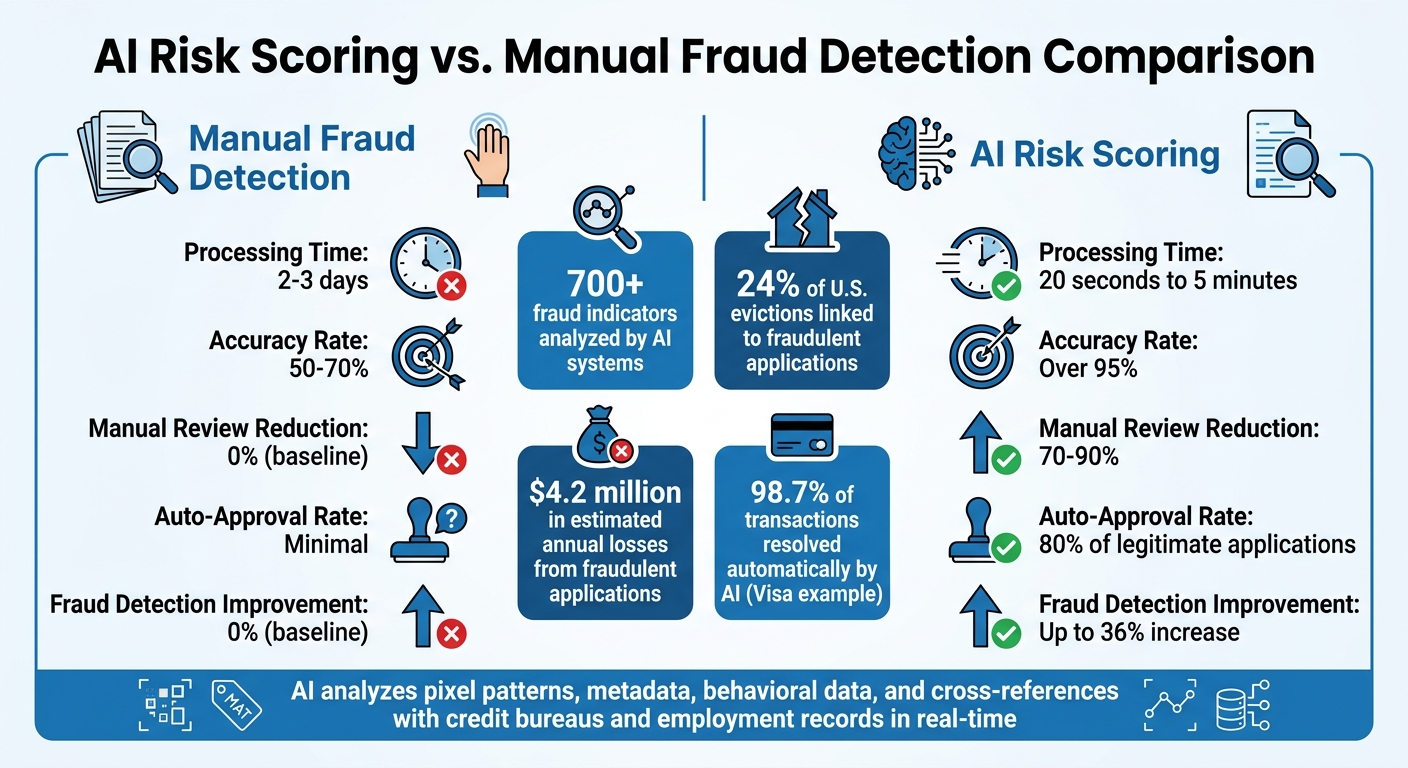
AI systems evaluate over 700 fraud indicators, providing actionable insights in less than 20 seconds [4][5]. By reviewing a range of documents - such as government-issued IDs, utility bills, pay stubs, tax forms, and employment records - AI can verify identity and financial details, uncovering signs of theft or forgery [4][5].
Document forensics play a key role too. By analyzing metadata, file structures, and pixel inconsistencies, AI can detect digital manipulation [4][5]. Many systems now integrate directly with platforms like Plaid for real-time financial data from banks and payroll providers, sidestepping the risks associated with manually uploaded, potentially altered documents [5][6].
AI doesn’t stop there. It dives into rental and credit histories, identifying patterns that go beyond standard credit scores. For instance, it can differentiate medical debt from recent collections, review eviction records, and validate rental references [4][6]. Behavioral data is another critical layer, helping to identify reused document templates (so-called "template farms") and cross-referencing details like employment and residential history to uncover inconsistencies [3][4].
By implementing AI for document fraud detection, businesses can increase fraud detection rates by up to 36%, while cutting manual review workloads by as much as 70% to 90% as part of a broader strategy to automate rental business operations [4][5]. These systems can automatically approve about 80% of legitimate documents, speeding up onboarding significantly [4].
This detailed analysis lays the groundwork for identifying fraud through behavioral and pattern-based insights.
How AI Identifies Fraudulent Patterns
AI pinpoints fraud by identifying signs of tampering in documents. This includes inconsistencies in fonts, pixel-level alterations, or even deepfake elements [4][5].
Patrick Hennessey, Vice President at Yardi, highlights the importance of these tools:
"While property management companies and renters continue to embrace open banking and other technology solutions to verify income, there are still instances where authenticating pay stubs is their only option. Nova Credit's enriched document fraud detection helps protect our clients from the growing threat of document manipulation" [5].
AI systems validate applicant-provided data by cross-referencing it with third-party databases, such as credit bureaus, employment records, and public filings. They also use anomaly detection to match incoming applications against known fraud patterns, flagging discrepancies in income, employment history, or identity [3][4][7].
Behavioral and pattern recognition adds another layer of defense. For example, AI can identify red flags like repeated use of the same bank account or employer across unrelated applications, or frequent address changes that don’t align with reported income [7][8]. Even in self-service rental processes, these systems can catch subtle fraud attempts. Advanced tools also harness natural language processing (NLP) to scan lease agreements and application text for inconsistencies that human reviewers might miss [8].
Alarmingly, nearly 24% of U.S. eviction filings are tied to fraudulent applications [8]. To address this, AI systems provide clear risk assessments with labels like "High Risk" (likely fraudulent), "Warning" (requires review), "Normal" (no issues), or "Trusted" (matches authentic templates) [4].
Real-Time Risk Scoring for Faster Decisions
When fraudulent patterns are detected, AI delivers real-time risk scores to streamline decision-making.
These systems provide verdicts in as little as 20 seconds to 5 minutes [4][8], a dramatic improvement over the 2–3 days typically needed for manual reviews. Despite the speed, AI achieves over 95% accuracy in fraud detection, compared to the 50–70% accuracy of traditional methods [4][8].
Low-risk applications are processed automatically for instant approvals, while high-risk cases are flagged for manual review. This approach prevents bottlenecks in rental workflows and ensures legitimate customers aren’t delayed.
AI also excels at identifying recurring fraud, such as repeated use of fabricated employer details or fraudulent templates. Additionally, it provides structured reason codes and audit-ready evidence, ensuring compliance with Fair Housing regulations.
Akaash Gupta, Head of Tenant Screening Partnerships at Nova Credit, underscores the value of these advancements:
"As document manipulation becomes increasingly convincing, property managers need protection that evolves at the same pace. Our AI-improved features examine hundreds of fraud indicators to catch sophisticated attempts at fraud, while maintaining the streamlined application process that renters expect" [5].
With its ability to operate around the clock, AI ensures rapid and precise risk assessments, protecting rental businesses while maintaining a smooth and efficient experience for customers.
sbb-itb-eb44693
How to Implement AI Risk Scoring in Your Rental Business
To secure your contactless rental operations, incorporating AI risk scoring can make a big difference.
Selecting an AI Risk Scoring Platform
Start by choosing a platform that matches your fraud risk profile and operational needs. Look for systems that analyze file-level forensics - this includes examining pixel patterns, layer structures, and metadata consistency to detect AI-generated manipulations [2].
A weighted scoring model (ranging from 0–100) is ideal for capturing subtle risk variations. For instance, Visa's Decision Manager in 2023 screened 3.2 billion transactions, preventing an estimated $33 billion in potential fraud losses. Impressively, 98.7% of these transactions were resolved automatically by AI [9].
Make sure the platform integrates seamlessly with your existing tools through APIs and webhooks. If you’re using property management software like AppFolio, Yardi, or Entrata, ensure the AI scores can populate custom fields directly. This eliminates the need for your team to juggle multiple logins [6]. For contactless rentals, verify that the platform connects smoothly with your booking systems and payment processors.
"By automating fraud management, businesses can quickly respond to emerging threats, improve customer trust and accept more good transactions without adding unnecessary friction" [9].
- John Munn, Head of Global Data Science at Visa
Once you've selected the right platform, focus on integrating it into your system without disrupting your workflow.
Integrating AI into Your Rental Workflow
For contactless rental operations, start by reviewing past applications to identify the specific red flags your AI should target [6]. This ensures the system is tailored to your business’s unique risks.
Begin with a shadow mode setup. In this mode, the AI evaluates incoming applications while your team continues with current processes. This allows you to compare results and fine-tune the system before fully implementing it [6]. Businesses using automated risk decisioning platforms have reported reducing manual reviews by over 25% with this strategy [9].
Train your staff to recognize AI-flagged issues, such as metadata inconsistencies or template mismatches. To encourage vigilance, consider rewarding employees who identify fraudulent applications [1]. Also, ensure decisions include structured reason codes to stay compliant with Fair Housing regulations and maintain thorough, audit-ready records [2].
Using Lockii for Automated Fraud Prevention
A great example of a tailored solution is Lockii, designed specifically for contactless rental operations. Lockii’s identity verification feature checks customer documents during bookings, while booking audit logs and item audit logs track every rental interaction.
Lockii works continuously, handling verifications and risk assessments without requiring staff input. It integrates with tools like Stripe and Zapier, creating multiple layers of verification to catch fraud early.
The platform also flags suspicious patterns, such as repeated bookings from the same device or mismatched customer details across reservations. Features like GPS tracking and hire end photos provide detailed documentation, which can assist in fraud investigations and insurance claims.
Operating across unlimited locations, Lockii centralizes management, making it easier to standardize fraud prevention protocols. This approach is crucial for over 50% of large rental operators who identify fraud and bad debt as significant challenges [1].
Balancing Fraud Prevention with Customer Experience
Stopping fraud is critical, but it shouldn't come at the cost of frustrating legitimate customers. The key lies in finding a balance - using methods that reduce errors while keeping customers informed and engaged.
Reducing False Positives and Negatives
AI-driven risk scoring has changed the game in fraud detection, boasting over 95% accuracy compared to the 50–70% range of manual reviews. How? By analyzing behavioral signals and file-level details like pixel patterns, metadata, and PDF artifacts. But even the best AI systems aren't perfect, which is why combining them with human oversight is crucial. For instance, a human reviewer might step in to evaluate edge cases, such as an applicant with a high income but limited credit history, ensuring fair decisions are made [2][8].
Regular audits are another must. Sampling AI decisions periodically can help uncover hidden biases or patterns of unfair denials. Documenting human overrides also sharpens the system over time. The fewer errors there are, the smoother the experience for genuine applicants - leading to happier customers overall [8].
Building Customer Trust through Clear Communication
Cutting down on false flags isn't just about efficiency; it's also about fostering trust. Customers are more likely to feel confident in the process if they understand why decisions are made. Providing clear and specific reason codes - like "three revisions within two years" - empowers applicants to dispute decisions when needed. This transparency also ensures compliance with Fair Housing regulations and reassures applicants that the process is fair and unbiased [2][8].
For contactless rental models, this balance is especially important. Customers expect fast approvals, and rapid processing for low-risk applicants shows that security doesn't have to mean inconvenience. At the same time, fraud prevention measures are essential to protect businesses from the estimated $4.2 million in annual losses caused by fraudulent applications [8]. Striking this balance helps build a system that's both secure and customer-friendly.
Conclusion
Fraud prevention has become a key challenge for contactless rental operations. Over half of the largest rental operators - those managing 10,000 or more units - identify fraud and bad debt as major hurdles [1]. The rise of generative AI, which can produce fake documents in mere minutes, has made traditional fraud detection methods ineffective [1].
AI risk scoring is reshaping fraud detection by leveraging file-level forensics. It analyzes pixel patterns, metadata, and layer composition - details that human reviewers simply can't detect. This technology not only identifies individual fraud attempts but also exposes patterns of serial fraud across multiple applications. As Ocrolus puts it:
"The core challenge is no longer spotting obvious forgeries. It is about building workflows that can distinguish authentic documents from sophisticated synthetic ones at scale, without slowing down leasing decisions" [2].
In the world of 24/7 contactless rentals, speed and security are non-negotiable. AI-powered systems can process applications in seconds, routing low-risk files while flagging high-risk ones, ensuring operations stay efficient and secure without creating delays.
The combination of speed, accuracy, and security makes AI risk scoring an ideal solution when paired with integrated technologies. For example, Lockii combines identity verification, AI-driven fraud detection, digital locks, automated communication tools, and GPS tracking. This layered system enables rental businesses to operate securely without on-site staff, making it possible to scale operations across multiple locations while minimizing financial risks tied to fraudulent applications.
With eviction processes often taking six months or more and repair costs piling up [1], delaying the adoption of AI risk scoring only increases exposure to fraud and financial losses. Now is the time to act - every moment of inaction could mean greater risks and higher costs.