Future of Smart Locks in Contactless Rentals
June 5, 2026 · 11 min read
Future of Smart Locks in Contactless Rentals
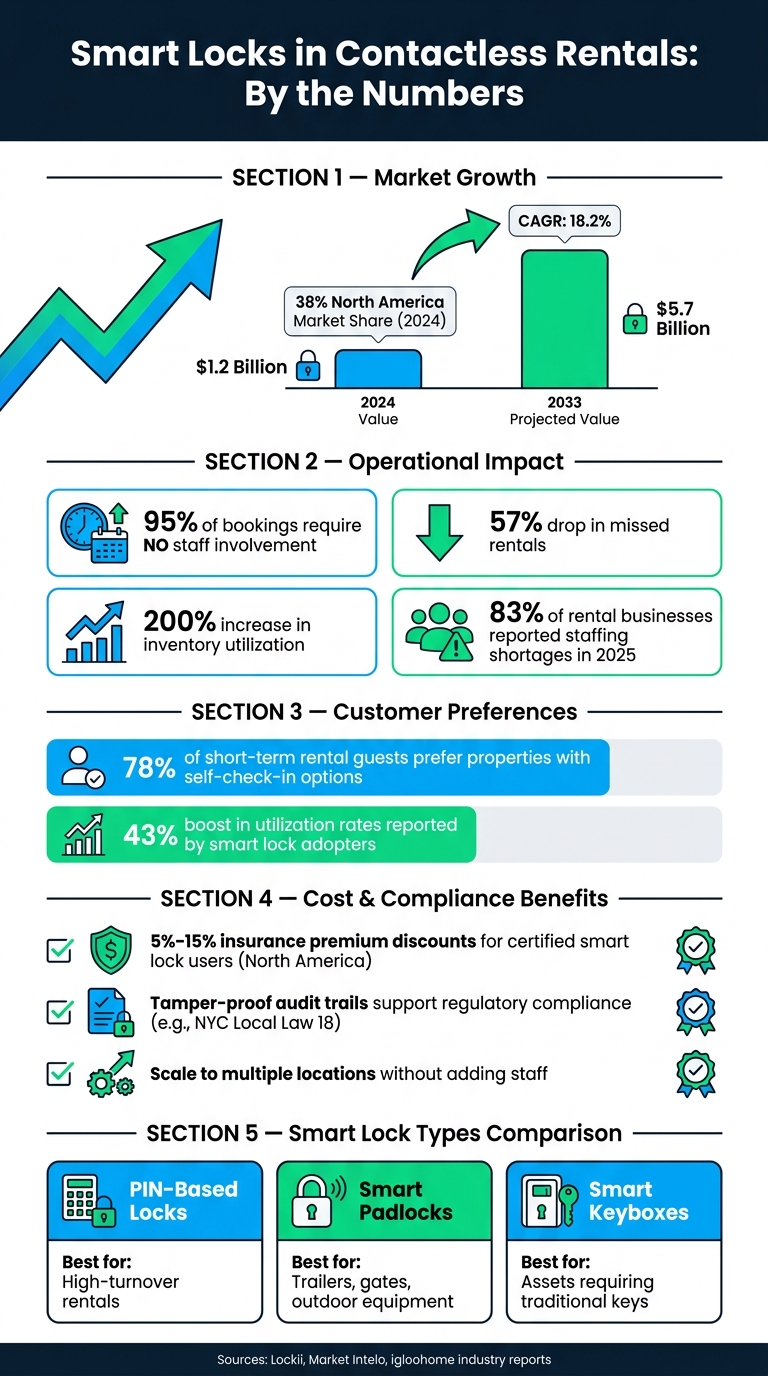
Smart locks are transforming the rental industry by enabling 24/7 self-service access. These devices replace physical keys with time-limited PIN codes, sent to customers after online booking. This eliminates staff involvement in 95% of bookings, reduces missed rentals by 57%, and boosts inventory utilization by 200%.
Key benefits include:
- Streamlined Access: Customers receive PINs via SMS or email, valid only during the rental period.
- Remote Management: Operators can oversee multiple locations from a single dashboard.
- Enhanced Security: Features like GPS tracking, identity verification, and digital logs ensure accountability.
- Cost Savings: Businesses can scale without hiring additional staff.
Smart locks also integrate with platforms like Lockii to automate processes like booking, identity checks, and return documentation. With a projected market growth from $1.2 billion in 2024 to $5.7 billion by 2033, adopting smart locks is a strategic move for rental businesses aiming to stay competitive.
Smart Locks in the Rental Industry: The Basics
What Are Smart Locks and How Do They Work?
Smart locks replace traditional keys with digital access credentials. In the rental industry, this often means issuing a unique, time-limited PIN code when a booking is completed. These codes are sent via SMS or email, are valid only during the rental period, and expire automatically once the booking ends. This eliminates the need for manual resets or physical key exchanges.
Many smart locks are designed to operate offline, relying on battery power and specialized time-sync technology. This ensures they can validate PIN codes locally, which is especially useful in areas with limited connectivity or remote locations.
When combined with platforms like Lockii, smart locks offer more than just access control. They can integrate identity verification, log every access event, and even request return photos when equipment is dropped off. This combination of features is revolutionizing contactless rental operations by streamlining workflows and enhancing security.
Why Smart Locks Work Well for Contactless Rentals
Traditional rental processes often require staff to be present for key handovers and ID checks, which limits flexibility and scalability. Smart locks eliminate these constraints, enabling self-service access 24/7. This shift has allowed 95% of bookings to occur without staff involvement [1], making it a game-changer for rental businesses.
"It's saved me a heap of time and stress, and I can actually focus on running the business again." - Matt Cole, Owner, Empire Trailer Hire [1]
Smart locks also provide enhanced security. Time-sensitive PIN codes, paired with automated identity checks, often make these systems more secure than traditional key handover methods.
Types of Smart Locks Used in Rentals Today
Different types of smart locks cater to various rental needs, offering flexibility based on the type of asset and use case.
| Lock Type | How Access Works | Best For | | --- | --- | --- | | PIN-Based Locks | Customers enter a code on a keypad | High-turnover rentals; no app needed | | Smart Padlocks | Access via PIN or Bluetooth | Trailers, gates, and outdoor equipment | | Smart Keyboxes | Holds a traditional key inside | Assets that can't be directly fitted with a lock |
For businesses renting out trailers, bikes, or equipment, PIN-based locks and smart padlocks are often the top choices. They simplify access by removing the need for app downloads at pickup. On the other hand, smart keyboxes are perfect for assets that require a traditional key but still benefit from secure, automated access.
The real power of smart locks lies in their integration with rental management platforms. A standalone smart lock is just a tool, but when connected to a platform, it becomes a seamless part of an automated system - handling everything from booking to identity verification, PIN generation, and even return documentation, all without manual input.
Smart Lock Market Trends and Growing Adoption
Market Growth and Key Adoption Trends
The smart lock market is gaining momentum fast. In 2024, the global smart lock market for vacation rentals was estimated at $1.2 billion and is expected to grow to $5.7 billion by 2033, with a compound annual growth rate (CAGR) of 18.2% [5]. North America is at the forefront, accounting for around 38% of the total market share in 2024 [5].
This growth highlights the challenges traditional methods face in keeping up with demand. For instance, 83% of rental businesses reported severe staffing shortages in 2025 [4]. Manual processes are no longer sufficient. Companies that adopted integrated smart lock systems reported a 57% drop in missed rentals and a 43% boost in utilization rates [4].
Beyond operational pressures, customer expectations are driving the shift. Renters in industries like equipment, trailers, and bikes increasingly demand on-demand, after-hours access. This push for convenience is speeding up the adoption of smarter, more compliant systems. The hospitality sector offers valuable insights into how contactless solutions can meet these evolving demands.
What the Hospitality Sector Can Teach the Rental Industry
Hotels and short-term rental hosts were early adopters of smart lock technology, and their success offers a roadmap for other rental industries. With 78% of short-term rental guests preferring properties with self-check-in options [6], it’s clear that automated access builds trust through verifiable, time-stamped logs. This approach has influenced broader rental markets.
Operators managing assets like trailers, bikes, or equipment can apply the same strategy: automate handovers, document access, and scale operations without increasing staff.
"Smart locks offer a compelling value proposition by enabling contactless entry, temporary digital keys, and real-time access logs, all of which are highly valued by both guests and hosts." - Market Intelo [5]
Platforms such as Lockii are adapting these hospitality lessons for the rental industry. They combine booking, identity verification, PIN generation, and return documentation into one seamless workflow, making it easier for businesses to adopt.
Security and Compliance Considerations
While the operational benefits of smart locks are clear, their security features are equally important. Time-sensitive digital codes that automatically expire or can be revoked remotely create a tamper-proof audit trail unmatched by traditional key handovers [5].
This functionality also supports compliance with evolving regulations. For example, New York City's Local Law 18 requires strict registration and auditable access control for short-term rentals [6]. Smart lock systems generate access logs that help meet these legal requirements while eliminating manual paperwork. Additionally, insurance providers in North America often offer 5% to 15% premium discounts for rental operations using certified smart lock systems [6], making the investment even more appealing.
For businesses managing high-value assets like trailers or equipment, tools like Lockii’s audit logs provide detailed documentation of who accessed what and when - ensuring accountability across all locations.
What's Next: Emerging Smart Lock Technologies
Biometric and Multi-Factor Authentication
The latest smart lock systems are stepping up security by verifying identities before granting access. Many rental platforms now combine _digital identity verification_ with time-sensitive PIN codes that are only active during the rental period [1]. For example, integrating a driver's license check into the booking process significantly reduces fraud, which is especially crucial for high-value rentals like trailers or heavy equipment [2].
"Verify your customers identity & contact methods before access codes are sent to clients and verify pickups and returns with GPS and return photos." - Lockii [2]
Additional security measures, such as GPS tracking and mandatory return photos, create a thorough record of every rental, even after the lock is opened [1]. These features, paired with strong identity checks, ensure a seamless yet secure experience for users - no extra apps required.
- * *
Mobile‑First and App‑Free Access
A major trend in smart locks is the shift toward app-free access. Customers no longer need to download an app to pick up a rental. Instead, modern systems use SMS or email to provide access, removing unnecessary steps and making the process much smoother [1]. Platforms like Lockii take it a step further: with QR codes or NFC tags, customers can skip lengthy booking processes and unlock rentals instantly [2].
"Customers standing in front of the item they want can just scan a QR code or tap their phone to an NFC tag to instantly skip through the booking process and pick up instantly." - Lockii [2]
This streamlined access is just the beginning - AI-powered tools are also transforming smart lock reliability.
- * *
AI and Predictive Maintenance for Smart Locks
While access becomes easier for users, AI technology ensures that the systems behind these locks remain efficient and secure. For instance, AI tools can now flag overdue returns or other issues, notifying operators only when their attention is needed [1]. Lockii’s technology supports rental fleets of up to 600 trailers, monitoring activity and sending alerts the moment a problem arises [3]. Features like mandatory return photos and digital checklists also help track the condition of items, making it easier to spot maintenance needs early [3].
"The business is notified of any issues such as unaccounted for movements by the item or hires that are overdue." - igloohome [1]
On the hardware side, companies like IglooHome are designing advanced locks that run on batteries, ensuring they work even in areas without Wi-Fi or cellular coverage. This reliability is critical for remote or off-grid locations [1].
How to Set Up Smart Locks for Contactless Rentals
Now that you understand the perks of smart locks, it’s time to set up your system. Start by pinpointing your specific operational needs.
Identifying Your Business Needs and Use Cases
Before diving into hardware purchases, take a moment to define what your operation truly requires. For instance, a trailer rental business with multiple unmanned locations will have very different needs compared to a single-location bike rental shop with part-time staff. To figure out what works best for you, ask yourself these three questions:
- Where are your assets stored? Are they in an urban lot, a remote area, or spread across multiple locations?
- What is the value of each rental item? High-value items might need stricter identity verification.
- What do your customers expect at pickup? Do they want instant access, or are they okay with a quick verification step?
Your answers will shape your hardware choices and software workflows. For example, high-value rentals might need advanced verification and tracking, while simpler PIN-based systems work well for lower-value items like bikes or surfboards.
- * *
How to Choose the Right Smart Lock Hardware
When picking smart locks, make sure the hardware integrates smoothly with your management platform. If it doesn’t, you’ll end up stuck with manual data entry, which defeats the purpose of going contactless.
Here are four key factors to consider:
- Keypad Access Over App-Based Access: Opt for locks with physical or touchscreen keypads. Requiring customers to download a Bluetooth app often leads to frustration and extra support calls.
- Offline Reliability: For remote or outdoor locations, choose locks that store codes locally or use algorithmic PIN generation (like IglooHome). This ensures customers won’t be locked out during a Wi-Fi outage.
- Weather Resistance and Battery Life: Outdoor locks should withstand tough weather conditions and operate reliably on battery power.
- Physical Backup: Always have a keyed override or manual lockbox available. This serves as a safety net in case of hardware issues.
Here’s a quick comparison of common lock types:
| Lock Type | Best For | Key Advantage | Main Limitation | | --- | --- | --- | --- | | Wi-Fi Smart Locks | Most rental setups | Real-time syncing and remote management | Needs stable Wi-Fi; drains battery faster | | Offline Algorithmic (e.g., IglooHome) | Remote/outdoor assets | Works without Wi-Fi or cellular data | Requires specific software integration | | Bluetooth Locks | Small fleets, owner-operated setups | Proximity-based secure access | Guests must download an app | | Retrofit Locks | Condos/HOAs with existing hardware | Uses existing exterior hardware | Often lacks a keypad |
Once you’ve chosen the right hardware, the next step is to create a seamless, software-driven workflow.
- * *
Building a Software-Driven Access Workflow
The hardware is important, but it’s the software that makes contactless rentals truly efficient. A well-designed workflow typically looks like this: a customer books online, their identity is verified, a unique PIN is generated for their rental period, the PIN is sent via SMS or email, and it automatically expires when the rental ends.
Platforms like Lockii handle this entire process, combining booking, identity checks, code delivery, GPS tracking, and return photo confirmations into one streamlined system.
In fact, businesses using automated workflows like this have reported that 95% of bookings require no staff interaction, while inventory utilization rates have jumped by 200% [1].
Here’s a tip: set access codes to expire 1–2 hours after the scheduled return time. This small buffer allows customers to retrieve forgotten items without leaving your assets vulnerable.
Conclusion: Getting Your Rental Business Ready for Smart Locks
Smart locks have become a game-changer for rental businesses, aligning perfectly with what modern customers expect. Today’s renters want the convenience of booking online, verifying their identity digitally, and picking up keys - if they even need them - at any hour, without having to interact with staff. Companies that adapt to these demands are setting themselves apart in a competitive market.
The numbers back this up: businesses that adopt integrated rental technology have seen a 57% drop in missed rentals and a 43% boost in utilization rates [4]. Specifically, operators using IglooHome locks with Lockii have reported an impressive 200% increase in inventory utilization [1], thanks to improved asset availability.
Beyond streamlining operations, this approach opens doors to scalable growth. With the right tools in place, you can expand to new locations without adding extra staff, oversee everything from one centralized dashboard, and let automation handle tasks like identity verification, PIN delivery, and return confirmations. This ensures 24/7 access and seamless workflows, as discussed throughout this guide.
To capitalize on these benefits, the next step is clear: start by implementing online booking and payment systems, choose hardware that fits your specific needs, and integrate it all with a software platform designed to automate the process. Businesses that act now will position themselves for long-term success, while those that wait risk falling behind.