How GPS Tracking Prevents Rental Asset Theft
March 26, 2026 · 13 min read
How GPS Tracking Prevents Rental Asset Theft
Rental asset theft costs U.S. businesses over $1 billion annually, with recovery rates below 25% without tracking technology. GPS tracking changes the game by offering real-time location updates, geofencing alerts, and tamper detection to prevent theft and speed up recovery.
Here’s what you need to know:
- Costs of Theft: Each theft costs businesses an average of $30,000, plus lost revenue ($150–$1,800/day) and insurance premium hikes (20–40%).
- Why Theft Happens: Universal keys, poor yard security, and off-hours theft make equipment easy targets.
- How GPS Helps: Track real-time locations, set geofences for alerts, and detect tampering or movement.
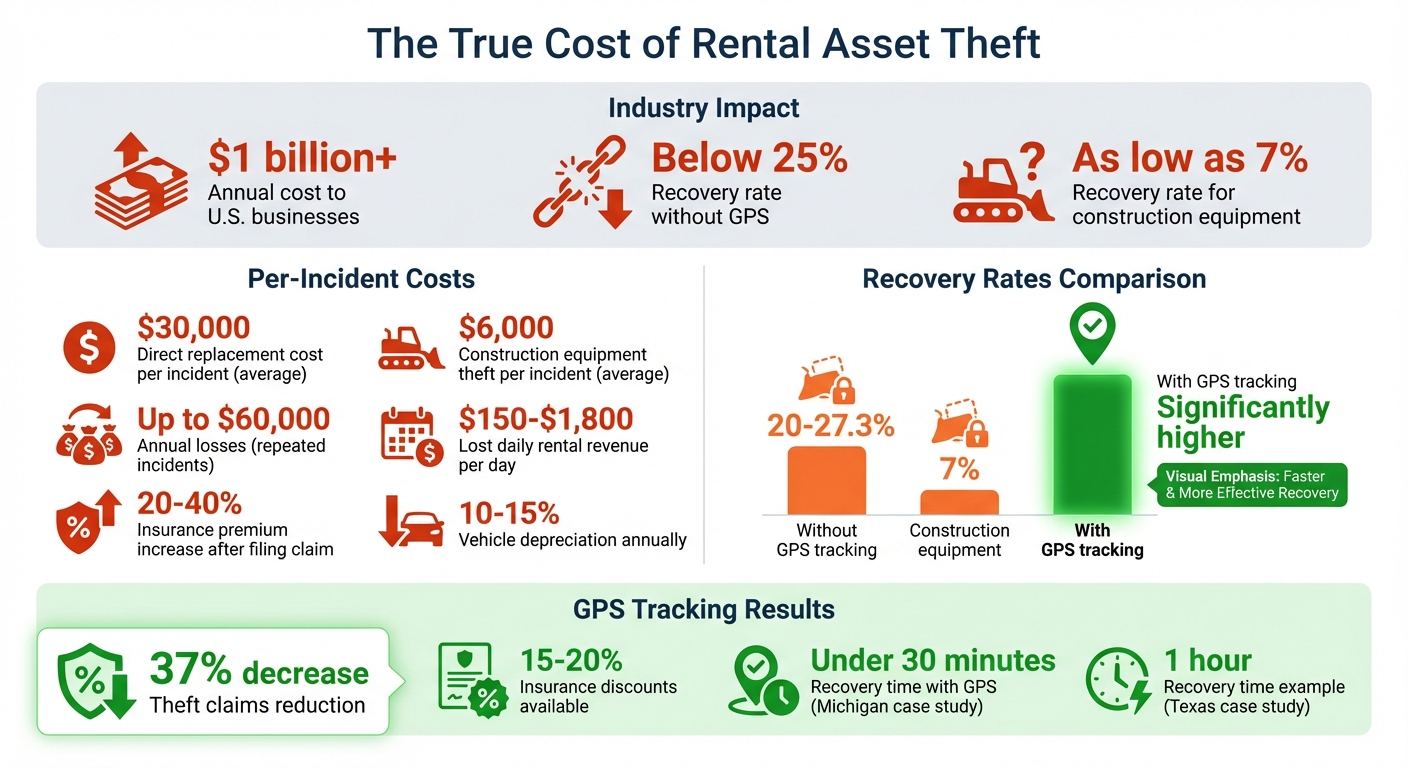
- Proven Results: Businesses using GPS report a 37% drop in theft claims and qualify for insurance discounts (15–20%).
Platforms like Lockii integrate GPS tracking with automated alerts and fleet management, helping businesses protect assets and recover stolen equipment quickly. GPS tracking isn’t just about theft prevention - it simplifies operations and ensures peace of mind.
The Problem of Rental Asset Theft
Rental asset theft is a massive issue in the United States, costing businesses billions annually. From construction sites to rental yards, criminals are targeting high-value items like skid steers, excavators, golf carts, and trailers. Let’s break down the financial toll and the flaws in current security measures that leave these assets vulnerable.
Financial Impact of Stolen Assets
When rental equipment gets stolen, the financial hit to a business is staggering. On average, a single theft costs about $30,000 [6], and for businesses dealing with repeated incidents, annual losses can climb to $60,000 [4]. Specific to construction equipment, each theft averages $6,000 [5].
But the costs don’t stop at replacement. While an asset is missing, businesses lose daily rental income, which can range from $150 to $1,800 per day, depending on the equipment [6]. Insurance claims add another layer of financial strain. Policies often reimburse based on depreciated value, meaning vehicles lose 10% to 15% of their worth annually [7]. On top of that, filing a claim can increase premiums by 20% to 40%, flagging the business as a higher risk [6].
Recovery rates for stolen equipment are dismal, especially without tracking technology. Only 20% to 27.3% of stolen assets are recovered, and some estimates suggest construction equipment recovery rates are as low as 7% [6,8].
| Impact Category | Description | Estimated Cost |
|---|---|---|
| Direct Loss | Replacement costs or insurance deductibles | $30,000 per incident [6] |
| Lost Revenue | Daily income lost while equipment is missing | $150–$1,800 per day [6] |
| Insurance Impact | Premium increases after filing a claim | 20%–40% increase [6] |
| Recovery Rate | Percentage of assets successfully returned | ~20% [6] |
These numbers show how devastating theft can be, especially when traditional security measures fail to protect these valuable assets.
Why Traditional Security Methods Fall Short
The combination of high theft rates and poor recovery outcomes makes it clear that conventional security measures aren’t enough to protect high-value assets. One major issue is the widespread use of universal keys for rental equipment. These keys are easy to purchase online, allowing thieves to simply drive off with skid steers or tractors [6,10].
Traditional tools like cameras and paperwork are reactive rather than preventive [9]. They document losses after the fact but do little to stop theft in real time. By the time a loss is discovered, it’s often too late to recover the asset.
"Traditional tools like paperwork, cameras, and insurance only react after the damage is done. By the time a loss is discovered, the shipment is already gone." - Mitch Belsley, GPX Intelligence [9]
Rental yards also face predictable vulnerabilities. Thieves often strike during off-hours or holidays \3,13]. Many yards are open lots with basic fencing and minimal lighting, making it easy for criminals to back up a trailer, load portable equipment, and vanish in minutes [[4].
Smaller, mobile equipment is particularly at risk. Items like generators or welders, often mounted on trailers, can be hitched and towed away quickly. Once stolen, assets without permanent identification or tracking technology can disappear into online resale markets, where buyers rarely question transactions under $10,000 [8].
sbb-itb-eb44693
How GPS Tracking Prevents Theft
GPS tracking transforms how rental businesses protect their assets, shifting the focus from just recovering stolen items to actively preventing theft. By providing instant location data and early alerts, GPS systems give businesses the tools to act quickly and make theft a much riskier endeavor for criminals.
Real-Time Location Monitoring
With GPS tracking, managers have access to a live map showing the exact location of every asset in their fleet. This constant visibility makes it easy to check if equipment is where it should be, whether it’s parked, idling, or being moved without permission. If something seems off, they can respond immediately.
The numbers speak for themselves: without tracking technology, fewer than 25% of stolen rental items are recovered [2]. But with GPS, the odds improve dramatically. Take, for example, a Michigan-based construction company that recovered a stolen backhoe in under 30 minutes in 2025. A geofencing alert at 2:00 a.m. tipped off the fleet manager, who tracked the equipment 15 miles away and guided police to the thief [2]. Similarly, J&M Contracting recovered a $50,000 backhoe thanks to live GPS data. Fleet Manager Garland Spivey worked directly with local law enforcement to locate the stolen equipment in real time [10].
"On a Saturday morning, I got an alert that the backhoe was being utilized.... While I was driving, I was talking with the Anderson County Sheriff Department…" – Garland Spivey, Safety and Fleet Manager, J&M Contracting [10]
Beyond recovering stolen equipment, real-time tracking also helps spot unauthorized use. For instance, if someone operates machinery during off-hours or moves it outside the agreed rental zone, managers can take action right away with automated rental solutions. Historical data adds another layer of insight, showing the exact routes assets have taken. This can help investigators track down storage locations or chop shops. All of this works hand-in-hand with geofencing for even tighter security.
Geofencing and Boundary Alerts
Geofencing uses GPS to create virtual boundaries around specific areas like job sites, storage lots, or approved travel zones. If an asset crosses one of these boundaries, the system immediately sends an alert via text, email, or a mobile app [11]. This technology is a cornerstone of modern self-service rental security, ensuring assets remain protected without constant manual oversight. This feature is especially useful during high-risk times, such as weekends or holidays, when theft is more likely.
Geofencing also helps enforce rental agreements. For example, if a renter takes equipment outside the approved area, managers are notified instantly. This allows them to address the issue before the equipment is moved too far or lost entirely [12]. The mere presence of geofencing can act as a deterrent - criminals are less likely to target fleets that are actively monitored. Knowing that moving equipment will trigger alerts and involve law enforcement in real time makes stealing far less appealing [11].
But GPS tracking doesn’t stop at location monitoring or boundary alerts. It also includes tamper and movement detection for added protection.
Tamper and Movement Detection
GPS systems equipped with motion sensors can detect unauthorized movement, even when the equipment is powered off. For instance, battery-operated trackers send alerts the moment an asset is moved [10]. When movement is detected, managers can adjust the system to provide updates more frequently - switching from every 15 minutes to every 30 seconds - to ensure they have near-continuous location data [2].
Thieves often try to disable factory-installed trackers, but rental businesses can outsmart them by using hidden, secondary trackers. These backup devices are hard to find with standard scanning tools and continue transmitting location data even if the primary tracker is disabled [2].
After-hours alerts provide another layer of security. If equipment is tampered with during periods when it should be idle, the system notifies managers without adding to their workload during regular business hours [11]. By combining real-time tracking, geofencing, and tamper detection, rental businesses create a robust system that not only prevents theft but also ensures faster recovery when incidents occur.
Using GPS Tracking to Recover Stolen Assets
When theft strikes, GPS tracking transforms a potential loss into a recoverable asset. Beyond acting as a deterrent, GPS technology ensures that stolen equipment can be located and retrieved quickly. The data collected during these incidents becomes a critical resource for law enforcement and insurance providers, significantly boosting the odds of successful recovery.
Providing Location Data for Recovery
GPS trackers deliver precise coordinates and live movement updates, enabling law enforcement to pinpoint stolen assets in real-time. Instead of relying solely on a police report and waiting for results, rental businesses can share detailed location data directly with officers. Many systems even offer collaborative tracking features, allowing businesses to generate secure links that provide live updates to police or recovery teams [2].
In addition, managers can remotely increase the frequency of location updates, providing almost continuous tracking during recovery efforts [2]. For example, a rental yard in Georgia successfully recovered a stolen mini-excavator in June 2025 by sharing live GPS tracking data with officers on the ground [2].
Historical tracking data adds another layer of value, logging the asset's full route. This information can reveal stops at temporary storage sites or even chop shops, offering crucial clues about where the equipment might be [9][11]. This combination of real-time and historical data not only speeds up recovery but also strengthens police reports and insurance claims.
Supporting Police Reports and Insurance Claims
The detailed records from GPS trackers don’t just facilitate recovery - they also play a key role in legal and insurance processes. Time-stamped data can pinpoint when and where a theft occurred, such as when an asset crossed a geofence or started moving during prohibited hours [2]. This eliminates uncertainty and provides law enforcement with the probable cause needed to act [9].
"Precise GPS coordinates and time-stamped route history are actionable evidence for police. Providing live location data significantly increases the speed of recovery and provides the necessary probable cause for law enforcement to intervene." – GPX Team [9]
For insurance claims, GPS data simplifies the process by offering a complete record of the asset's movements, engine hours, and maintenance history. This helps verify the equipment's condition before the theft and supports accurate valuations [10]. In one case, a Texas rental company recovered a stolen trailer-mounted light tower in just one hour by responding immediately to an automated geofence alert, showcasing how GPS evidence can streamline claims [2].
To ensure the data is admissible as evidence, businesses should confirm that their GPS tracking practices comply with state-specific laws. While most states permit tracking of company-owned assets without restrictions, some - like California - have additional consent requirements [13].
These recovery features work seamlessly with automated alert systems, as seen in Lockii's advanced GPS tracking solutions. By combining rapid response with reliable data, GPS tracking proves to be an invaluable tool in asset recovery.
How Lockii Integrates GPS Tracking
Lockii combines GPS tracking with automated alerts and multi-location fleet management, streamlining operations for rental businesses. By linking bookings, locks, and asset monitoring into a single dashboard, Lockii incorporates GPS data into every rental order. This eliminates the need for manual checks and creates a fully automated, round-the-clock theft prevention and fraud protection system. It also lays the groundwork for advanced features that simplify asset recovery.
Automated GPS Alerts
With Lockii, GPS trackers are programmed to detect geofence breaches, unauthorized movements, or tampering. When any of these occur, instant notifications are sent via text, email, or directly to the platform's inbox. These alerts immediately inform operators of potential theft, tying the event to the specific rental order and customer involved. This means operators can act in real time, rather than discovering issues during routine inventory checks hours or days later. Additionally, Lockii's audit logs ensure every movement is tracked and documented.
GPS-Enabled Audit Logs
Each rental tracked through Lockii includes a comprehensive audit log that records GPS events alongside maintenance updates, asset status changes, and customer interactions. These logs provide a detailed timeline, showing exactly when an asset left its location, its travel path, and its return. GPS data also enables the system to automatically confirm returns, updating availability without requiring manual verification by staff. This automated tracking not only aids in quick asset recovery but also simplifies filing insurance claims or police reports, offering time-stamped proof of an asset's movements during the rental period.
Managing GPS Tracking Across Multiple Locations
Lockii extends its GPS tracking capabilities across multiple locations, ensuring consistent oversight. Its multi-location system allows operators to monitor their entire fleet from a single interface, no matter how many sites they manage. This centralized approach simplifies operations, enabling businesses to scale efficiently. For example, companies using Lockii across more than 10 locations report that 95% of customer bookings are handled without human intervention [14]. This automation allows businesses to expand into new markets without needing additional staff or large physical facilities at each site.
"Lockii has been a game-changer for our business. It's allowed us to operate fully automated, 24/7 trailer rentals and scale that side of our operation with confidence." – Yvann Karamoko, Operator, The Trailer Co [14]
Lockii integrates GPS tracking seamlessly with other automated features like digital locks, identity verification, and payment processing. Together, these elements form a theft prevention ecosystem where GPS tracking plays a central role in ensuring smooth and secure rental operations.
Best Practices for GPS Tracking Implementation
Effective GPS tracking is key to quickly recovering stolen assets. Combining the right hardware, layered security measures, and consistent monitoring can safeguard your fleet and equipment.
Selecting the Right GPS Trackers
The choice of GPS tracker depends on what you're monitoring. Wired GPS trackers are ideal for powered equipment like excavators, cranes, and backhoes. These devices provide not only location data but also telematics insights such as engine hours and fuel consumption [2]. On the other hand, battery-powered trackers are better suited for unpowered assets like trailers, generators, and containers. They require little maintenance and can last for years on a single charge [2][10].
For long-range needs, cellular-based GPS solutions are a better fit than Bluetooth-only devices, which have limited range [2]. To protect high-value equipment, consider installing a hidden secondary tracker. This extra layer makes it harder for thieves to detect and disable the device [2].
It's also wise to use trackers with adjustable update frequencies. Lower ping rates during normal operations extend battery life, while higher update intervals during theft incidents provide law enforcement with real-time location data for quick recovery [2][10]. Integration with fleet management software can further automate rental business operations, letting you track maintenance schedules and operational metrics alongside location data [10].
But GPS tracking alone isn’t enough - physical security measures are equally important.
Using GPS Tracking with Physical Security
Combining GPS tracking with strong physical security measures offers the best protection. While GPS can help locate stolen assets, tools like heavy-duty locks and secure storage deter theft in the first place. This layered approach creates multiple hurdles for thieves, buying you valuable time to respond.
For high-value equipment, consider adding digital locks, geofencing, and secondary trackers to build a stronger defense. Geofencing, in particular, can alert you instantly if an asset moves unexpectedly. For instance, a rental company in Texas recovered a stolen trailer-mounted light tower in under an hour by acting on geofence alerts [2].
Layered security is most effective when paired with consistent monitoring of GPS data.
Monitoring GPS Data for Unusual Activity
Keeping a close eye on GPS data can help you catch theft early. Setting up geofences around job sites or storage yards ensures you’ll receive instant alerts if equipment crosses a boundary [1][2]. Monitoring activity during non-work hours is also crucial - unexpected movement or engine activity at odd times often signals unauthorized use.
Regularly reviewing movement logs can help you spot suspicious relocations quickly. For battery-powered trackers, it’s important to check battery health routinely, ensuring your devices are ready to protect your assets when needed most [10].
Conclusion
GPS tracking plays a key role in helping rental businesses safeguard their assets and improve daily operations. With equipment theft costing the industry over $1 billion each year [2][3], tools like real-time location monitoring and geofencing alerts empower companies to prevent theft before it occurs and greatly increase the chances of recovering stolen items. These benefits strengthen the foundation for a more secure and efficient rental business.
Platforms like Lockii demonstrate how GPS tracking, combined with modern tools, can reduce theft while simplifying operations across multiple locations.
Beyond theft prevention, GPS tracking streamlines operations, making it easier to scale and manage your business. When paired with automated systems, such as Lockii’s contactless rental platform, GPS tracking helps protect your assets, cut down on labor costs, and accelerate expansion into new markets.