Scaling Booking Systems for Multi-Location Rentals
March 24, 2026 · 11 min read
Scaling Booking Systems for Multi-Location Rentals
Managing rentals across multiple locations is challenging without the right tools. Businesses face issues like double bookings, inconsistent customer experiences, and high operating costs. A scalable booking system solves these problems by centralizing inventory, automating processes, and supporting growth across new locations without adding complexity.
Key takeaways:
- Centralized inventory: Real-time updates prevent double bookings and track items across locations.
- Automation: Features like instant confirmations, reminders, and digital locks reduce manual tasks and no-shows.
- Cost efficiency: Automation lowers staffing needs and eliminates reliance on expensive third-party platforms.
- Growth support: Systems like Lockii handle unlimited locations and bookings, ensuring smooth expansion.
These solutions improve efficiency, save time, and enhance customer satisfaction, making them essential for multi-location rental businesses.
Main Challenges in Multi-Location Rental Management
Tracking Inventory Across Multiple Locations
Managing inventory across several locations is no small feat. A lack of real-time updates can lead to double bookings, which not only hurt your revenue but also damage your reputation. Imagine a trailer being booked at Location A, but due to delayed system updates, it’s also reserved at Location B. These kinds of slip-ups can leave customers frustrated and distrustful of your service.
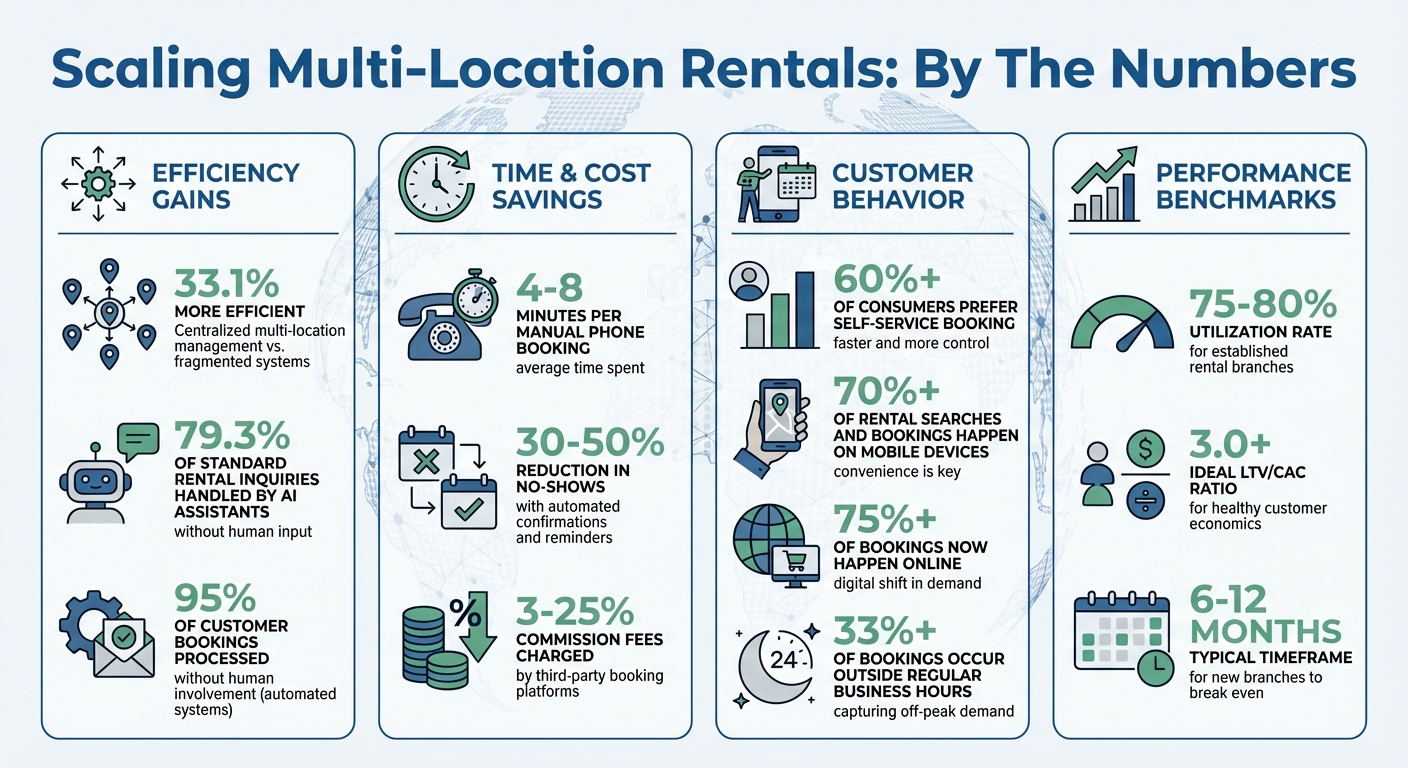
Manual processes make this even worse. Tasks like uploading listings, updating descriptions, or adjusting pricing across different platforms consume valuable staff time. Without a centralized system that syncs availability and pricing across all locations and platforms, your team ends up putting out fires instead of focusing on growth. Research backs this up - centralized multi-location management has been found to be 33.1% more efficient than outdated, fragmented systems [5]. And when inventory management falters, the customer experience takes a direct hit.
Keeping Customer Experience Consistent
Inconsistencies in how bookings are handled across locations can be a major frustration for customers. One location might require a phone call to reserve, another sends email confirmations, while a third relies on an online portal. When these systems don’t communicate with each other, it creates a chaotic experience that can make your business seem unorganized.
Poor communication adds to the problem. Scattered customer inquiries across various systems lead to uneven response times. For instance, AI assistants can handle up to 79.3% of standard rental inquiries - like changes, extensions, or cancellations - without human input [5]. But without standardized workflows, even loyal customers who’ve had smooth experiences at one location might face confusion or delays at another.
Staff and Operating Costs
Traditional systems often require more staff to handle calls, bookings, and check-ins, which significantly increases your expenses.
But wages aren’t the only cost. You also need office space at every location, along with computers, phone systems, and other tech to support on-site operations. On top of that, third-party booking platforms typically charge commission fees ranging from 3% to 25% [4], eating into your profits. Expanding to new locations without automation or centralized systems means higher overhead, making growth both expensive and complicated. By centralizing operations, you can reduce staffing needs and streamline costs, creating a more scalable business model.
sbb-itb-eb44693
Required Features for Multi-Location Booking Systems
Centralized Inventory with Real-Time Synchronization
A real-time availability engine is essential for managing a multi-location rental operation. Without it, you risk double bookings when one location rents out an item that another still shows as available. Real-time synchronization ensures that the moment an item is reserved - whether online or in-store - it’s instantly marked as unavailable across all locations [2].
The most effective systems treat your inventory as a global fleet, enabling customers to pick up an item at one location and return it to another. Each item’s location is tracked and updated automatically when it’s checked out or returned [3]. This level of flexibility not only improves the customer experience but also opens up new revenue opportunities that traditional systems can’t manage.
"An online booking system for rentals isn't a nice-to-have anymore. It's the difference between capturing revenue around the clock and losing it to operators who already made the switch." - EquipDash Team [2]
With a synchronized inventory in place, you can build on it by automating customer communication.
Automated Messaging and Customer Verification
Manual phone bookings aren’t just time-consuming - they’re inefficient. Each reservation can take 4–8 minutes of staff time [2]. For a business handling 20 bookings daily, that’s more than two hours lost to administrative tasks. Automated messaging eliminates this burden by sending instant confirmations, 24-hour reminders, and day-of notifications with directions and waivers.
These features also cut down on no-shows. Businesses using automated confirmations and reminders report 30–50% fewer no-shows compared to those relying solely on phone bookings [2]. That’s money saved by ensuring your inventory is actively generating income instead of sitting idle.
Customer verification is another critical component, especially as your business scales. Tools like integrated identity verification, screening, and digital waivers simplify the onboarding process while reducing fraud risks. With over 60% of consumers preferring self-service booking and more than 70% of rental searches and bookings happening on mobile devices, automated verification ensures customers can complete their reservations whenever it’s convenient for them [2].
These automated features allow your booking system to grow seamlessly as your business expands.
No Limits on Locations or Bookings
A booking platform should support your growth, not restrict it. Avoid systems that cap the number of locations you can manage or charge based on booking volume. These limitations can create unnecessary roadblocks as your business scales.
The best platforms handle everything from a small inventory to thousands of items without slowing down [6]. Whether you have three locations or thirty, the system should remain fast and reliable. This scalability is especially important for decentralized operations, allowing you to expand quickly without needing extra staff at every site.
For example, systems like Lockii offer unlimited locations, unlimited orders, and unlimited lock codes as part of their pricing. This means you’re free to grow without worrying about hitting artificial limits or triggering higher fees. Adding a new location is as simple as setting it up in the system - no restrictions, no headaches.
Performance Optimization for Growing Operations
Managing High Traffic and Busy Periods
A reliable booking system needs to handle demand spikes without slowing down. Real-time inventory synchronization is key - if updates lag by even 15 minutes, you risk double bookings during high-traffic moments [2]. During peak times, delays of just 10–20 minutes in responding to customer inquiries can cost you valuable bookings [7].
"Use automated messages for a competitive edge – waiting too long to reply might cause the guest to book elsewhere." - Orit Haiby, Vacation Rental Consultant [7]
To avoid scheduling conflicts, consider implementing a mandatory 30-minute buffer between bookings. This ensures there’s enough time for safety checks and cleaning [2]. Cloud-based platforms are particularly effective here - they scale automatically to handle increased workloads and let you manage operations remotely from anywhere [1]. Once peak periods are under control, tracking every action through audit logs can further enhance system reliability.
Audit Logs for Tracking and Compliance
Beyond handling high traffic, audit logs are essential for maintaining accountability. These logs record every transaction, update, and equipment movement, providing a clear trail for compliance and operational oversight [8]. When issues arise, audit logs help pinpoint what happened, when, and who was involved.
Role-based access control ensures that branch managers only see the data they need, while headquarters retains full visibility across the network [8]. Digital check-in and check-out records, complete with timestamps and digital signatures, add an extra layer of verification for insurance claims or resolving customer disputes [1]. For businesses managing multiple locations, centralized visibility eliminates operational silos, keeping everyone aligned with the same data [8].
Maintenance and Problem Tracking Systems
To support continuous growth, it’s crucial to standardize maintenance and resolve issues quickly. A centralized maintenance calendar ensures rental items follow consistent service schedules, reducing the risk of unexpected breakdowns that can disrupt operations during busy seasons [8]. When maintenance is due, the system should automatically block those items from being booked, avoiding last-minute equipment-related delays [2].
For businesses managing vehicles or equipment across multiple locations, telematics integration offers real-time insights like fuel levels, battery health, and odometer readings, helping prevent costly downtime [8]. Modern systems also use AI assistants to handle over half (52.4%) of maintenance-related queries, allowing your team to focus on more complex challenges [5].
As your business grows, standardized maintenance logs and inspection protocols ensure consistent quality across all locations, avoiding the uneven service standards that can emerge with expansion [8]. Additionally, centralizing maintenance contracts and purchases gives you bargaining power with service providers, leading to better rates and uniform repair quality across your branches [8].
How Lockii Supports Multi-Location Growth
24/7 Self-Service Rentals with Digital Locks
Lockii (https://lockii.app) makes fully automated, round-the-clock pickups and returns a reality by using digital locks. The system takes care of everything: assigning available inventory, generating unique lock codes, and sending automated notifications via email and SMS. This lets businesses expand to new locations without needing to hire extra staff or maintain costly retail spaces.
With 95% of customer bookings processed without any human involvement [9], your team can focus on more strategic priorities. Lockii's verification process, which includes photo checks during both pickup and return, ensures every transaction is secure and traceable. Even if you're not on-site, this system provides the reliability you need. Plus, these automation capabilities make it easy to integrate with third-party tools, simplifying operations even further.
Lockii has allowed us to operate fully automated, 24/7 trailer rentals and scale that side of our operation.
Integration with IglooHome, Stripe, and Zapier
Lockii doesn't just stop at automating rentals - it also streamlines essential tasks with smart integrations. It connects seamlessly with IglooHome for managing digital locks, Stripe for secure payments and automated billing (including booking extensions), and Zapier to link AI agents and customer support tools via the Lockii Management Control Plane. This creates a smooth workflow where payments, bookings, and customer communication all happen in one place - no need to juggle multiple systems.
Stripe integration makes online booking extensions and secure payment processing effortless, while QR and NFC-enabled express checkouts speed up in-person transactions for walk-in customers.
Built-In Support for Multiple Locations
Lockii is built to handle multi-location operations with ease, making it a perfect fit for platform companies managing over 10 locations [9]. A centralized dashboard gives you a complete overview of your fleet, including GPS tracking and return forms across all sites. Customers can use built-in location finder tools to locate the nearest rental point, and cross-selling features help promote inventory from other locations when one site is fully booked.
Since switching to Lockii, things have gotten so much easier. I was juggling three different systems before, and now it's all in one place. It's saved me a heap of time and stress.
Lockii supports unlimited locations and orders at no extra cost, making it ideal for businesses looking to grow quickly. Maintenance tracking features let you flag items for repairs and monitor audit logs for every piece of equipment across all locations. Combined with real-time GPS tracking, this eliminates the need for manual reconciliation and keeps everything running smoothly.
Measuring Success and Improving Over Time
Performance Metrics to Track
To determine how well your multi-location booking system is performing, focus on a few critical metrics. One key indicator is the Utilization Rate, which shows how much of your fleet is actively generating revenue. Established branches often hit a utilization rate of 75–80% [8]. Another important metric is Revenue per Available Vehicle (RevPAV), which measures the revenue potential of your fleet. For example, a car rental branch with 40 vehicles operating at 75–80% utilization and an average daily rate of $50–$55 would typically achieve a RevPAV in the low $40s [8].
Don’t stop at fleet metrics - also track your Customer Acquisition Cost (CAC) against Lifetime Value (LTV). A strong LTV/CAC ratio is typically 3.0 or higher, meaning each customer generates at least three times the cost of acquiring them [8]. Additionally, keep an eye on maintenance and downtime across your locations. Reducing the time assets are out of service can significantly improve availability. For instance, Perco Rentals implemented digital checklists and high-resolution inspection photos in March 2021. According to Service Manager William Strength, this change saved the company "thousands upon thousands of dollars" [10].
"I couldn't even calculate the amount of money we've saved so far just by holding people accountable." – William Strength, Service Manager, Perco Rentals [10]
Operational efficiency metrics like revenue per employee, dispute rates, and booking channel profitability are also worth monitoring. Tools like Lockii’s audit logs make it easier to track these numbers by maintaining a complete record of bookings and equipment movements across all locations. Together, these metrics provide a solid foundation for optimizing your operations as your business grows.
Adjusting to Business Growth and Market Changes
New rental branches often face cash-flow challenges during their first 6–12 months as they work to establish local visibility [8]. However, a well-prepared branch can break even in six to ten months, though seasonal markets may take longer [8]. Before expanding, create a branch-level profit and loss statement and test it under conservative assumptions, such as a 40–50% utilization rate during the initial ramp-up phase [8].
As your business expands to three or more locations, it becomes essential to standardize operations. Consistent rental processes ensure a uniform customer experience across all sites. Streamlining maintenance by centralizing contracts with a few dependable service providers can also cut downtime and repair costs [8]. With over 75% of bookings now happening online [11] - and more than one-third occurring outside regular business hours [11] - your booking system must operate seamlessly 24/7. This is where Lockii’s automated system can be a game-changer, handling demand without the need for constant manual oversight.