Why you need a rental system that proactively secures your items for you
January 22, 2026 · 12 min read
Why you need a rental system that proactively secures your items for you
Running a rental business without automation can lead to inefficiencies, security risks, and high labor costs. Manual systems may work when you're small, but as you scale up, they often fall short. Here's why an automated, integrated system is the smarter choice:
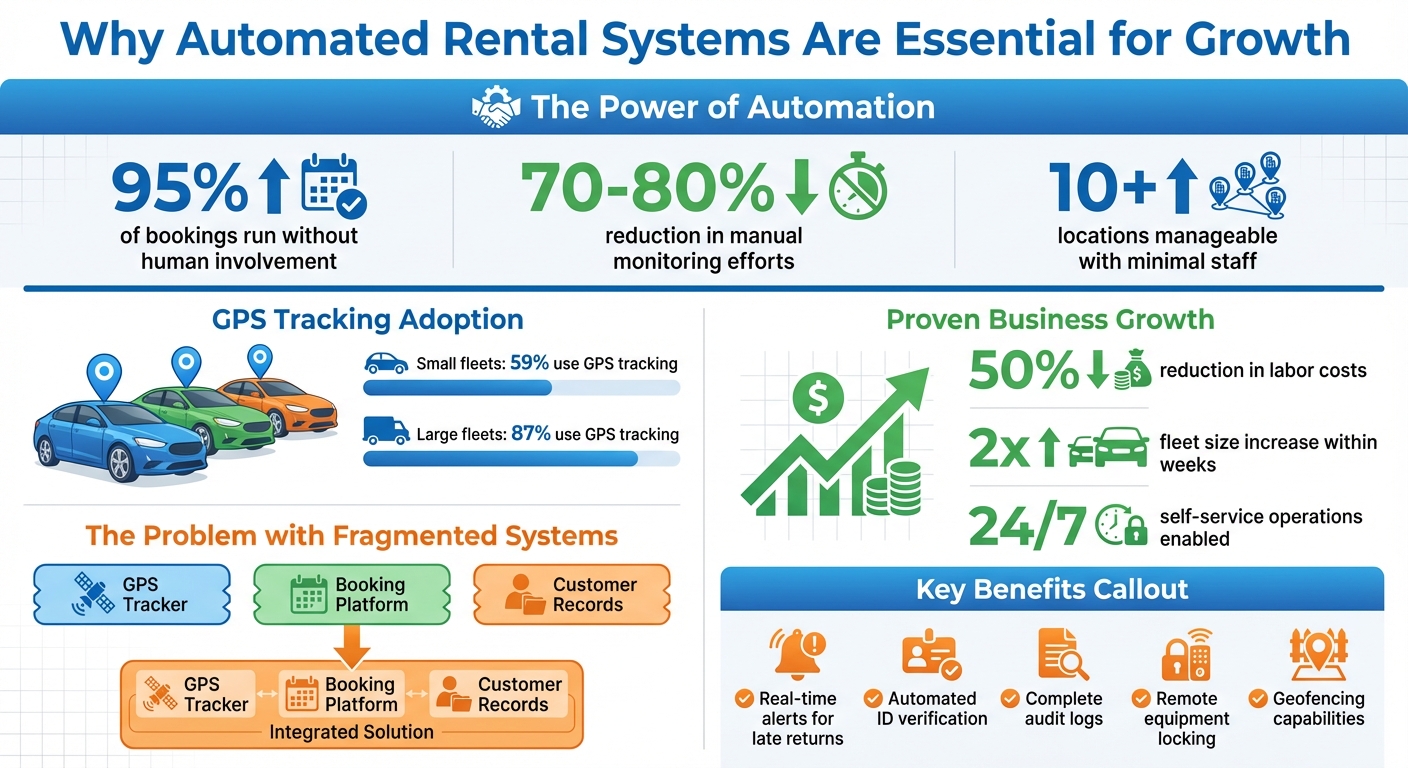
- 95% of bookings can run without human involvement with automation, reducing labor costs and errors.
- Manual processes like ID verification and cross-referencing GPS and booking data are time-consuming and prone to mistakes.
- Separate systems for GPS tracking, customer data, and bookings create delays and security gaps.
- Integrated platforms combine GPS, booking, and customer data in real time, allowing instant alerts, detailed audit logs, and proactive issue resolution.
- Automation enables 24/7 self-service pickups, reduces staff dependency, and supports expansion to multiple locations without increasing costs.
Why Your GPS, Customer Data, and Bookings Need to Be in One System
When your GPS tracker, customer records, and booking calendar operate in separate systems, you're setting yourself up for data fragmentation - and that can cost you valuable time in critical moments. Imagine this: your GPS tracker shows a trailer moving unexpectedly. To respond, you first need to log into a booking platform to find out who rented it, then switch to another system to pull up the customer’s contact details. By the time you’ve pieced it all together, the situation may have escalated, leaving you with fewer options to act quickly. This lack of integration not only slows down response times but also increases security risks.
How Separate Systems Create Security Gaps
Fragmented systems mean you’re constantly cross-referencing data manually, and that’s a recipe for delays. For example, if a GPS alert flags an overdue item, but your booking records are stored elsewhere, figuring out who rented it and when it was due back becomes a frustrating game of catch-up. Instead of proactively addressing the issue, you’re stuck reacting after the fact - and every second counts when security is on the line.
The risks grow when critical functions like securing contactless rentals through identity verification, booking management, and GPS tracking are split across different platforms. Without automated links between verified customers and digital lock codes, you’re leaving the door wide open for fraud. And without a unified audit log tying GPS movements to customer actions, tracking down what happened turns into a lengthy investigation instead of a quick database search. In short, separate systems create blind spots, making it harder to respond effectively and hold people accountable.
What Integrated Data Systems Give You
As your rental business grows, consolidating your data into one system becomes a game-changer. A unified platform connects GPS data, booking schedules, and customer profiles in real time. For instance, if an item moves during an active rental, the system instantly identifies the customer and sends out automated alerts. This real-time visibility ensures that issues are flagged and addressed as they happen, not hours later when someone finally connects the dots [4].
An integrated system also creates detailed audit logs, capturing every action with timestamps and linking GPS data, identity verification, and booking details into a single timeline. This comprehensive record is invaluable for resolving disputes, filing insurance claims, or providing evidence in theft cases. As Lockii explains:
Inbuilt GPS tracking, identity verification and more directly tied into a single audit log to keep track of every item and order at all times [2].
With everything in one place, you gain the clarity and accountability that fragmented systems simply can’t provide.
Automated Notifications That Catch Problems Before They Escalate
Time is critical when it comes to addressing issues. Automated systems provide instant alerts - whether it’s a 15-minute delay or an unexpected movement of equipment - allowing you to step in before minor problems turn into major setbacks. This kind of proactive monitoring ensures you’re resolving issues while there’s still room to act, avoiding the chaos of trying to fix things hours later. These instant notifications are a key part of integrating data-driven security into your operations.
Real-Time Alerts for Late Returns and GPS Irregularities
Automation ensures your team is immediately informed when something goes off track. For example, if a rental item isn’t returned by its scheduled time, the system sends an instant SMS or email alert. Let’s say a trailer due back at 3:00 PM hasn’t been returned by 3:15 PM - the system flags the issue right away, including its current GPS location and customer details. This lets you take quick action, whether that’s arranging a booking extension or dispatching a recovery team.
The same applies to GPS anomalies. If a trailer moves after the rental period ends without an approved extension, the system triggers an alert. It provides live location data, booking details, and a full audit log. This setup works much like advanced security systems that detect unusual activity in real time, offering a faster response than traditional monitoring methods ever could.
How Automation Lightens the Load for Staff
Manual monitoring can be a huge drain on time and resources, requiring constant attention to data. Automation removes this hassle by sending alerts only when action is required. For instance, your team might receive a single message like, “Trailer #12 is overdue,” complete with GPS coordinates and customer contact details. This targeted approach can cut manual monitoring efforts by as much as 70–80%, freeing up your staff to focus on higher-priority tasks.
Lockii sums it up perfectly:
Let Lockii do the hard work and be notified when you're needed so you can focus on growing, not handing out stock [1].
With automation handling routine tasks like monitoring, sending reminders, and enabling self-service booking extensions, using a contactless rental process planner, your team’s role shifts to managing exceptions rather than day-to-day operations. This way, your staff can concentrate on driving growth instead of getting bogged down in operational details.
How GPS Tracking Works with Booking Data to Secure Your Items
GPS tracking pinpoints an item's location, while booking data reveals who rented it and for how long. When combined, these systems create a seamless way to maintain accountability throughout the rental period. This integration allows for precise, real-time actions to keep your assets safe.
Real-Time Location Tracking for Every Item
With live GPS tracking, you can monitor the location of rental items 24/7. It's a widely adopted practice, with 59% of small fleets and 87% of large fleets using this technology [5]. These systems continuously track movement and send instant alerts if, for example, a trailer leaves its designated area or moves after the rental period ends.
Modern GPS solutions often utilize geofencing, which sets up virtual boundaries around specific locations like worksites or warehouses. If these boundaries are crossed, the system can trigger immediate alerts and even remotely lock equipment [6].
When it comes to battery life, professional-grade GPS trackers are designed for durability. With hourly location updates, most trackers last about a year. For less frequent updates, such as daily "heartbeat" pings, the battery life can extend to over three years [5].
Connecting Location Data with Customer Records
The real power of GPS tracking lies in its integration with customer booking data. This connection ensures a clear, continuous chain of accountability. For instance, when you check a trailer's GPS location, the system also displays who rented it, the rental period's end date, and their contact information - all on a single screen. This eliminates guesswork and makes it instantly clear who is responsible for any given item [6].
Imagine a scenario where a bike's GPS shows it's overdue and outside its geofence. The system can immediately cross-reference the renter's details and booking status. From there, it can send alerts, apply late fees, or even remotely lock the item [6]. This level of automation replaces the need for manual checks, saving time and reducing errors.
One trailer rental business saw impressive results by adopting an integrated platform. They cut their labor costs in half and doubled their fleet size within weeks, thanks to the elimination of manual cross-referencing between GPS dashboards and booking records [5]. As one Booqyy user shared:
GPS tracking made fleet oversight 'dead easy' once it was part of their all-in-one system [5].
Lockii's platform showcases this integration perfectly, combining GPS tracking with customer booking management. This unified, real-time view not only strengthens security but also boosts operational efficiency for rental businesses.
How to Scale Without Hiring More Staff
With automated security measures and integrated data systems already protecting your assets, you can shift your focus entirely to growth. Many rental businesses face challenges when trying to expand, as opening new locations often requires hiring more staff for day-to-day operations. However, automated rental systems change the game, allowing you to grow without inflating payroll costs. This approach simplifies managing multiple locations while keeping operations efficient.
Managing Multiple Locations with Automation
Comparing smart locks that generate unique access codes make 24/7, staff-free pickups and drop-offs possible [1][2]. This means you can operate from unmanned sites - like storage yards, parking lots, or partner venues - without needing a dedicated storefront or on-site personnel.
Integrated GPS tracking adds another layer of efficiency, enabling a single operator to monitor hundreds of assets in real time from one dashboard. This provides instant visibility into the location and status of your inventory [5]. Pair this with automated ID verification, which processes customer documents during booking, and the need for manual checks is virtually eliminated.
Automation also supports exception-based management. Your team only steps in when there’s an issue - such as a late return, a damaged item, or a specific customer question. For instance, businesses using platforms like Lockii often manage 10 or more locations with minimal staff involvement [1].
The Cost Savings of Reducing Staff Dependency
By automating operations across locations, the financial benefits are immediate. Self-service tools significantly reduce the volume of customer support inquiries. When customers can extend rentals, modify bookings, and make payments online, most routine questions are handled without staff intervention [1][2]. Features like QR codes and NFC tags on items also enable walk-up customers to check out instantly using their phones, eliminating the need for a staffed service counter [1][2].
Beyond staffing, automation helps cut real estate costs. Without the need for large offices or fully staffed storefronts, expanding to new locations becomes far more affordable [1][3]. Automated return photos and hire-end quizzes replace manual inspections, giving you remote oversight of your fleet’s condition. This streamlined setup allows you to grow geographically without a proportional rise in operational expenses [1][2].
Why Audit Logs Matter for Security and Customer Trust
When your rental system automatically logs every action, location change, and interaction, it creates a reliable trail of evidence that can protect your business in disputes and reassure your customers. These audit logs act as your first line of defense against misunderstandings, while also boosting your professional credibility with clear, timestamped records. This unchangeable documentation works hand-in-hand with automated monitoring to strengthen your overall security measures. This is one of several ways to automate rental business operations for better efficiency.
Complete Audit Logs for Security and Legal Protection
An effective audit system tracks multiple data points at once. For instance, booking and GPS logs detail every reservation adjustment and location update with precise timestamps. Maintenance and damage logs record all services performed and any issues identified, shielding you from liability claims over pre-existing damage.
These records transform disputes into fact-based resolutions. Imagine a customer claiming an item was already damaged at the time of rental. Audit logs, paired with pre-rental photos and inspection checklists, provide undeniable proof of the item's condition. Similarly, if a disagreement arises over a late fee, GPS data can confirm the exact return time and location.
For legal protection, audit logs must remain unchanged. Systems like Lockii automatically generate timestamped records during routine operations, ensuring they’re admissible in court or for insurance claims. This level of documentation also helps meet regulatory requirements, showcasing that your business follows established safety and professional standards.
How Documentation Builds Customer Confidence
Beyond legal and security benefits, thorough audit logs help build trust with your customers. When renters know their interactions are being carefully documented, they feel confident that any issues will be resolved fairly. Providing access to rental records - like pickup times, GPS tracking, and return details - through a customer portal shows your dedication to transparency and accountability.
This openness not only reassures your customers but also improves their experience, encouraging positive reviews and repeat business.
Conclusion
Growing your rental business doesn’t have to mean sacrificing security for expansion. When GPS tracking, customer details, and booking data are scattered across disconnected systems, it creates inefficiencies and reactive problem-solving for issues like late returns or theft. But with an automated, integrated platform, these gaps are closed. You can monitor your fleet proactively and address potential problems before they escalate into costly disruptions.
The numbers back this up. Automated systems manage 95% of bookings without requiring human intervention, enabling businesses to scale to over 10 locations without needing to significantly increase staff [1]. This level of efficiency reduces overhead and lays the foundation for a scalable operation.
Lockii brings all these tools together in one place. With features like real-time GPS tracking, automated identity verification at checkout, digital locks that only grant access to verified customers, and detailed audit logs for every transaction, Lockii simplifies operations while keeping your fleet secure. There’s no need to juggle multiple tools or manually piece together data - you can focus entirely on growing your business.
As the rental industry shifts toward contactless self-service models, having a robust security system in place isn’t just a nice-to-have; it’s a competitive edge. Customers benefit from the ease of contactless pickups and self-service extensions, while you gain the confidence and efficiency to scale your operations smoothly. The real question isn’t whether you should automate - it’s how soon you can implement the tools that make secure growth a reality.