
How to make your own automated car sharing service
August 2, 2026 · 16 min read
How to make your own automated car sharing service
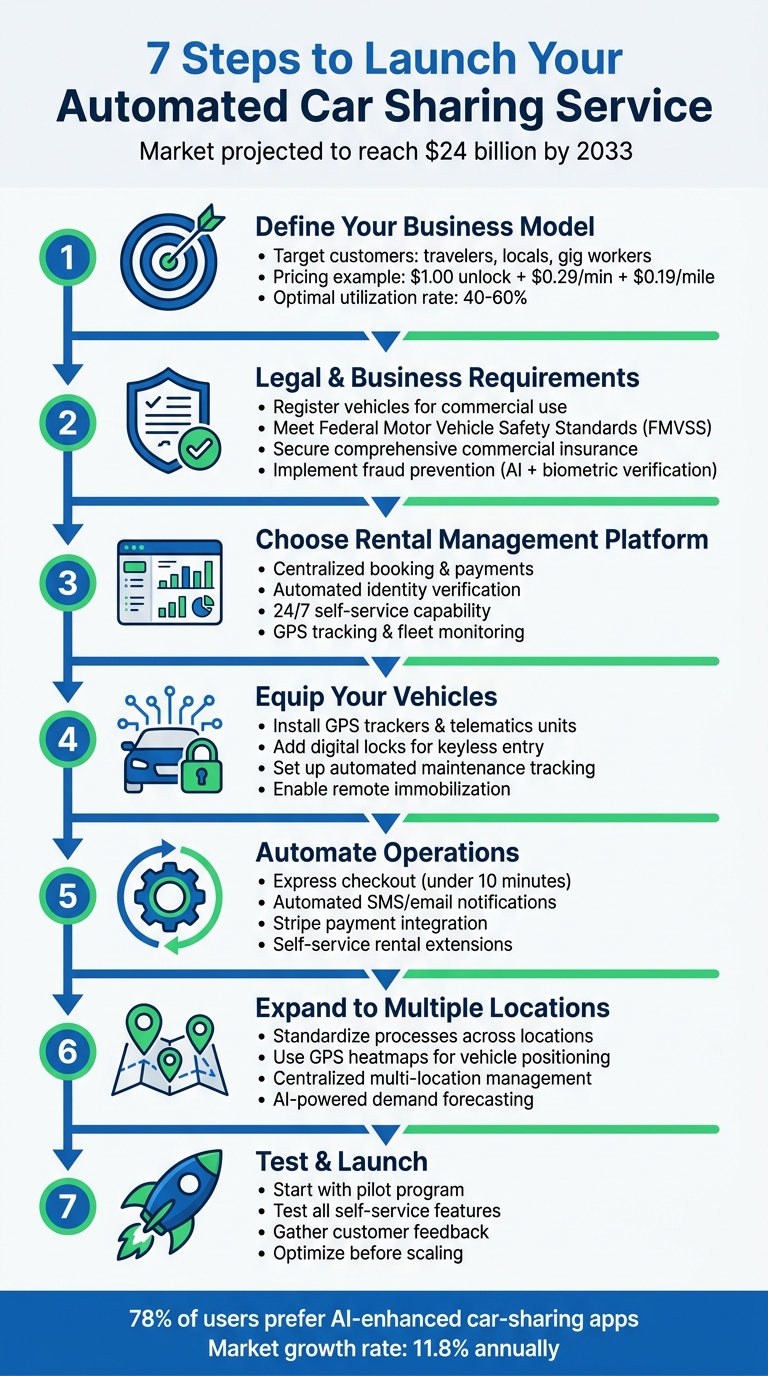
Want to launch a car-sharing service that runs itself? Here's how to build an automated, contactless system that meets modern demands. Car sharing is booming, with the market projected to exceed $24 billion by 2033. Customers want 24/7 access, no paperwork, and smartphone convenience. Traditional rental models can’t keep up, but automation makes it possible to deliver a better experience while cutting costs.
Key Steps to Get Started:
- Define your business model: Target specific customer groups (travelers, locals, gig workers) and set clear pricing (e.g., $1 unlock fee, $0.29/min, $0.19/mile).
- Meet legal and insurance requirements: Register vehicles for commercial use, comply with federal/state safety standards, and secure comprehensive insurance.
- Prevent fraud: Use AI tools for identity verification, biometric checks, and real-time fraud detection.
- Equip your fleet: Install GPS trackers and telematics, digital locks, for remote control and monitoring.
- Automate operations: Use platforms like Lockii for booking, payments, and fleet management, enabling 24/7 self-service.
- Expand strategically: Start with a pilot program, refine processes, and replicate success in new locations.
Why automation matters: It reduces labor costs, improves efficiency, and meets the demands of a growing user base. With tools like Lockii, you can manage everything from bookings to maintenance in one place.
Ready to start? Equip your fleet, automate your operations, and create a service that works around the clock.
Step 1: Define Your Car Sharing Business Model
Understand Customer Expectations for Contactless Rentals
Today's customers want convenience, and for car sharing, that means managing everything through their smartphones. No lines, no paperwork, no hassle. This shift aligns with the market's rapid growth, which is expected to hit $24.4 billion by 2033, with an annual growth rate of 11.8% [8]. Much of this momentum comes from Millennials and Gen Z, who value access over ownership and are highly comfortable with digital solutions.
To succeed, you’ll need to focus on specific customer groups like travelers looking for affordable airport transportation, locals needing cars for short-term trips, and gig workers seeking flexible, on-demand options. Each group comes with its own pricing expectations and preferences, so understanding these differences will help shape your strategy.
Set Business Goals and Plan for Growth
Start small - focus on one metropolitan area before scaling up. Successful platforms typically operate with utilization rates between 40% and 60% [3]. Falling below 40% might mean you’ve got too many cars or weak demand, while exceeding 60% could suggest you don’t have enough vehicles to meet customer needs.
Your goals should align with the needs of your target audience. Establish a clear pricing model early on. Common pricing structures include a mix of fees, such as $1.00 to unlock a car, $0.29 per minute, and $0.19 per mile [5][6]. These rates should not only cover costs like vehicle financing, insurance, cleaning, and maintenance but also leave room for profit.
To track success, use metrics like Revenue Per Available Car (RevPAC) [7]. Additionally, aim for a customer lifetime value that’s at least three times higher than your acquisition costs to ensure sustainable growth [3]. Before launching, set specific goals for fleet size, service areas, and monthly revenue to keep your business on track.
sbb-itb-eb44693
Step 2: Set Up Legal and Business Requirements
Register and Insure Your Fleet
To operate your fleet commercially, you’ll need to register your vehicles for this specific use. Start by consulting your local DMV for the necessary permits, as requirements vary by state. For instance, California has separate permits for testing and full commercial deployment. Notably, Nuro became the first company to secure a commercial deployment license in California in December 2020, followed by Cruise) and Waymo in September 2021 [10].
Your vehicles must also meet the Federal Motor Vehicle Safety Standards (FMVSS) established by the National Highway Traffic Safety Administration (NHTSA). As of March 2022, NHTSA regulations allow vehicles without traditional controls like steering wheels or pedals to comply with safety standards, provided they meet other safety criteria [10]. In states like Nevada, you’ll also need to secure designated operational areas approved by the DMV that align with local safety standards [10].
Commercial auto insurance is another must. This should cover liability, theft, and accidents that occur during rentals. The legal landscape is shifting, with liability increasingly falling on system operators and manufacturers rather than individual drivers [10]. Starting in June 2025, operators will be required to report crashes involving fatalities, hospitalizations, or pedestrian injuries within five days. For property damage exceeding $1,000, reports must be filed within one month [11]. Additionally, stay informed about federal legislation, such as the SELF DRIVE Act. As Rep. Bob Latta has pointed out, "There is currently no federal framework for autonomous vehicles, even as the technology continues to advance at a rapid pace" [9].
By ensuring your fleet is legally compliant and properly insured, you’ll be better prepared to manage potential risks effectively.
Add Fraud Prevention Measures
Once you’ve tackled the legal and insurance requirements, the next step is to secure your service against fraud. A robust fraud prevention system is essential for maintaining automated rental business operations and ensuring a reliable self-service experience for customers.
Automated identity verification tools can help confirm user documents by matching biometric data from driver’s licenses or passports with real-time information [13]. These systems use AI to analyze features like watermarks, fonts, and security stamps on identification documents. Liveness detection, which requires users to take a real-time selfie, adds another layer of protection by preventing fraudsters from using static photos or deepfakes [13].
For even greater security, leverage smartphone-enabled NFC technology to read RFID chips embedded in identity documents. This method offers near-perfect proof of authenticity [13]. Between 2020 and 2022, Lyft demonstrated the effectiveness of such measures, reducing financial losses by 22% through continuous criminal background checks and real-time identity verification. These efforts resulted in over 99% of rides being completed without safety-related reports [13].
Consumers also value data protection - 53% prefer companies that prioritize safeguarding customer information. Strong identity verification systems can even improve customer satisfaction by 10–15% [13]. Keep an eye out for suspicious activity like account takeovers, location spoofing via VPNs, or attempts to create fake accounts to exploit referral bonuses [12][13].
Step 3: Use Lockii for Rental Management
Once you've ensured legal compliance and fraud prevention, the next step is managing the technical side of running a fully automated car-sharing service. That's where Lockii comes in. This platform brings together booking, identity verification, payment processing, GPS tracking, and customer communication - all in one streamlined dashboard. Whether you're managing a fleet of 6 or 600 vehicles across over 200 locations, Lockii simplifies it all [2]. Matt Cole, Founder of Empire Trailer Hire, shares his experience:
Since switching to Lockii, things have gotten so much easier. I was juggling three different systems before, and now it's all in one place. [2]
Here's a closer look at how Lockii can transform your rental operations.
Key Features of Lockii for Automated Rentals
Lockii offers embeddable booking widgets that integrate seamlessly into your website, letting you maintain full control over your brand. With its "Express Checkout" feature, customers can handle booking, identity verification, and vehicle access in under 10 minutes, enabling 24/7 self-service rentals [2].
The platform uses automated identity verification with bank-level security to digitally validate driver's licenses and insurance policies. This ensures secure, contactless pickups and returns. At the end of a rental period, GPS geofencing confirms the vehicle's return to its designated location and triggers final billing - no manual action required [2].
Lockii also automates customer communication, sending updates via SMS, email, and push notifications. Customers can even extend their rentals and pay the additional cost online, cutting down on support calls [2].
For fleet management, Lockii provides tools to capture pickup and return photos through digital forms, creating a reliable record of vehicle condition. It tracks maintenance schedules and issues across locations and supports specialized maintenance teams. Its performance is reflected in its 5.0-star ratings from both companies and customers [2].
These features highlight how Lockii's automated approach outperforms traditional manual processes.
Lockii vs. Manual Operations
| Feature | Manual Operations | Lockii Automated Platform |
|---|---|---|
| Access Control | Physical key handovers or manual lockboxes | Digital locks and keyless entry |
| Availability | Limited to staff business hours | 24/7 self-service |
| Verification | Manual ID and insurance checks | Automated digital verification |
| Booking Process | Phone calls, emails, or manual forms | Embeddable widgets and Express Checkout |
| Communication | Manual follow-ups | Automated SMS, email, and push notifications |
| Vehicle Tracking | Periodic manual inventory checks | Real-time GPS tracking and alerts |
| Condition Monitoring | Paper-based damage logs | Digital photo forms and maintenance tracking |
| Rental Extensions | Staff-processed extensions and billing | Self-service online extensions and payments |
The difference is clear. Hayden Given, Owner of 208 Trailer Rental, points out:
We've even had customers switch over from competitors specifically because their system was too complicated. This CRM has made a noticeable difference in both customer experience and conversions. [2]
Yvann Karamoko of The Trailer Co adds:
It's allowed us to operate fully automated, 24/7 trailer rentals and scale that side of our operation with confidence. [2]
Step 4: Get and Equip Your Vehicles
Once your digital management system is in place, the next step is to outfit your vehicles with reliable tracking and security features. With your rental management platform ready, it’s time to source vehicles and install the technology needed for round-the-clock, staff-free operation.
Install GPS Trackers and Digital Locks
Every vehicle in your fleet should be equipped with a telematics unit to connect it to your management software. Julian Simon from Invers describes these units as follows:
"The telematics unit is a physical device installed in each vehicle that turns a normal car into a shared one." [15]
There are several ways to integrate telematics into your fleet:
- CAN Bus installations: These are hardwired systems offering full functionality, including remote immobilization, fuel monitoring, and damage detection. They’re the most secure and provide the highest level of control.
- OBD-II plug-ins: These are quicker to install and work well for pilot fleets but are less secure compared to CAN Bus systems.
- OEM API integrations: These don’t require additional hardware, as they connect directly through the vehicle manufacturer’s systems. For example, in March 2026, the Danish company GoMore used Tesla's API with INVERS OEM Integration to add new Teslas to their fleet. Their first vehicle was made bookable in just 11 minutes [14].
For maximum security and control, prioritize CAN Bus installations. Julian Simon emphasizes their importance:
"Professional hardware also offers robust security features like remote immobilization. You can disable a vehicle instantly in case of unauthorized use or theft." [15]
Additionally, ensure your telematics hardware supports Bluetooth for offline unlocking. This feature is essential for vehicles parked in areas with poor cellular coverage, such as underground garages. Real-time updates on location, fuel or battery levels, and mileage should also flow seamlessly into your system [15].
Once these features are in place, integrate them with automated maintenance tracking to keep your fleet running smoothly.
Track Maintenance and Vehicle Issues
With secure tracking systems installed, focus on maintaining your fleet’s reliability through automated maintenance monitoring. Telematics data can feed directly into your system, helping prevent breakdowns and ensuring maximum fleet availability. Platforms like Lockii can track maintenance schedules across all locations, support specialized maintenance teams, and maintain a continuous audit trail to protect your assets and manage liability [15].
AI-driven tools can further enhance fleet management by analyzing usage patterns to predict when vehicles will need servicing. This helps reduce downtime and ensures cars are always ready for the next rental.
For electric vehicles, consider setting up fixed charging hubs. Since most trips are under 200 miles [16], your system should monitor battery levels and notify you when a vehicle needs charging before its next booking. Keeping your fleet charged and ready ensures smooth operations for your customers.
Step 5: Automate Booking, Payments, and Access
Once your vehicles are set up for secure operation, the next step is to simplify the customer experience. Imagine a system where renters can book a car, verify their identity, pay, and unlock the vehicle - all without needing to interact with staff. Automation makes this possible and shifts your business from being labor-intensive to scalable.
Set Up Automated Booking and Identity Verification
Your booking system should combine reservations and identity checks into a smooth, efficient process. Tools like Lockii’s embeddable booking widgets allow customers to complete everything in less than 10 minutes, right on your website [2].
When it comes to verifying IDs, AI-driven tools like Veriff and Klippa take the lead. They use document analysis and liveness checks to validate IDs in seconds, cutting onboarding time by as much as 70% [20][21]. Once the verification is complete, Lockii sends access codes directly to the customer via SMS or email, so they can unlock the car immediately [2].
Connect Payment Platforms like Stripe
Stripe simplifies the payment process by automating deposits, incidental charges, and recurring payments [17][18]. It’s a popular choice for car-sharing platforms because of its ability to handle everything from upfront deposits to additional charges after a rental.
For example, Stripe integrates with vehicle telematics to automate incidental billing. At the end of a rental, it calculates costs like mileage overages, fuel usage, or EV charging differences and charges the renter’s saved payment method [17][19]. If you're offering long-term rentals or subscription models, Stripe also manages recurring billing cycles and even retries failed payments automatically while notifying customers about any issues [17].
To enhance security, you can use Stripe Identity for biometric facial recognition during checkout, adding another layer of fraud prevention [17]. Additionally, linking your payment system with insurance verification tools like Axle ensures that renters have active coverage before completing their booking [17]. This level of automation allows your business to operate efficiently 24/7.
Step 6: Expand to Multiple Locations
Once your automated booking and fleet management systems are running smoothly, it’s time to grow your car-sharing service into new cities. Scaling up requires a shift in strategy compared to managing a single location. With the global car-sharing market expected to hit $16.5 billion by 2027, operators who standardize their operations have successfully expanded into hundreds of cities [23]. The secret? Perfect your system locally, then replicate it elsewhere.
Standardize Processes Across All Locations
Your first location acts as a blueprint. Once you’ve optimized your booking system, pricing strategy, and vehicle verification process, these elements should be duplicated in new markets. Tools like Lockii’s multi-location support make this easier. This platform extends your automated, contactless rental system, allowing you to manage everything - fleet data, reservations, user accounts, and payments - seamlessly from one central hub [25].
"Standardized playbooks for market entry... allow you to refine operations, build local partnerships, and establish proof of concept with manageable complexity." - Sharetribe [23]
By creating a standardized playbook, you simplify operations, build relationships with local partners, and establish a repeatable plan for success. While tweaks may be needed to address local regulations or parking infrastructure, the core processes should stay consistent. This consistency is critical for avoiding the fleet quality issues that led to the downfall of earlier car-sharing ventures [22]. Automated systems for tracking mileage and fuel levels further reduce manual errors across sites [24].
Monitor Operations with GPS Alerts
Managing a fleet across multiple cities can feel overwhelming, but geofencing and real-time GPS alerts make it manageable. Virtual boundaries can trigger alerts if a car leaves its designated area, helping prevent unauthorized use or removal [26].
GPS heatmaps are another game-changer. They highlight high-demand areas, allowing you to strategically redistribute vehicles where they’re needed most [26]. AI-powered algorithms analyze this GPS data along with historical booking trends to ensure cars are optimally positioned, cutting down on idle time and improving availability [1]. If a vehicle requires maintenance or charging, automated workflows can dispatch service crews directly to its location using diagnostic data [26].
Lockii’s GPS tracking integrates with maintenance systems, enabling you to monitor the health of your fleet across all locations. This ensures every vehicle is ready for rental, even without on-site staff. With this level of automation, you can operate 24/7 in multiple cities, streamlining your expansion efforts and preparing for a smooth launch in each new market.
Step 7: Test and Launch Your Service
Before hitting the ground running, make sure every aspect of your automation is thoroughly verified. Start small with a pilot program - use a limited fleet in a specific area to evaluate operations, technology, and market fit on a manageable scale [27].
"The main advantage of a pilot is not speed but learning. It surfaces operational gaps while the cost of fixing them is still manageable." - Markus Gammersbach, INVERS [27]
For example, an Australian car-sharing service tested multiple configurations of CloudBoxx telematics hardware before scaling up to 520 vehicles. This careful approach helped them avoid costly errors that could have been amplified with a larger fleet [27].
Once your pilot is up and running, shift your focus to in-depth testing of self-service features.
Test Self-Service Features and Customer Workflows
Every vehicle in your pilot fleet should undergo rigorous testing to confirm the telematics hardware works as expected. This includes ensuring remote locking and unlocking and real-time tracking function seamlessly [27]. Simulate the complete customer journey on your Lockii-powered platform, covering everything from booking and identity verification to remote unlocking, rental extensions, and payments. Use clear benchmarks like "doors unlock within 3 seconds of command" to evaluate success [29].
Localization is equally important. Double-check that your platform uses accurate formats for dates (ISO 8601 standard: YYYY-MM-DD), displays currency with the dollar sign ($) and proper decimal separators, and measures distances in miles and gallons instead of kilometers and liters [28]. These small details build trust by making your service feel intuitive and reliable to users [28].
Operational readiness is another critical step. Clearly define roles for tasks like vehicle inspections, customer support, damage management, and fleet monitoring. Test automated maintenance alerts and service crew dispatch systems to ensure they activate correctly when a vehicle needs attention [26][27].
Gather Feedback and Optimize
Once you’ve confirmed everything works, focus on gathering feedback to refine your service. Implement a post-trip review system to capture user opinions immediately after their rental. Fresh feedback is invaluable for identifying areas where your service excels - or falls short [4]. Use Lockii's admin dashboard to analyze data like booking locations, popular vehicle types, and customer demographics to uncover trends and potential gaps [4].
Automate the collection and analysis of tester feedback by setting up tools that parse support emails and messages. Log these insights into your support system for further review [1]. With 78% of car-sharing users favoring AI-enhanced apps for features like booking and personalization, pay close attention to how well your automated systems meet expectations [1].
Define your success metrics early - such as the success rate of remote unlocking or the average time it takes to complete a booking. These benchmarks will help you decide when your system is ready for a full-scale launch [27].
Use feedback to refine your service. Roll out updates regularly to address issues identified during testing, and ensure your support team is prepared to handle any problems quickly [4]. Treat your pilot program as a valuable learning opportunity, setting the stage for a smooth and successful launch.
Conclusion
Creating an automated car-sharing service goes far beyond simply acquiring vehicles. It’s about designing a smooth, contactless system that operates 24/7 without needing staff at every location. By combining legal compliance, cutting-edge fleet technology, and automated operations, you can lay the groundwork for a service that practically runs itself. Every step - from defining your business model and meeting legal requirements to outfitting your fleet with GPS trackers and digital locks - contributes to building a reliable and scalable service.
Lockii brings everything together in one platform: booking, identity verification, remote access, payment processing, and fleet monitoring. This integrated approach not only meets customer expectations for convenience but also boosts operational efficiency. With the car-sharing market growing quickly, automation is no longer optional for operators looking to scale effectively.
"The success of a carsharing operation is built on the foundation of a reliable technology platform. In order to offer a seamless carsharing experience, the technology must support the functions and business model of the operation." - INVERS [30]
Before scaling, test your workflows thoroughly and gather user feedback to ensure everything runs smoothly. Once the system is fine-tuned, expanding to new locations becomes straightforward. Automation allows you to grow without needing to proportionally increase staff or overhead - just more vehicles and digital locks.
Start today by equipping your fleet with advanced technology and automating your operations with Lockii. Deliver the round-the-clock, contactless experience that modern customers expect.