
Ultimate Guide to Contactless Rental Solutions
May 21, 2026 · 16 min read
Ultimate Guide to Contactless Rental Solutions
Contactless rental systems let customers book, pay, access, and manage rentals entirely online without face-to-face interaction. These systems use technologies like digital locks, automated payments, and GPS tracking to simplify operations for businesses and enhance convenience for users. Key benefits include lower operating costs, 24/7 availability, and faster service. Industries like car rentals, bike sharing, and equipment hire are already using these tools to scale operations and improve customer experiences. This guide explains how to adopt these systems and highlights their advantages.
- What It Is: Fully digital rental processes using smart locks, online payments, and automation.
- Why It Matters: Saves time, reduces costs, and meets growing demand for self-service options.
- How It Works: Customers book online, receive access codes, and manage everything via mobile apps.
- Industries Using It: Car rentals, trailers, bikes, and equipment hire.
Example: Companies like Alamo, Life Storage, and CubeSmart have implemented contactless systems, reporting increased efficiency and customer satisfaction. Ready to upgrade your rental business? Start by reviewing your current system, selecting software, and testing before scaling.
Automating Contactless Experience: Simplify Your Rental Process!
Benefits of Contactless Rental Solutions
Contactless rental solutions bring a host of advantages that boost operations, enhance customer satisfaction, and streamline costs. By automating processes, these systems simplify operations, improve customer experiences, and help businesses scale efficiently without significant cost increases. Let’s break down how these benefits play out in practice.
Improved Operating Efficiency
Automation takes over repetitive tasks that typically slow down traditional rental operations. Tasks like identity verification, booking assignments, lock code generation, and payment processing are handled seamlessly without requiring human input.
The benefits don’t stop at customer-facing tasks. Automated inventory management optimizes stock usage and offers real-time visibility into the fleet. Integrated audit logs track item status and maintenance history, removing the need for tedious manual checks. For instance, when an item needs repair, operators can block it out in the system instantly - no spreadsheets or back-and-forth phone calls required.
This efficiency becomes even more apparent as businesses grow. Companies using contactless systems often manage operations across 10 or more locations[1], handling hundreds of rental assets without a corresponding increase in administrative workload. The platform effortlessly manages reservations, payments, and customer communications across all sites, making scaling far less daunting.
Enhanced Customer Convenience
Contactless systems redefine convenience by offering 24/7 access. Customers receive digital codes via email or SMS, allowing them to pick up rental items like trailers or equipment at any time - no need to wait for regular business hours. Self-service portals further simplify the experience, enabling renters to extend bookings or pay additional fees online without making a call or visiting an office.
Mobile apps take this convenience a step further by centralizing the entire rental process. Customers can upload IDs, sign agreements, make payments, and unlock rental items - all from their phones. For walk-up customers, QR codes and NFC tags on rental items enable instant bookings, bypassing traditional check-in counters entirely. Plus, automated SMS and email updates keep renters informed at every step, from booking confirmations to return reminders.
Reduced Costs for Scaling
Scaling a business often comes with steep expenses, but contactless solutions help keep costs under control. Labor and real estate - the two biggest hurdles - are minimized. Since customers handle pickups and returns on their own, businesses can expand to multiple locations without hiring staff for each site. Rental assets, such as trailers, can be stored in parking lots instead of fully staffed facilities, significantly cutting real estate expenses.
Self-service options also reduce customer support needs. Renters can modify bookings, extend rentals, and handle payments online, eliminating the need for additional staff. Digital identity verification and GPS tracking further lower costs by preventing theft and fraud, reducing losses from unreturned items.
Automated workflows for tasks like lock code generation, verification, and return processing save countless hours of manual labor each week. Maintenance tools use data to schedule repairs proactively, avoiding expensive breakdowns and extending the lifespan of rental equipment. As revenue grows, operational costs remain steady, highlighting the efficiency of automated rental systems.
Core Technologies for Contactless Rentals
Contactless rental systems rely on three key technologies - digital locks, automated booking and payment systems, and GPS tracking with maintenance tools - to streamline the rental process. These tools enable businesses to operate 24/7 with minimal staffing by automating every step of the customer journey. Let’s break down each technology and how it simplifies rental operations.
Digital Locks and Smart Access Systems
Digital locks, like those used by IglooHome, leverage QR codes, NFC, or PINs to provide temporary access via email or SMS for rentals such as trailers, bikes, or equipment. These access codes are programmed to work only during the rental period, automatically disabling once the booking ends to prevent unauthorized use.
The system’s deterministic coding ensures lock codes stay synced with the booking software without manual intervention. Solutions like Lockii integrate seamlessly with IglooHome, enabling businesses to manage access across multiple locations remotely. For those already using brands like Yale or Schlage, these smart locks can be retrofitted, making it easy to modernize existing setups.
Automated Booking and Payment Systems
With embeddable booking widgets, customers can reserve items directly from your website. Securing contactless rentals with automated ID verification ensures security and minimizes fraud, while payment processors like Stripe handle transactions safely, offering options like credit cards and ACH transfers. These systems also manage extensions or refunds automatically through customer portals.
Digital signatures for rental agreements eliminate the need for in-person paperwork. Automated notifications - such as booking confirmations, access codes, and return reminders - are sent via SMS or email, reducing the need for manual follow-ups. Additionally, self-service options allow renters to extend bookings and pay additional fees online, cutting down on support calls and simplifying the process for both customers and operators.
GPS Tracking and Maintenance Systems
GPS tracking provides real-time updates on the location of rental items, helping deter theft and log pickups or returns. This is especially useful for high-value assets like vehicles, trailers, or equipment spread across multiple locations. The system also alerts operators to overdue items or unauthorized movements, ensuring better oversight.
Maintenance tools work hand-in-hand with GPS tracking by documenting the condition of items at return. Customers can upload photos through mobile forms, creating a visual record that flags any damage immediately. Maintenance logs allow operators to mark items as unavailable for repairs or routine service directly within the system. Platforms like Lockii integrate GPS tracking with damage audits and maintenance histories, offering a complete management solution. This ensures smooth, secure operations across various rental locations while reinforcing the contactless model[5].
How to Implement Contactless Rental Solutions
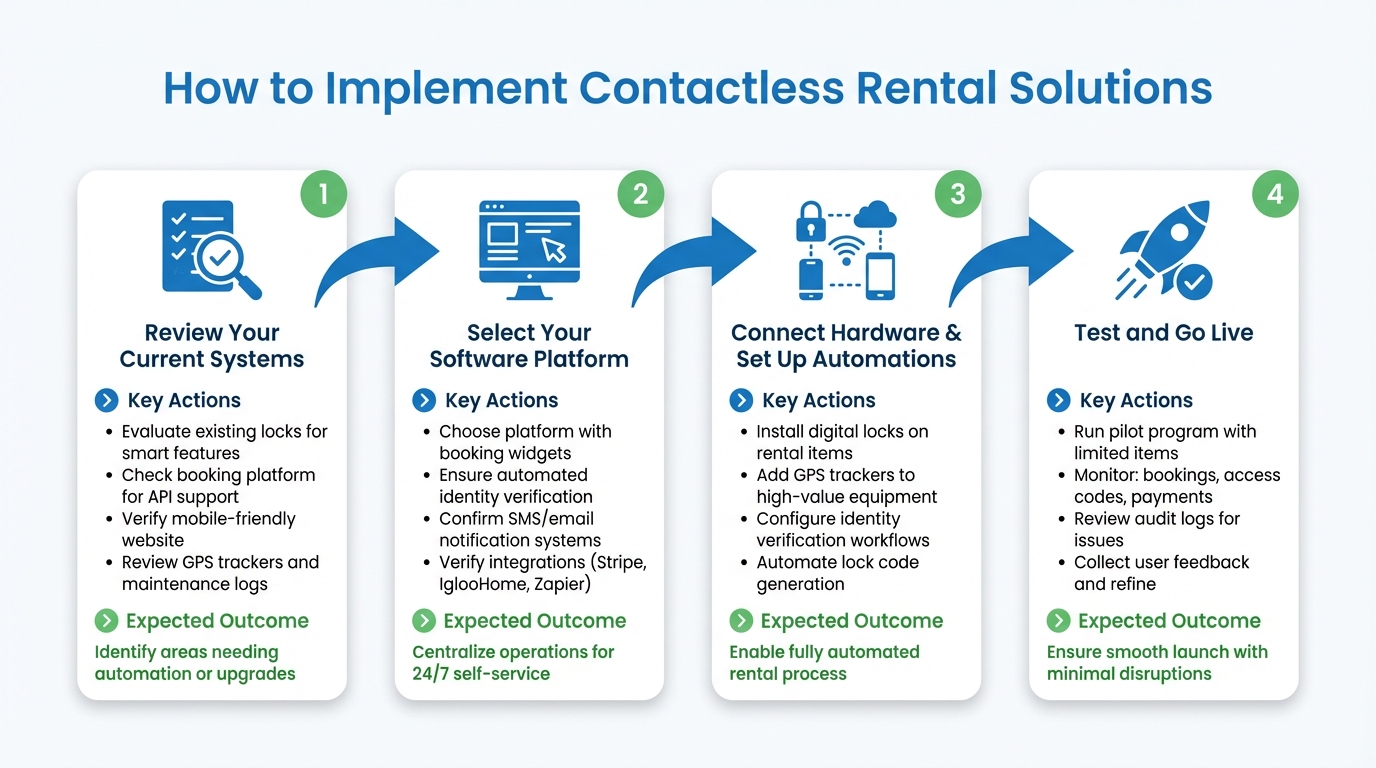
Switching to contactless rental solutions involves four main stages: assessing your current setup, choosing the right software, integrating hardware, and running thorough tests before going live. Each step builds on the last, helping you move from manual to automated rental business operations without unnecessary hiccups.
Step 1: Review Your Current Systems
Start by evaluating your existing operations. Check whether your current locks can handle smart features or if they need to be replaced. Review your booking platform and payment processor to confirm they support API integrations, which are crucial for automating tasks like ID uploads, digital signatures, and real-time availability updates. A mobile-friendly website is essential - if your site isn’t optimized for phones, customers might struggle to complete bookings.
Next, take a closer look at your GPS trackers and maintenance logs. What data are you already gathering? Are there any gaps? Simulating your operations can help pinpoint potential issues and prepare your team for the upcoming changes.
Step 2: Select Your Software Platform
Choose a software platform that simplifies and centralizes your operations. Look for features like embeddable booking widgets, automated identity verification, and notification systems that send access codes via SMS or email. A good platform will also allow renters to extend bookings, report issues, and manage their rentals through a customer portal.
The software should integrate smoothly with tools like Stripe for payments, smart locks such as IglooHome, and automation platforms like Zapier.
For example, Lockii offers a comprehensive solution tailored for contactless rentals. It supports industries like trailer, equipment, bike, car, and scooter rentals. Key features include integrated GPS tracking, maintenance logs, damage tracking, and detailed audit logs. With Lockii, you can streamline labor-intensive tasks and enable 24/7 self-service for your customers. Once your software is in place, the next step is connecting your hardware.
Step 3: Connect Hardware and Set Up Automations
After selecting your software, integrate it with your physical equipment. Install digital locks on trailers, storage units, or other rental items, and connect them to your platform using API integrations. Add GPS trackers to high-value equipment for real-time tracking.
Set up automations to handle tasks like identity verification, sending notifications, and generating lock codes. For instance, require customers to upload necessary documents before access codes are issued. Automate booking confirmations, provide access codes shortly before pickup, and send reminders as the rental period nears its end. Configure your locks to generate codes that are valid only during the rental window, removing the need for manual updates.
Step 4: Test and Go Live
Begin with a small-scale pilot program. Focus on a limited number of items or a single location to test the entire customer journey - from booking to receiving access codes, and finally, returning items with condition reports.
During testing, track key performance indicators: Are bookings completing without issues? Do access codes work seamlessly? Are payments processing correctly? Check audit logs for any glitches or security concerns, and collect feedback from early users to identify and address any friction points. Use this phase to fine-tune your automations and train your team on backup procedures in case of technical issues. Once the pilot runs smoothly for several weeks with minimal intervention, you’ll be ready to expand.
| Implementation Stage | Key Actions | Expected Outcome |
|---|---|---|
| Review Systems | Evaluate locks, platforms, and mobile optimization | Identify areas needing automation or upgrades |
| Select Platform | Choose software with identity checks, notifications, and hardware integrations | Centralize operations for 24/7 self-service |
| Connect & Automate | Install digital locks/GPS and configure workflows | Enable a fully automated rental process |
| Test & Go Live | Pilot the system, monitor metrics, and refine processes | Ensure a smooth launch with minimal disruptions |
Industry Applications and Examples
Contactless rental solutions have transformed how businesses operate across various sectors. While the specifics differ depending on what's being rented, the overarching advantages - round-the-clock access, reduced labor needs, and streamlined workflows - are consistent. Let’s look at how trailer, equipment, bike, car, and scooter rental companies are using these technologies to improve operations and enhance customer experiences.
Trailer Rentals
Trailer rental businesses are embracing digital locks and GPS tracking to minimize staffing requirements. Here’s how it works: customers book online, verify their identity, and receive an access code via SMS. Once they arrive at the lot, they enter the code on a digital lock, hitch the trailer, and drive away - all without any in-person assistance. GPS tracking automatically logs when the trailer is taken and returned, and it sends real-time alerts if a trailer is overdue or moves unexpectedly.
Damage management is handled through mandatory photos uploaded by customers before and after their rental. This ensures transparency and aligns with earlier discussions on smart access and automated reporting. Such systems allow companies to expand into multiple locations without hiring additional staff. For instance, businesses using Lockii for trailer rentals typically manage over 10 locations, with about 95% of bookings requiring no human interaction[1]. QR codes further speed up the process, making it even more convenient.
Equipment and Bike Rentals
Equipment and bike rental companies benefit from automated systems that handle maintenance tracking and rental extensions. Digital locks keep items secure, while customers can extend their rentals and pay online with ease. GPS-verified returns ensure accurate tracking of when and where items are returned. For equipment rentals, return photos help confirm that all components are accounted for. This unified system reduces the need for staff, even across multiple locations.
Car and Scooter Rentals
Car and scooter rentals rely heavily on digital documentation to maintain security and efficiency. Customers upload their driver’s licenses for instant verification, receive a PIN or smartphone access, and GPS tracking confirms the vehicle’s return. This approach eliminates manual processes, making operations smoother and more efficient.
With contactless workflows, customers can book, pay, sign contracts, and access vehicles entirely through their devices, removing the need for physical counters. Lockii integrates with tools like Stripe for payments and Zapier for automations, enabling 24/7 operations with minimal manual involvement. QR codes and NFC tags on vehicles also allow for instant on-site bookings, providing a seamless experience. These features not only simplify fleet management but also enhance customer satisfaction, showcasing how digital automation is reshaping the rental industry.
Solving Common Contactless Rental Challenges
To create a seamless contactless rental experience, it's crucial to tackle challenges like security risks, system integration issues, and high customer expectations. Let’s break down how to address these hurdles effectively.
Security and Fraud Prevention
Without face-to-face verification, contactless rentals can be vulnerable to identity fraud and theft. Automated identity verification tools offer a solution by validating driver's licenses and IDs before generating time-sensitive access codes. These codes, paired with digital locks, only work during the booking window, ensuring unauthorized access is blocked.
GPS tracking adds another layer of protection by monitoring rental items in real time. For instance, if a trailer moves unexpectedly, instant alerts can notify you. By combining GPS data with mandatory return photos and end-of-hire quizzes, you create a detailed audit trail for every rental. This approach not only ensures security but also helps solve labour shortages by reducing the need for direct staff involvement. Together, these tools form a robust defense system that integrates smoothly with your existing operations.
Connecting with Existing Systems
Integration can be tricky, especially when dealing with outdated APIs or legacy systems. Tools like Lockii simplify this process by offering pre-built integrations with popular platforms such as IglooHome for digital locks, Stripe for payments, and Zapier for workflow automation. These solutions eliminate the need for custom coding, enabling hardware and software to connect effortlessly.
To ease the process, opt for systems with open APIs and cloud-based operations. Start small - like incorporating mobile-friendly booking widgets on your website - and expand with features like smart locks and automated communications as your business grows. Once integration hurdles are cleared, you can shift your focus to enhancing the customer experience.
Meeting Customer Expectations
A straightforward and intuitive customer portal is key to keeping users happy. These portals should centralize everything - bookings, extensions, payment history, and issue reporting - while automated SMS and email updates keep customers informed throughout the process. Features like personalized access codes and "find my order" options make the experience even smoother, allowing customers to handle everything from their phones.
Take Hertz as an example: when they upgraded 40,000 vehicles with their Smart Car Access solution in just six months, customer wait times dropped by 30%, and satisfaction scores increased by 25% [7]. This highlights a crucial point: automation should simplify the process so customers can complete rentals independently, all from their mobile devices.
Tracking Performance and Improving Operations
Important Metrics to Monitor
Pickup rates are a key indicator of how well your self-service system is performing. The goal? Achieve 95% of bookings completed entirely through self-service, meaning only a small 5% require manual support [2]. You can track this by comparing the number of smooth, uninterrupted bookings to those that generate support tickets or require phone assistance.
Labor cost reductions highlight the return on investment for automation. A simple way to measure this is by comparing staff hours per rental before and after implementing automation. Many businesses report 50-70% savings as tasks like key handoffs and paperwork are eliminated [4][5].
Rental extensions are another important metric, signaling both customer satisfaction and additional revenue potential. If 20-30% of customers are extending their bookings through self-service portals, it’s a strong sign of convenience and demand [8][6]. Other metrics worth tracking include utilization rates (how often items are rented versus sitting idle), fraud incidents (aim for under 1% with proper identity verification), and customer satisfaction scores (target Net Promoter Scores above 80) [3][5].
GPS tracking data can also provide valuable insights. For example, the use of location monitoring with automated reminders often results in 85% on-time returns [6]. These metrics can serve as a foundation for identifying areas where operations can be fine-tuned.
How to Continuously Improve
Once you’ve established your key metrics, the next step is ongoing refinement. Start by reviewing GPS alerts weekly to adjust your return policies. For instance, tweaking geofencing settings can reduce unnecessary alerts by 30% with better zone configurations [5]. Audit logs can also help you identify patterns, such as specific times when fraud attempts are more frequent, allowing you to enhance identity verification and fraud prevention during those periods.
Customer feedback is a goldmine for actionable improvements. Automated surveys sent after each rental can help you correlate satisfaction scores with specific features like checkout speed or the ease of extending a rental. Businesses that actively use this feedback often see 25% increases in repeat bookings after improving mobile app functionality [5]. Schedule quarterly reviews to A/B test different automation strategies - small adjustments can lead to a 10% boost in key performance metrics [5].
Maintenance tracking is essential for preventing problems before they arise. By uploading return photos and completing end-of-hire quizzes, you can build a visual record that predicts service needs, cutting downtime by 40% [4][5]. Keep an eye on resolution times (aim for under 24 hours) and damage rates (keep below 2%) to maintain fleet quality without relying on constant manual inspections.
Conclusion: Moving Forward with Contactless Rentals
Building a Scalable Contactless Rental Business
Contactless rentals are transforming the way businesses grow by removing the usual bottlenecks caused by staffing limitations. With automation in place, you can operate 24/7, freeing yourself to concentrate on scaling your business instead of getting bogged down in daily operations.
Features like self-service portals, mobile access, and instant booking extensions create the smooth, hassle-free experience customers now expect. Leaders in the industry have shown how smart technology speeds up checkouts and strengthens customer loyalty. For instance, average checkout times can shrink to just 30 seconds[7], giving you more time and resources to focus on growth opportunities.
The benefits go beyond just saving money. Tools such as GPS tracking, digital identity verification, and streamlined documentation not only protect your assets but also enhance security. With centralized management, overseeing multiple locations becomes simpler, enabling expansion into new markets without a spike in overhead costs or the need for additional real estate.
This level of operational efficiency sets the stage for a seamless shift to fully automated systems.
Getting Started with Your Business
To take advantage of these scalable benefits, start by evaluating your current operations. Pinpoint manual tasks - like key handoffs, managing paperwork, or handling phone calls for extensions - that slow things down, and prioritize these areas for automation. Consider using a platform like Lockii, which combines everything you need in one place: best smart locks for self-service rentals, embeddable booking widgets, identity verification, GPS tracking, and integrations with tools like Stripe and Zapier. This all-in-one solution saves you the trouble of juggling multiple systems.
Begin with a pilot program for part of your fleet, train your team on troubleshooting, and set up automated email and SMS notifications. Make sure to clearly communicate the benefits of these changes to your customers. Businesses that take this step-by-step approach often see smoother rollouts and quicker adoption. As the rental industry moves toward 24/7 self-service models, implementing contactless solutions now will put you ahead of competitors still relying on traditional, staff-heavy systems. Evaluate your needs today and start building an operation that can scale effortlessly across multiple locations.