
Automation vs. Manual Operations: Cost Breakdown
January 18, 2026 · 11 min read
Automation vs. Manual Operations: Cost Breakdown
Automation is reshaping how businesses manage costs and scale operations. While manual processes dominate traditional rental operations, they come with high labor expenses, inefficiencies, and error-prone systems. Automation offers faster, error-free workflows and significantly reduces long-term costs, making it a smarter choice for many businesses.
Key Takeaways:
- Manual Costs: Labor makes up 65% of fulfillment expenses. Manual tasks like bookings and data entry are time-consuming, leading to missed rentals and revenue loss.
- Automation Savings: Automation cuts labor needs by 40–60%, reduces errors, and enables 24/7 operations. Companies report a 57% drop in missed rentals and 64% time savings on admin tasks.
- Scalability: Unlike manual setups, automation allows businesses to grow without proportional increases in staff or infrastructure, reducing overhead by 33%.
Quick Comparison:
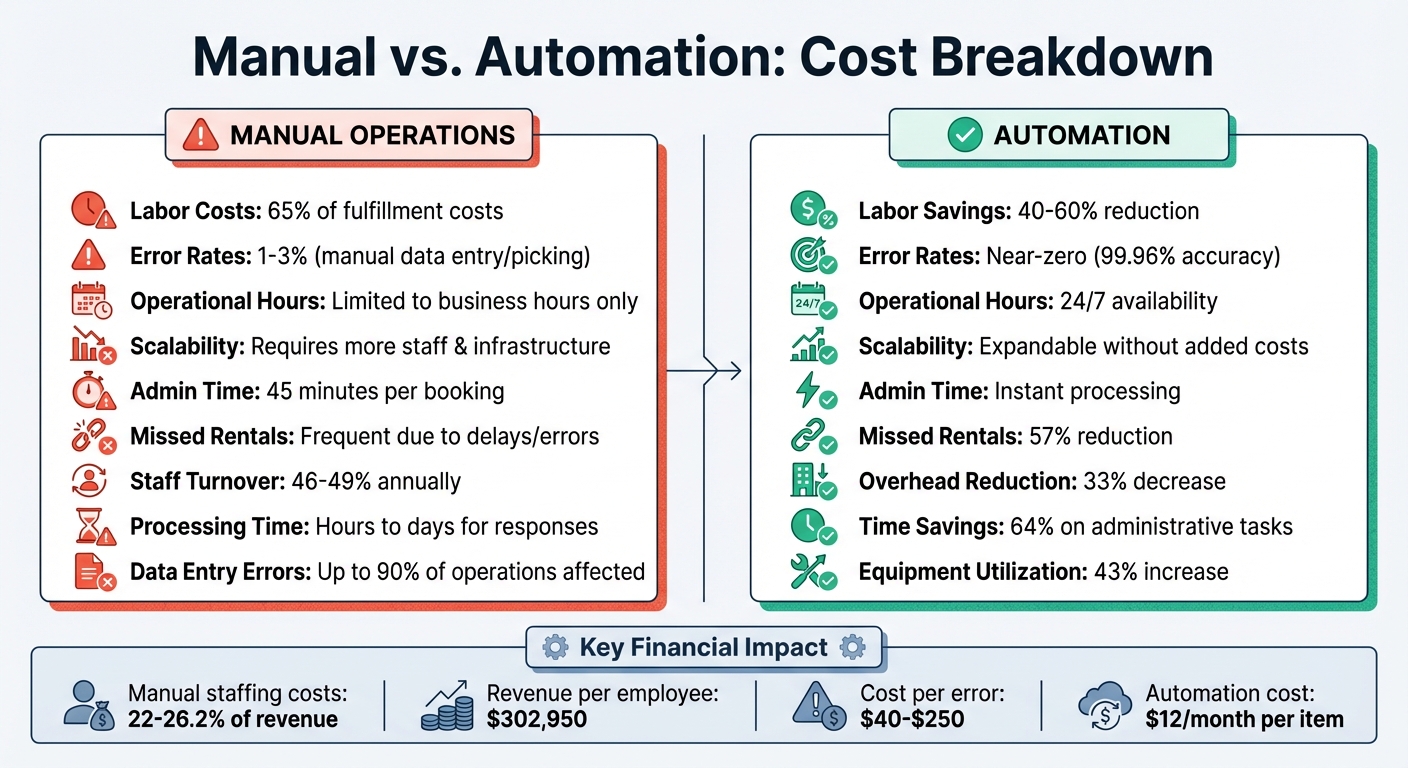
| Criteria | Manual Operations | Automation |
|---|---|---|
| Labor Costs | High (65% of fulfillment costs) | Reduced (40–60% savings) |
| Error Rates | 1–3% (manual data entry/picking) | Near-zero (99.96% accuracy) |
| Operational Hours | Limited to business hours | 24/7 availability |
| Scalability | Requires more staff/infrastructure | Expandable without added costs |
| Time for Admin Tasks | 45 mins per booking | Instant processing |
| Missed Rentals | Frequent (manual delays/errors) | 57% reduction |
Automation isn’t just about cutting costs - it transforms how businesses operate, enabling faster service, fewer errors, and scalable growth. If your business struggles with inefficiencies or staffing challenges, automation could be the solution you need. Use this rental business automation checklist to get started.
The Fundamental Differences Between Manual and Automated Equipment Handling
Manual Operations Cost Breakdown
Running manual operations comes with a hefty price tag that extends well beyond basic payroll. These expenses accumulate across various areas, driving up costs with every transaction.
Labor Costs and Staffing Requirements
The cost of labor is a significant factor. A full-time manager earns about $50,000 annually, while clerks and customer service representatives make around $34,010 and $40,830 per year, respectively. When you factor in taxes, benefits, and insurance, labor costs rise by an additional 35–42% [6][11][10].
"Labor: Salaries, benefits, payroll taxes and training add up in a hurry. The standard compensation for a full-time self-storage manager starts at $50,000 per year." - Brett Copper, President and Partner, Self Storage 101 [6]
It doesn't stop there. Extra staff for tasks like check-ins, bookkeeping, and maintenance adds to the expense. For instance, part-time site visits cost roughly $600 per month, and seasonal staffing can come with a 40–75% wage markup [6][11][10]. High turnover rates in warehouse and rental operations, averaging 46–49% annually, further inflate costs. Replacing a single worker can cost around $18,600 [10].
Labor isn’t the only expense, though. Administrative tasks and maintaining physical infrastructure also contribute to the high cost of manual operations.
Administrative and Operational Overheads
The physical setup for manual operations can be expensive. Constructing a management office for onsite staff costs between $70 and $90 per square foot, while warehouse space runs $12–$15 per square foot annually [6][10]. Manual sortation processes require 4–25 square feet per destination, along with an additional 15–25% space for movement [10]. Even aisle space for manual carts takes up 8–12 feet, cutting into otherwise productive areas [10].
Administrative inefficiencies add another layer of cost. Property managers using manual vs. automated rental processes spend 30% more time on administrative tasks [9]. Managing bookings manually takes about 45 minutes per transaction, and processing payments manually requires 30 minutes per transaction [9]. Paperwork costs are also 60% higher in manual setups [9].
Errors in manual operations are costly. Data entry mistakes occur in up to 90% of rental operations [9], and each error can cost between $40 and $75. More complex mistakes, involving customer service and re-shipping, can escalate to $100–$250 [10]. Manual picking and sorting without barcode verification results in error rates of 1–3%, leading to constant rework and customer appeasement efforts [10].
These inefficiencies, combined with limited operating hours and delays, create further challenges.
Limitations and Inefficiencies
Manual operations are constrained by operating hours. Most manual systems work only during business hours, requiring staff to be present for every transaction. This limitation prevents businesses from tapping into after-hours demand, cutting off potential revenue during evenings, weekends, and holidays when customers are often most active.
Processing delays also hurt customer satisfaction and revenue. Manual response times can take hours or even days [9]. Additionally, syncing calendars manually creates delays of 1–4 hours, increasing the risk of double bookings and platform penalties [8]. These delays reduce customer satisfaction by 20% [9] and lead to a 15% revenue loss due to errors and slow responses [9]. Responding to inquiries "between meetings" lowers rankings on platforms like Airbnb, which directly impacts booking volume [8].
Inventory management is another pain point. Using spreadsheets for tracking rental usage and availability is tedious and error-prone, often leading to financial discrepancies [4][2]. In fact, 43% of retailers report major challenges in managing inventory costs effectively when relying on manual methods [7]. Short-term rentals add to the burden, as equipment requires manual cleaning, inspection, and maintenance after each use [4].
These combined challenges highlight how manual operations can drain resources and limit growth opportunities for businesses. Transitioning to automation in rentals helps save costs while allowing the business to scale faster.
Automation Cost Advantages
Automation flips the traditional cost structure on its head, enabling businesses to operate around the clock with minimal overhead. It delivers immediate savings on labor while boosting efficiency and scalability over time. Let’s explore how automation cuts costs and drives operational improvements.
Labor Reduction and Cost Savings
Automated solutions like digital locks and self-service check-in systems eliminate the need for on-site staff. Considering that labor accounts for 65% of total fulfillment costs[3], this shift represents a significant opportunity for savings. For example, Lockii’s pricing model - just $12 per month per item - allows businesses to redirect funds toward other priorities.
Automation also eliminates hidden costs. Studies reveal that 67% of rental companies waste valuable human resources on repetitive tasks that modern software can handle in seconds[1]. Tasks like data entry, booking confirmations, and payment processing are completed automatically. This frees up staff to focus on more meaningful work, such as maintaining fleet quality or building strong customer relationships.
Operational Efficiency and Time Savings
Beyond cutting labor costs, automation makes operations smoother and faster. Businesses that adopt integrated technology report saving 64% of the time typically spent on administrative tasks[1]. Bookings, payments, and confirmations are processed almost instantly, ensuring customers experience seamless service without manual delays.
Automated messaging systems take care of welcome notes, pickup instructions, and even local recommendations, providing consistent, round-the-clock customer engagement. Errors in manual processes, like order picking, can reach rates of up to 4%, with each mistake costing between $20 and $60 to resolve[3]. Automated systems, however, achieve near-perfect accuracy - ranging from 99.96% to 99.99%. For instance, when Kookaburra Educational Resources implemented an automated sorting system, they processed 2,400 items per hour while cutting labor needs by 65%[3]. This combination of speed and precision ensures businesses can deliver better service with fewer resources.
Scalability Without Additional Costs
Automation changes the game for scaling rental businesses. Traditional models require proportional increases in staff, facilities, and overhead as operations grow. Automation, however, allows businesses to expand without these added burdens. A centralized system can manage multiple locations from a single dashboard, offering real-time inventory tracking to prevent double bookings and missed rentals. Companies using automation report a 57% drop in missed rentals and a 43% boost in equipment utilization rates[1].
Infrastructure costs also remain stable as businesses grow. Digital locks enable remote pickup points without requiring on-site staff, and automated verification systems can handle increased customer onboarding effortlessly. Businesses that implement automation see a 33% reduction in overhead costs[1]. This means companies can test new markets, open additional locations, and scale inventory to meet demand - all without the steep labor and real estate expenses that often limit growth in traditional operations. Automation creates a new growth model, where businesses can expand efficiently and sustainably, avoiding the scaling challenges that weigh down manual operations.
Cost Comparisons: Manual vs. Automated
Manual vs. Automated Cost Metrics
Traditional rental businesses allocate a significant chunk of their revenue - about 22% to 26.2% - to staffing and payroll. For every $1.9 million in rental revenue, manual operations typically require three employees: one inside sales representative, one outside sales representative, and one administrative or management team member. This setup generates approximately $302,950 in revenue per employee on average [12].
However, manual processes come with hidden inefficiencies. For example, processing a single booking takes about 45 minutes of staff time [9]. Additionally, tracking critical metrics like asset utilization and break-even points manually increases the likelihood of errors [4].
Automation, on the other hand, significantly reduces labor demands - by as much as 40% to 60% - by streamlining repetitive tasks. This allows employees to focus on higher-value responsibilities, such as quality assurance and system oversight [10]. Tools like Lockii enable 24/7 operations at a cost of just $12 per month per item, automating routine tasks and providing real-time dashboards. These dashboards replace cumbersome spreadsheets, generating useful insights into metrics like utilization rates, maintenance expenses, and progress toward break-even goals. The result? Lower overhead costs and a scalable operational model [4].
Case Study: Rental Business Transformation
Let’s look at how these cost savings play out in the real world. A mid-sized trailer rental business in Texas, managing around 50 units across multiple locations, adopted Lockii's automated system. The system included features like digital locks, self-service check-in, and integrated management tools.
This automated approach reduced the need for on-site staff and allowed customers to pick up and return trailers outside traditional business hours. A centralized dashboard provided real-time updates on inventory, utilization rates, and maintenance schedules, enabling the business to fine-tune its operations. As a result, the company achieved an impressive 75% fleet utilization rate, hitting the industry benchmark [4]. They also reached break-even on new equipment purchases faster than before. Overall, automation reshaped their business model, eliminating staffing and location constraints and paving the way for profitable growth.
Choosing the Right Model for Your Business
Key Takeaways
Running a business manually eats up a significant chunk of your revenue in staffing costs. Rental operators, in particular, spend countless hours on tasks that automation can handle in seconds [1]. By automating these repetitive processes, you can free up your team to focus on growth and strategy instead of getting bogged down in tedious work.
But the benefits of automation go beyond just saving time and money on labor. Companies using integrated systems have seen a 57% drop in missed rentals and a 43% increase in equipment utilization rates [1]. These aren't just minor improvements - they directly impact your profitability. And with staffing shortages hitting rental businesses hard, delaying automation could mean falling behind competitors who are already reaping these benefits.
Automation also makes scaling your business much easier. Unlike manual operations, which demand more employees and physical space for every new location, automated systems like Lockii allow you to expand without those added costs. For just $12 per month per item, you can manage multiple locations without hiring extra staff [5]. Customers benefit too, with 24/7 access through digital locks and self-service systems, freeing you from the constraints of traditional business hours and physical storefronts.
These insights highlight why automation is more than just a convenience - it's a game-changer for streamlining operations and boosting growth.
Next Steps for Automation
If these savings and efficiency gains resonate with your business needs, it’s time to take action. Start by identifying the areas where inefficiencies are holding you back. Are you spending excessive time processing bookings, handling check-ins, or managing operations across multiple locations? These are prime candidates for automation. Keep an eye on your EBITDA margins - automation could push them from around 30% to over 40% [1].
One effective way to start is by implementing contactless pickup systems that integrate seamlessly into your current workflow. Platforms like Lockii offer features such as identity verification, GPS tracking, automated communications, and maintenance tracking, all working together to simplify your processes. In fact, 64% of rental businesses that have adopted integrated technology report saving substantial time on administrative tasks [1].
Begin with a gradual rollout - perhaps at one location or for a specific product line. As you see results, you can expand further. Tools like embeddable booking widgets, self-service extensions, and real-time dashboards give you the data and visibility to make informed, strategic decisions rather than relying on guesswork.
Ready to see the difference automation can make? Visit Lockii to discover how automated rental management can transform your business.